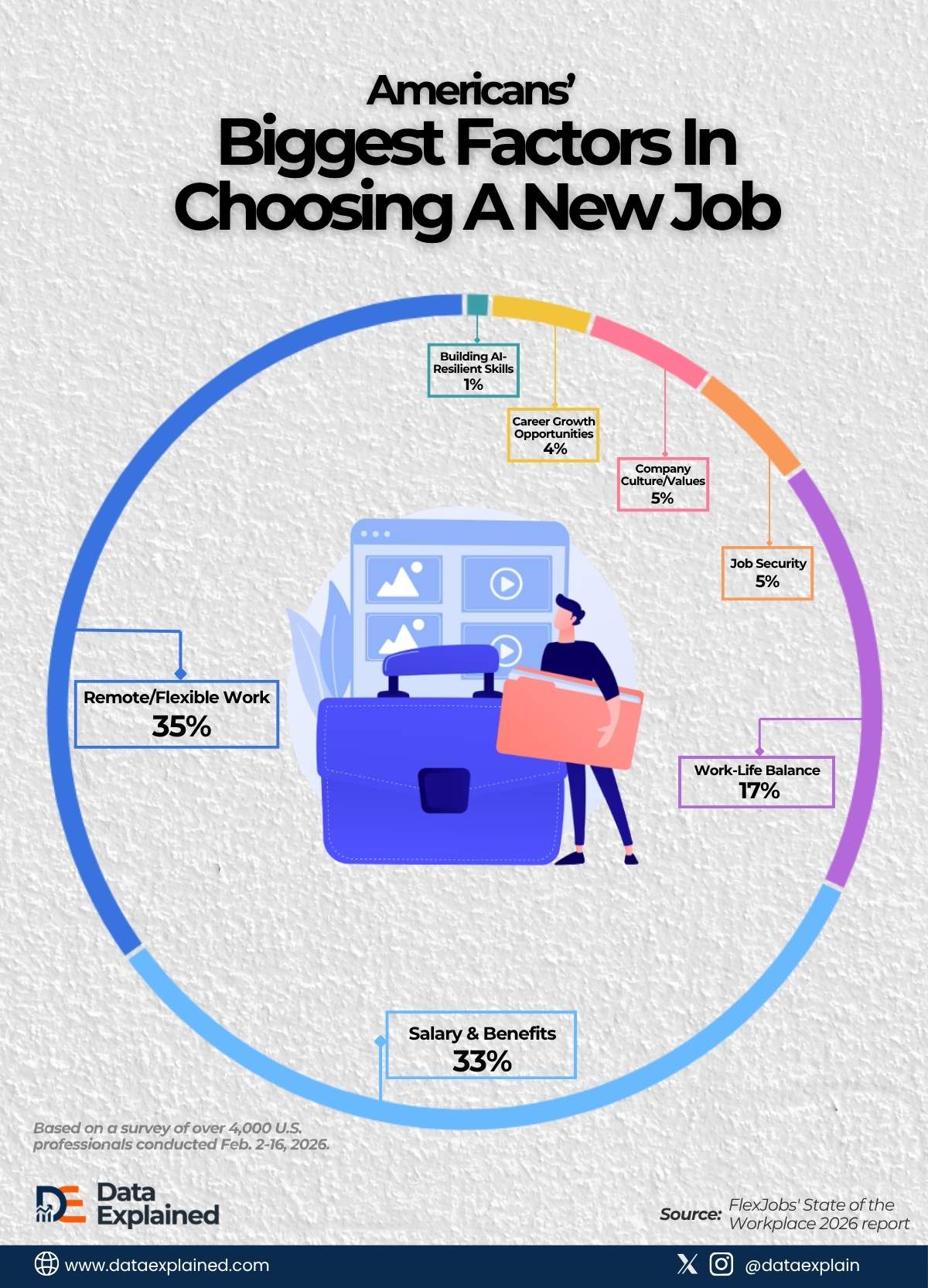
When more than 4,000 U.S. professionals were asked to name the single biggest factor in choosing a new job, remote or flexible work came first, chosen by 35% of respondents.
This comes directly from FlexJobs’ State of the Workplace 2026 report. The survey was conducted between February 2 and February 16, 2026.
That was the period during which Amazon, JPMorgan Chase, Goldman Sachs, and the federal government under DOGE were actively mandating or expanding return-to-office requirements.
TL;DR
- Remote or flexible work is the top job priority for 35% of American professionals, according to a survey of 4,000+ workers conducted in February 2026, at the height of the return-to-office mandate wave.
- Less than 1% named building AI-resilient skills as their primary consideration, despite widespread public anxiety about AI job displacement.
| wdt_ID | wdt_created_by | wdt_created_at | wdt_last_edited_by | wdt_last_edited_at | Deciding Factor | Percentage |
|---|---|---|---|---|---|---|
| 1 | emmanuel-ashemiriogwa | 24/05/2026 09:26 PM | emmanuel-ashemiriogwa | 24/05/2026 09:26 PM | Remote or Flexible Work | 35 |
| 2 | emmanuel-ashemiriogwa | 24/05/2026 09:26 PM | emmanuel-ashemiriogwa | 24/05/2026 09:26 PM | Salary and Benefits | 33 |
| 3 | emmanuel-ashemiriogwa | 24/05/2026 09:26 PM | emmanuel-ashemiriogwa | 24/05/2026 09:26 PM | Work-Life Balance | 17 |
| 4 | emmanuel-ashemiriogwa | 24/05/2026 09:26 PM | emmanuel-ashemiriogwa | 24/05/2026 09:26 PM | Company Culture and Values | 5 |
| 5 | emmanuel-ashemiriogwa | 24/05/2026 09:26 PM | emmanuel-ashemiriogwa | 24/05/2026 09:26 PM | Job Security | 5 |
| 6 | emmanuel-ashemiriogwa | 24/05/2026 09:26 PM | emmanuel-ashemiriogwa | 24/05/2026 09:26 PM | Career Growth Opportunities | 4 |
| 7 | emmanuel-ashemiriogwa | 24/05/2026 09:26 PM | emmanuel-ashemiriogwa | 24/05/2026 09:26 PM | Building AI-Resilient Skills | 1 |
The timing of this data matters.
In February 2026, Amazon began enforcing a five-day-a-week office attendance policy. JPMorgan Chase and Goldman Sachs were in the middle of similar pushes.
The Trump administration’s DOGE restructuring was actively reducing the federal workforce, sending government employees into a competitive private job market.
The Remote Work vs. Salary Gap
In a period when inflation has eroded real purchasing power and cost-of-living concerns dominate household budgets, salary is not the clear winner.
Part of the explanation is financial.
Remote work eliminates commuting costs, reduces the need for office-appropriate wardrobes, and in many cases allows workers to live in lower-cost areas.
For many workers, flexibility carries a direct economic value that sits alongside the compensation figure itself.
The AI Number That Stands Out
Building AI-resilient skills ranked below 1% among primary job considerations.
That is the lowest figure in the entire survey.
The survey was conducted in February 2026, during a period of sustained, high-profile media coverage of AI job displacement.
- Tech companies were citing AI efficiency in layoff announcements.
- Congress was holding hearings on the workforce impact of automation.
- Yet fewer than 1 in 100 surveyed professionals said that building skills to withstand AI disruption was their top priority when job hunting.
There are a few possible explanations.
Many workers may not yet see their specific role as AI-threatened in any immediate, concrete way, but the disruption that fills headlines has not yet reached their desks.
Others may believe that AI resilience is built through the job itself rather than selected for in the hiring process.
And some may simply be focused on current working conditions (pay, flexibility, balance) rather than the structural shifts that may reshape the market over a longer horizon.
Whatever the reason, the gap between AI anxiety in public discourse and AI priority in actual job decisions is striking.
What Employers Should Take From This
Employers currently mandating a full-time return to the office are telling 35% of the job-seeking market that their primary consideration will not be met.
That is a recruiting disadvantage, and the gap between what workers say they want and what large employers are currently offering is not narrowing.
On the other side, employers who have maintained flexible or hybrid policies have a measurable edge in attracting the largest share of the active job-seeking population.
The FlexJobs data does not guarantee that preference translates into hiring decisions.
People take jobs that do not meet all their criteria.
But as a signal of what workers are leading with when they start looking, 35% is not a number that can be rounded down.
ELI5
A big survey asked over 4,000 American workers what they care about most when looking for a new job. More people said “working from home or flexible hours” (35%) than “getting paid more” (33%). Almost nobody (less than 1%) said learning skills to survive AI taking over jobs, even though that’s all over the news. People care most about how and where they work, not future-proofing their careers.
Source:
FlexJobs, State of the Workplace 2026 Report