
Many European cuisines aren’t complete without eggs.
But just how much egg does the average European consume annually? This varies by country.
Some countries consume hundreds of eggs per person each year, while others barely consume a few dozen. Let’s find out which country consumes the highest.
TL;DR
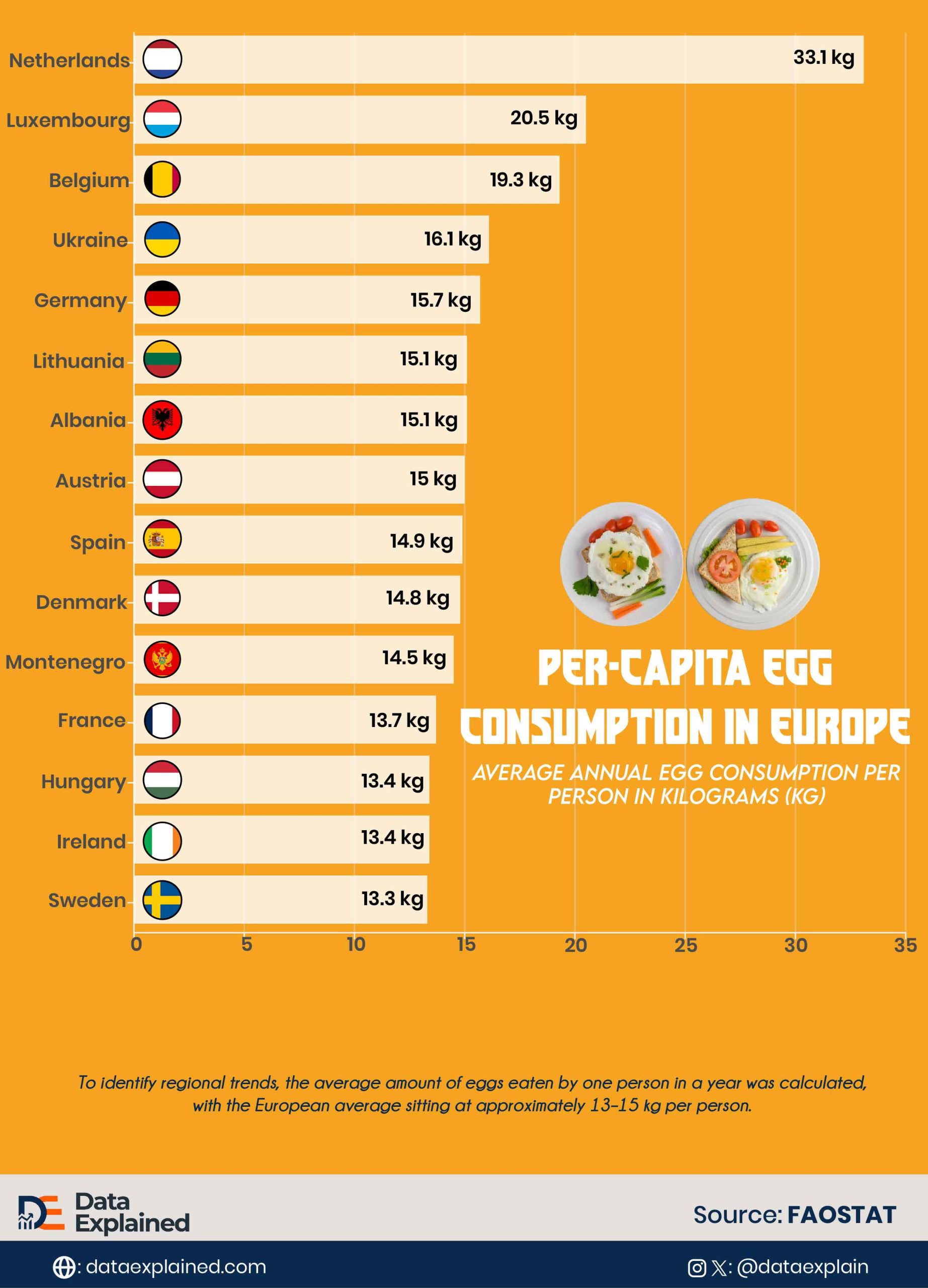
- In Europe, the average egg consumption is approximately 13–15 kg per person per year, equivalent to 200–230 eggs.
- The Netherlands consumes the most eggs in Europe, at approximately 33 kg per person per year.
- Compared with Asia and the Americas, Europe’s average is low but higher than those of Africa and Oceania, indicating a balanced yet steady demand for eggs.
The data for this article are sourced from World Population Review.
The figures are based on 2022 estimates from FAOSTAT, the official database of the Food and Agriculture Organization (FAO) of the United Nations.
Per-capita egg consumption” simply means the average amount of eggs eaten by one person in a year, and this is usually measured in kilograms per person or number of eggs per year.
Top Countries in Europe by Per-Capita Egg Consumption
| wdt_ID | wdt_created_by | wdt_created_at | wdt_last_edited_by | wdt_last_edited_at | Rank | Countries | Egg consumption rate per year (kg/person) |
|---|---|---|---|---|---|---|---|
| 1 | Monica Ebunoluwa | 19/05/2026 02:05 PM | Monica Ebunoluwa | 19/05/2026 02:05 PM | 1 | Netherlands | 33.1 kg |
| 2 | Monica Ebunoluwa | 19/05/2026 02:05 PM | Monica Ebunoluwa | 19/05/2026 02:05 PM | 2 | Luxembourg | 20.5 kg |
| 3 | Monica Ebunoluwa | 19/05/2026 02:05 PM | Monica Ebunoluwa | 19/05/2026 02:05 PM | 3 | Belgium | 19.3 kg |
| 4 | Monica Ebunoluwa | 19/05/2026 02:05 PM | Monica Ebunoluwa | 19/05/2026 02:05 PM | 4 | Ukraine | 16.1 kg |
| 5 | Monica Ebunoluwa | 19/05/2026 02:05 PM | Monica Ebunoluwa | 19/05/2026 02:05 PM | 5 | Germany | 15.7 kg |
| 6 | Monica Ebunoluwa | 19/05/2026 02:05 PM | Monica Ebunoluwa | 19/05/2026 02:05 PM | 6 | Lithuania | 15.1 kg |
| 7 | Monica Ebunoluwa | 19/05/2026 02:05 PM | Monica Ebunoluwa | 19/05/2026 02:05 PM | 7 | Albania | 15.1 kg |
| 8 | Monica Ebunoluwa | 19/05/2026 02:05 PM | Monica Ebunoluwa | 19/05/2026 02:05 PM | 8 | Austria | 15.0 kg |
| 9 | Monica Ebunoluwa | 19/05/2026 02:05 PM | Monica Ebunoluwa | 19/05/2026 02:05 PM | 9 | Spain | 14.9 kg |
| 10 | Monica Ebunoluwa | 19/05/2026 02:05 PM | Monica Ebunoluwa | 19/05/2026 02:05 PM | 10 | Denmark | 14.8 kg |
The Netherlands’ figure of 33.1 kg/person places it ahead of other European nations, indicating exceptionally high per-person egg consumption.
Countries like Luxembourg, Belgium, and Ukraine fall within the 16–21 kg/person range, which is still less than the over 30 kg/person range in the Netherlands but much higher than in many others.
These measured values show large differences across Europe, even within a wealthy region.
The amount of eggs each person eats each year varies due to cultural preferences, production capacity, and dietary habits.
How These Countries Compare to Global Benchmarks
Compared with leading global egg-consuming countries, Europe presents a mix of moderation and enthusiasm.
The Netherlands, for instance, ranks among the world’s top consumers with around 33 kg per person per year, challenging countries like Japan and Mexico, where eggs are used and eaten daily.
This puts the Dutch ahead of most European countries and close to the global elite in per-capita egg intake.
Meanwhile, countries like Belgium, Luxembourg, and Ukraine, with averages of 17–20 kg per person, remain above the European regional average of roughly 13–15 kg but below Asia’s egg-heavy diets.
On the other hand, France and Germany stay around 12–14 kg per person, which is roughly half the Dutch rate.
Compared globally, this puts them closer to countries like Canada and Australia, where eggs are common but not a key part of the diet.
Europe’s figures also stand in contrast to those of other regions. In Africa, the average per-capita egg consumption is just 3–5 kg per person annually, with even the continent’s top consumers, Seychelles and Libya, falling well below Europe’s regional average.
South America is closer to Europe, averaging around 12 kg per person per year, with Paraguay at 17.7 kg — a figure comparable to Belgium and Luxembourg.
The contrast across Europe highlights cultural food traditions, which shape how many eggs are consumed.
What’s Driving Egg Consumption in Europe?
The factors of population size and availability are major drivers of high egg consumption in Europe.
Countries with well-established poultry industries, such as the Netherlands and Belgium, produce more eggs than they need, making them not only top consumers but also major exporters.
According to the Agriculture and Rural Development report, there are over 350 million laying hens in the European Union, and egg producers are supported through marketing standards and various market support measures.
This high supply keeps prices low and makes eggs widely accessible, leading to regular consumption in households.
Another reason is the shift in dietary preferences toward protein-rich foods.
As more Europeans adopt flexitarian or low-meat diets, eggs have become a popular, affordable protein alternative.
In Germany and France, where meat consumption is slowly decreasing, egg sales have remained stable or even increased slightly, indicating that people are rebalancing their diets.
Lastly, affordability and convenience keep eggs at the top of Europeans’ grocery lists.
Even with the changes in food prices, eggs remain one of the most cost-effective sources of nutrition.
In countries with strong middle-income populations, like Luxembourg and Russia, eggs are versatile enough for quick meals and still nutritious enough to fit into modern, health-conscious eating habits.
ELI5
A lot of people across Europe are eating more eggs than ever, but some countries are seeing faster growth than others.
For instance, Poland has been gradually increasing its egg consumption by about 3–4% each year, thanks to strong local production and high demand for affordable protein.
Hungary has also experienced rapid growth, particularly in egg imports. This means that more people are buying and eating eggs from neighboring countries.
Meanwhile, Spain is notable for increasing its egg exports by almost 8%, indicating that its production is surging to meet both local and international demand.
This doesn’t just mean more eggs at breakfast, but reflects how eggs are rapidly becoming an everyday food choice in Europe.
Sources: