Language is part of culture.
In some countries, you could walk through a single street and hear five different languages in ten minutes; that’s how incredible linguistic diversity can be.
In this explainer, we focus on the top countries for language diversity.
TL;DR
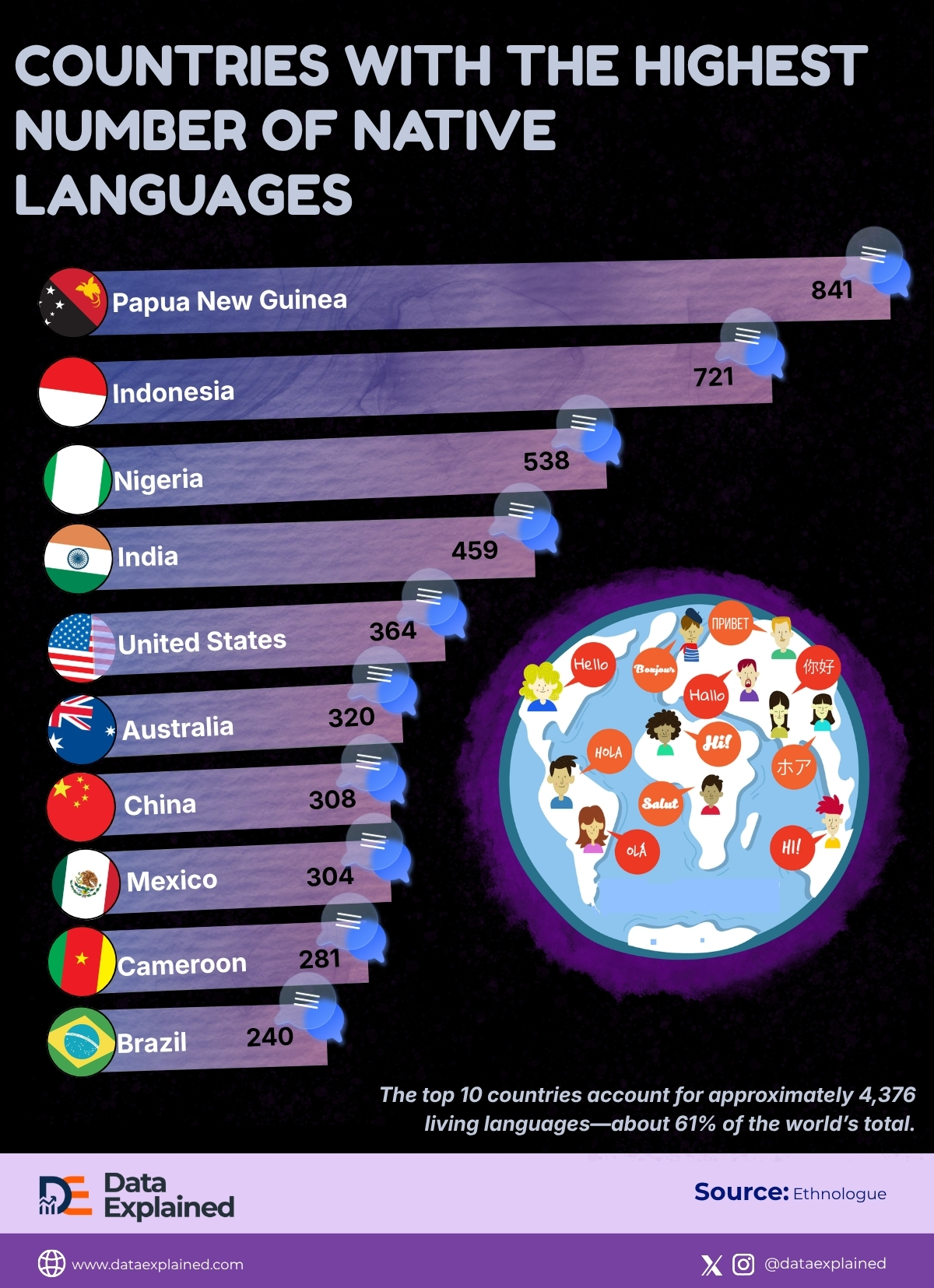
- Papua New Guinea is the nation with the most native languages, boasting 841.
- The total sum of living languages across the top 10 countries is 4,376, which makes up roughly 61% of the world’s total languages spoken (above 7,000).
The data for these insights is retrieved from Ethnologue, a leading global database that tracks and documents all living languages worldwide.
Top 10 Countries with Language Diversity
| wdt_ID | wdt_created_by | wdt_created_at | wdt_last_edited_by | wdt_last_edited_at | Rank | Country | Number of Languages | Total Population |
|---|---|---|---|---|---|---|---|---|
| 1 | Monica Ebunoluwa | 23/04/2026 10:44 AM | Monica Ebunoluwa | 23/04/2026 10:44 AM | 1 | Papua New Guinea | 841 | 17 million |
| 2 | Monica Ebunoluwa | 23/04/2026 10:44 AM | Monica Ebunoluwa | 23/04/2026 10:44 AM | 2 | Indonesia | 721 | 283.5 million |
| 3 | Monica Ebunoluwa | 23/04/2026 10:44 AM | Monica Ebunoluwa | 23/04/2026 10:44 AM | 3 | Nigeria | 538 | 232.7 million |
| 4 | Monica Ebunoluwa | 23/04/2026 10:44 AM | Monica Ebunoluwa | 23/04/2026 10:44 AM | 4 | India | 459 | 1.451 billion |
| 5 | Monica Ebunoluwa | 23/04/2026 10:44 AM | Monica Ebunoluwa | 23/04/2026 10:44 AM | 5 | United States | 364 | 340.1 million |
| 6 | Monica Ebunoluwa | 23/04/2026 10:44 AM | Monica Ebunoluwa | 23/04/2026 10:44 AM | 6 | Australia | 320 | 27.2 million |
| 7 | Monica Ebunoluwa | 23/04/2026 10:44 AM | Monica Ebunoluwa | 23/04/2026 10:44 AM | 7 | China | 308 | 1.409 billion |
| 8 | Monica Ebunoluwa | 23/04/2026 10:44 AM | Monica Ebunoluwa | 23/04/2026 10:44 AM | 8 | Mexico | 304 | 130.9 million |
| 9 | Monica Ebunoluwa | 23/04/2026 10:44 AM | Monica Ebunoluwa | 23/04/2026 10:44 AM | 9 | Cameroon | 281 | 29.12 million |
| 10 | Monica Ebunoluwa | 23/04/2026 10:44 AM | Monica Ebunoluwa | 23/04/2026 10:44 AM | 10 | Brazil | 240 | 212 million |
What makes the difference is that some small countries have a high level of language diversity.
For instance, Papua New Guinea, with a population of less than 20 million, has around 841 languages, which is more than the combined total of many large countries.
Meanwhile, countries with large populations, such as India and China, accommodate hundreds of languages, but their per-capita language density is relatively low.
This suggests that linguistic complexity is not solely a function of population size; other factors, such as geography, history, and isolation, also play a role.
Local Language Decline
Most minority languages in these linguistically rich countries are at risk.
Over 40% of the world’s languages are considered endangered. This means that their speakers are dwindling by the day.
As many languages lack digital resources, communities struggle to protect them.
A new UNESCO report reveals that about 40% of the world’s population lacks access to education in a language they speak fluently.
In some regions of low and middle-income countries, the rate rises to 90%.
Why So Many Languages?
Countries like Papua New Guinea and Nigeria have long histories of isolated communities, diverse ethnic groups, and rugged terrain, including mountains, forests, and islands, which made travel and communication difficult.
Additionally, when people relocate from one location to another, whether voluntarily or involuntarily, it can introduce new languages to a region.
Meanwhile, countries like France or Japan that rely on just “one dominant language” often experience strong nation-building, centralized governance, and standardized education systems, which promote a single national language for unity and administration.
In a few cases, colonialism also played a significant role, as colonial powers imposed a single language, such as English, French, or Spanish, which became the official language even after independence.
ELI5
The number of languages spoken in a country can depend on its history, geography, and people.
Countries like Papua New Guinea, Nigeria, and Indonesia have hundreds of languages because people have lived in small, separate communities for years.
On the other hand, countries like France or Japan have mostly one dominant language because the governments promoted a common language through schools, media, and national pride.
This helped unify the country but also reduced the number of local languages spoken.
In some places, colonial history also played a significant role. Colonial powers spread their languages around the world, replacing native languages.
Sources: