
Habitat loss, climate change, and human exploitation are pushing some animals closer to extinction.
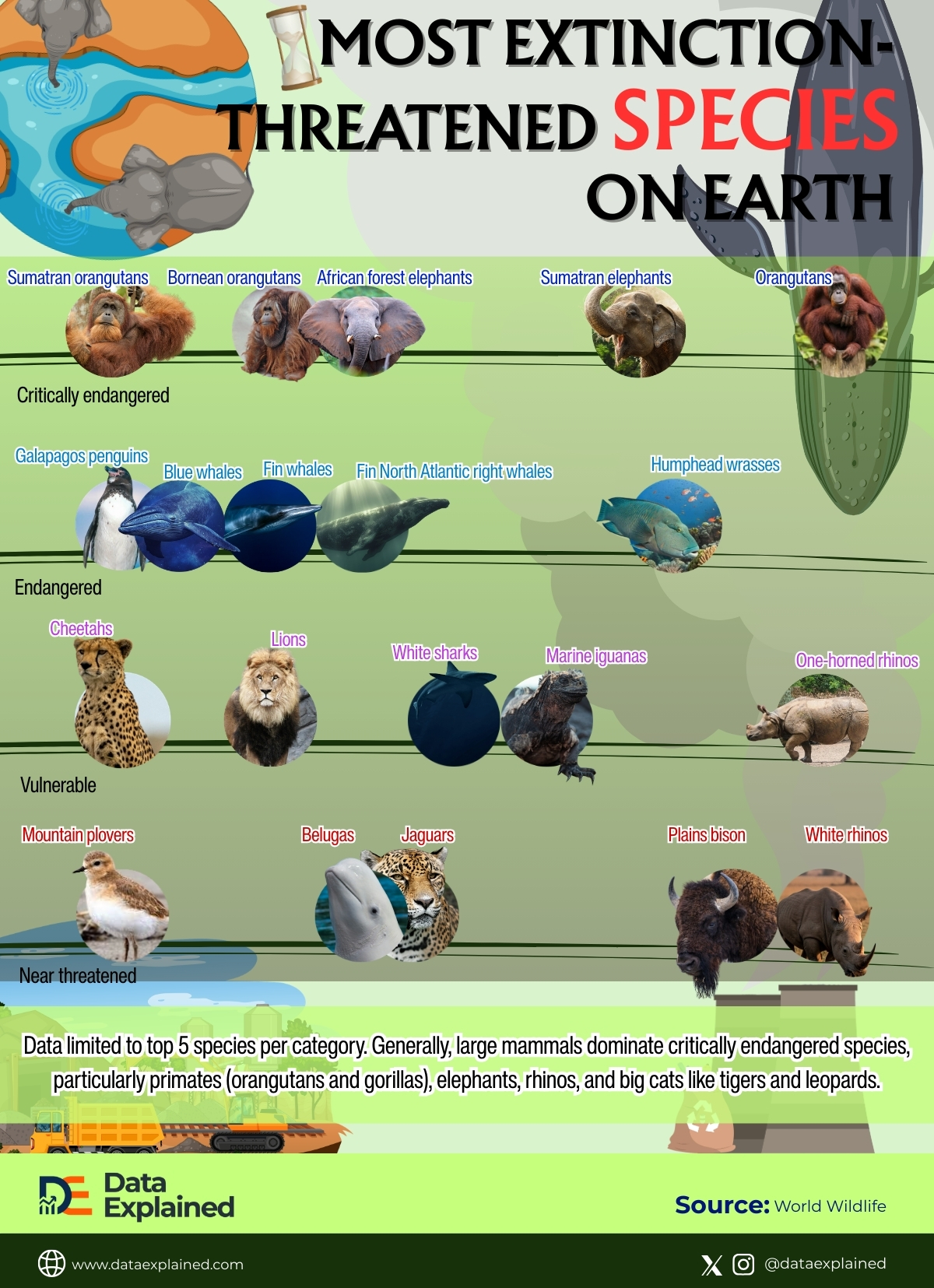
Using data from the World Wildlife Fund, this graphic shows the species most at risk of extinction and the areas under the highest pressure.
TL;DR
- Large mammals and marine species make up a high share of the world’s most threatened animals.
- The highest concentrations of threatened species are found in tropical forests, islands, and freshwater systems, particularly in Southeast Asia, Central Africa, and parts of South America.
Threatened Species And Their Conservation Status
| wdt_ID | wdt_created_by | wdt_created_at | wdt_last_edited_by | wdt_last_edited_at | Animal | Conservation status |
|---|---|---|---|---|---|---|
| 1 | Monica Ebunoluwa | 19/03/2026 04:13 PM | Monica Ebunoluwa | 19/03/2026 04:13 PM | Orangutans | Critically endangered |
| 2 | Monica Ebunoluwa | 19/03/2026 04:13 PM | Monica Ebunoluwa | 19/03/2026 04:13 PM | Sumatran orangutans | Critically endangered |
| 3 | Monica Ebunoluwa | 19/03/2026 04:13 PM | Monica Ebunoluwa | 19/03/2026 04:13 PM | Bornean orangutans | Critically endangered |
| 4 | Monica Ebunoluwa | 19/03/2026 04:13 PM | Monica Ebunoluwa | 19/03/2026 04:13 PM | African forest elephants | Critically endangered |
| 5 | Monica Ebunoluwa | 19/03/2026 04:13 PM | Monica Ebunoluwa | 19/03/2026 04:13 PM | Sumatran elephants | Critically endangered |
| 6 | Monica Ebunoluwa | 19/03/2026 04:13 PM | Monica Ebunoluwa | 19/03/2026 04:13 PM | Western lowland gorillas | Critically endangered |
| 7 | Monica Ebunoluwa | 19/03/2026 04:13 PM | Monica Ebunoluwa | 19/03/2026 04:13 PM | Eastern lowland gorillas | Critically endangered |
| 8 | Monica Ebunoluwa | 19/03/2026 04:13 PM | Monica Ebunoluwa | 19/03/2026 04:13 PM | Cross River gorillas | Critically endangered |
| 9 | Monica Ebunoluwa | 19/03/2026 04:13 PM | Monica Ebunoluwa | 19/03/2026 04:13 PM | Sunda tigers | Critically endangered |
| 10 | Monica Ebunoluwa | 19/03/2026 04:13 PM | Monica Ebunoluwa | 19/03/2026 04:13 PM | Yangtze finless porpoises | Critically endangered |
Most Threatened Species Groups
Most of the animals listed as critically endangered are large mammals.
They are particularly primates (orangutans and gorillas), elephants, rhinos, and big cats like tigers and leopards.
Marine mammals such as dolphins, porpoises, and whales also appear frequently in the highest threat categories.
This shows that large-bodied animals, those with slow reproductive rates, and those with high habitat requirements are especially vulnerable to extinction, mainly due to habitat loss, poaching, human–wildlife conflict, and pollution.
Too Many Aquatic And Freshwater Species
Another noticeable pattern is the high number of aquatic and freshwater species under threat, including river dolphins, turtles, whales, and large fish species.
These species are heavily affected by overfishing, bycatch, water pollution, dam construction, and climate change.
In contrast, fewer amphibians and small animals appear on this list, even though they are also globally threatened.
Tropical Regions Under More Attention
Biodiversity hotspots under the most tremendous pressure are mainly in tropical regions, such as:
- Southeast Asia
- Central Africa
- Parts of South America.
These areas have high numbers of unique species but are facing rapid deforestation, habitat loss, and human expansion.
Regions with the highest densities of threatened species include Borneo, Sumatra, and Madagascar.
Islands often host species found nowhere else, making them more vulnerable when their habitats are disturbed.
Freshwater ecosystems, such as the Amazon and Mekong rivers, also host many threatened species.
Water pollution, dam building, and overfishing are key threats to these areas.
But What Really Drives Extinction Risk?
Habitat loss is the most immediate driver of extinction risk, especially in tropical forests.
For example, in Sumatra and Borneo, large areas of rainforest have been cleared for oil-palm plantations, mining, and roads, pushing orangutans into small, isolated forest patches.
This is especially dangerous for the critically endangered Tapanuli orangutan, whose remaining habitat is now highly fragmented.
Thus, it limits access to food, breeding, and long-term survival.
Meanwhile, climate change is accelerating extinction risk by altering ecosystems faster than many species can adapt.
For example, rising ocean temperatures have caused widespread coral bleaching in recent years, destroying reef habitats that support thousands of marine species.
In polar regions, shrinking sea ice reduces breeding and feeding grounds for seals and other ice-dependent animals, directly lowering survival rates.
ELI5: Animals at Extinction Risk
Animal extinction means the complete disappearance of a species from Earth. The animals most at risk are often large mammals (such as elephants and apes), and marine animals (such as whales and turtles).
Why? It’s because they need large spaces to live and reproduce slowly.
They are mainly threatened by habitat destruction, hunting and overfishing, pollution, and a changing climate.
These problems are most severe in tropical forests, islands, and river systems, where many species live in small, fragile environments and have nowhere else to go when their habitats are damaged.
Sources: