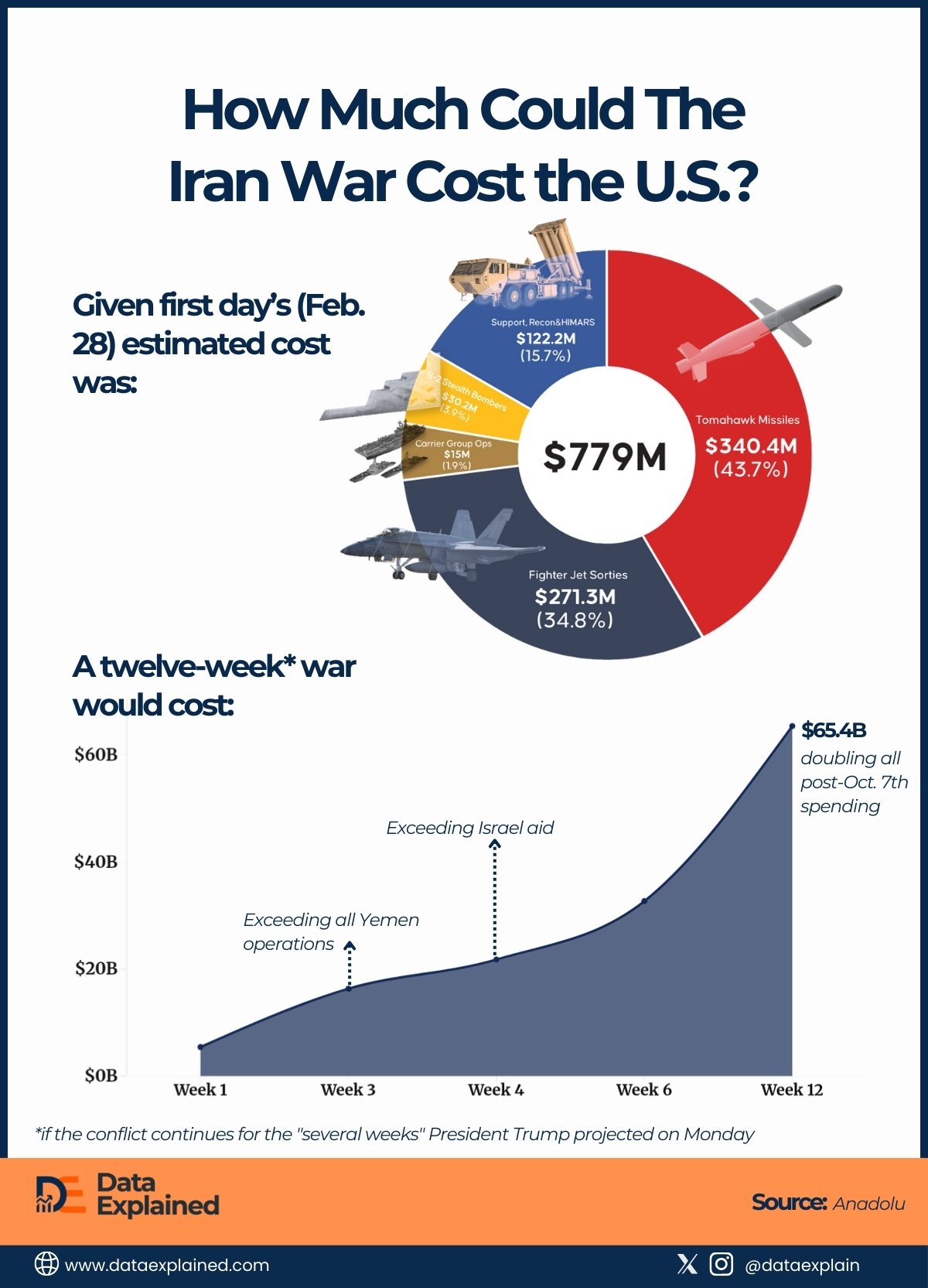
The U.S. military operation against Iran cost $1.4 billion in its first 24 hours, and if the conflict continues for the “several weeks” President Trump projected on Monday, the financial toll could dwarf everything America has spent in the Middle East since October 2023.
The current pace is $779 million per day in combat operations, estimated by Turkey’s Anadolu news agency. It was based on munitions expenditure during the opening strikes.
Building on that, a twelve-week war would cost approximately $65.4 billion.
TL;DR
- Iran war’s $779 million per day pace means week 6 costs $32.7 billion (matching entire 2-year Middle East budget), week 12 hits $65.4 billion (doubling it)
- Direct U.S. combat ($284 billion annualized) costs 26 times more than funding Israel’s war ($10.85 billion per year). Proxy warfare was dramatically cheaper.
The math is straightforward but sobering.
Each week of combat at Monday’s intensity costs $5.45 billion.
By week three, cumulative spending hits $16.4 billion, exceeding the $9.65 to $12.07 billion Brown University reports the U.S. spent on two full years of operations in Yemen, Iran, and the wider region from October 2023 through September 2025.
By week six, the total reaches $32.7 billion, matching the entire two-year budget including $21.7 billion in military aid to Israel.
- The $779 million daily combat figure doesn’t include the estimated $630 million spent repositioning aircraft carriers, deploying naval vessels, and mobilizing regional military assets before the first missile was fired.
The Two-Year Baseline
Brown University’s September 2025 Costs of War report provides the clearest picture of recent Middle East military spending.
From October 2023 (when Hamas attacked Israel, triggering the Gaza war) through September 2025, the United States spent between $31.35 and $33.77 billion across the region.
Military aid to Israel accounted for $21.7 billion of that total, or roughly 64%
The remaining $9.65 to $12.07 billion funded U.S. military operations including strikes against Houthi rebels in Yemen, limited operations against Iranian-backed militias in Iraq and Syria, and regional deterrence missions.
That two-year spending averaged approximately $15.7 billion annually, a baseline the Iran war could exceed in just over three weeks.
What Combat Actually Costs
The disparity between presence and combat becomes clear in the cost breakdown.
Operating a carrier strike group like the USS Gerald R. Ford costs approximately $6.5 million per day, according to the Center for New American Security.
- Combat operations cost $779 million daily (roughly 120 times more than simply maintaining naval presence in the region).
- Tomahawk cruise missiles cost approximately $2 million each. Air-launched cruise missiles run $1.4 million.
- Precision-guided bombs range from $25,000 to $70,000 depending on sophistication.
When the U.S. military launches dozens or hundreds of these munitions daily, costs escalate rapidly.
The Proxy vs. Direct Combat Premium
The financial comparison between supporting Israel and fighting Iran directly reveals a stark cost differential.
The United States spent $21.7 billion on military aid to Israel over two years (an average of $10.85 billion per year) to fund their combat operations against Hamas and Hezbollah.
Direct U.S. combat against Iran, at $779 million daily, would cost $284 billion if sustained for a full year. That’s roughly 26 times more expensive than proxy support.
This explains why U.S. strategy for decades emphasized arming regional allies rather than deploying American forces directly.
Four weeks of U.S. combat operations against Iran ($21.8 billion) would cost more than two years of supporting Israel’s significantly larger military operations.
Historical Context
For perspective, the Afghanistan war cost an average of $115 billion annually over its twenty-year duration, according to Brown University’s broader Costs of War analysis.
At the current Iran combat pace, the U.S. would reach Afghanistan’s annual average spending in approximately five months.
A full year of sustained operations would cost $284 billion (more than double peak Afghanistan expenditures).
The comparison isn’t exact, though.
Afghanistan involved occupation, reconstruction, and nation-building costs beyond pure combat.
But the Iran war’s munitions-intensive opening phase suggests the financial burden could quickly approach or exceed previous “forever wars” if the conflict extends beyond Trump’s “several weeks” projection.
Hidden Costs
Brown University’s report includes a critical footnote that, “the displayed figures “do not include the tens of billions of dollars in arms sales agreements that have been committed for weapons and services that will be paid for and delivered in the years to come.”
This means the $21.7 billion in aid to Israel represents direct transfers, not the full cost of weapons sales agreements that will generate bills for decades.
The Iran war will likely accumulate similar long-tail costs (think replacement munitions, equipment wear and tear, and future procurement) that won’t appear in immediate spending tallies.
Note:
- These aren’t worst-case scenarios—they assume combat intensity remains constant at opening-day levels rather than escalating.
- They also don’t account for potential Iranian retaliation that could expand the conflict’s geographic scope or force additional U.S. deployments.
Trump’s Monday statement that the war could extend “several weeks” leaves the ultimate cost uncertain.
But the data from the first 24 hours, measured against two years of previous spending, suggests “several weeks” of combat against a major adversary like Iran operates at a fundamentally different financial scale than the limited strikes and proxy support that defined post-October 7th operations.