We’re in an era where, if you are not online, you can easily be categorized as someone who lives under a rock.
But just how many people worldwide currently have access to and use the internet?
Well, there’s a pattern of a massive gap between absolute users and penetration rates.
TL;DR
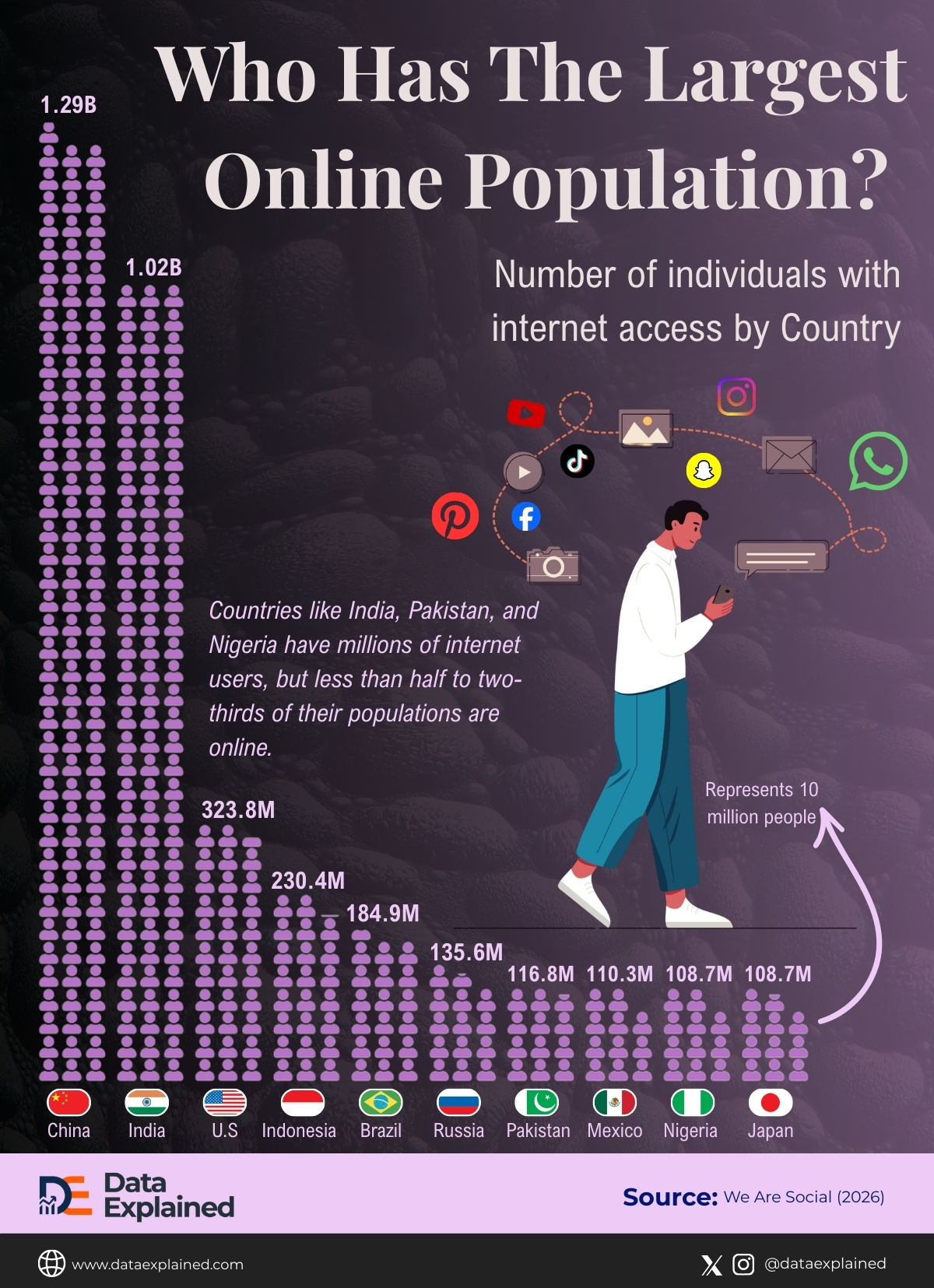
- China currently has the largest internet user base, with 91.6% of its population online (1.296 billion users).
- Countries like India, Pakistan, and Nigeria have millions of internet users, but less than half to two-thirds of their populations are online.
The data comes from the We Are Social: Digital 2026 Global Overview Report. It lists the number of individuals with internet access and compares it with the total national population.
Largest Online Populations, Ranked
| wdt_ID | wdt_created_by | wdt_created_at | wdt_last_edited_by | wdt_last_edited_at | Rank | Country | Users (Million) | Share of population (%) |
|---|---|---|---|---|---|---|---|---|
| 1 | emmanuel-ashemiriogwa | 13/03/2026 02:10 PM | emmanuel-ashemiriogwa | 13/03/2026 02:10 PM | 1 | China | 1,296.40 | 91.60 |
| 2 | emmanuel-ashemiriogwa | 13/03/2026 02:10 PM | emmanuel-ashemiriogwa | 13/03/2026 02:10 PM | 2 | India | 1,027.00 | 70.00 |
| 3 | emmanuel-ashemiriogwa | 13/03/2026 02:10 PM | emmanuel-ashemiriogwa | 13/03/2026 02:10 PM | 3 | United States Of America | 323.90 | 93.10 |
| 4 | emmanuel-ashemiriogwa | 13/03/2026 02:10 PM | emmanuel-ashemiriogwa | 13/03/2026 02:10 PM | 4 | Indonesia | 230.40 | 80.50 |
| 5 | emmanuel-ashemiriogwa | 13/03/2026 02:10 PM | emmanuel-ashemiriogwa | 13/03/2026 02:10 PM | 5 | Brazil | 185.00 | 86.90 |
| 6 | emmanuel-ashemiriogwa | 13/03/2026 02:10 PM | emmanuel-ashemiriogwa | 13/03/2026 02:10 PM | 6 | Russian Federation | 135.70 | 94.40 |
| 7 | emmanuel-ashemiriogwa | 13/03/2026 02:10 PM | emmanuel-ashemiriogwa | 13/03/2026 02:10 PM | 7 | Pakistan | 116.80 | 45.60 |
| 8 | emmanuel-ashemiriogwa | 13/03/2026 02:10 PM | emmanuel-ashemiriogwa | 13/03/2026 02:10 PM | 8 | Mexico | 110.30 | 83.50 |
| 9 | emmanuel-ashemiriogwa | 13/03/2026 02:10 PM | emmanuel-ashemiriogwa | 13/03/2026 02:10 PM | 9 | Nigeria | 108.80 | 45.50 |
| 10 | emmanuel-ashemiriogwa | 13/03/2026 02:10 PM | emmanuel-ashemiriogwa | 13/03/2026 02:10 PM | 10 | Japan | 106.90 | 87.00 |
Asia’s Dominance
Up to 13 of the top 20 countries by online population are Asian.
Another way to look at it is that Asia has about 3 billion internet users, more than the rest of the world combined.
Meanwhile, Japan, a tech-advanced nation, has only 87% penetration.
This is lower than Russia (94.4%), Thailand (94.7%), and Germany (93.5%). Why?
For a country that invented Sony, Nintendo, and robotics, 87% feels low.
This reflects Japan’s demographic crisis. Old age is incompatible with digital adoption.
India’s Paradox
India has 1.027 billion internet users (the 2nd highest globally after China).
Yet only 70% penetration.
This means 440 million Indians have never used the internet. To put that in perspective:
- India’s offline population (440 million) is larger than the entire U.S. population (335 million).
- India’s offline population exceeds the combined populations of Germany, the UK, France, and Italy.
Implications for Global Internet Restrictions
China, Russia, and even Iran all have high penetration but a heavily censored internet.
This creates the “Splinternet.”
That is, a fragmented global internet where some countries block/filter content.
For global tech companies (Google, Meta, Twitter), this means:
- Blocked from 1.4 billion Chinese users (Great Firewall)
- Restricted in Russia (Ukraine war censorship)
- Banned in Iran (government blocks Western platforms)
That’s why local platforms dominate, such as WeChat in China, VKontakte and Yandex in Russia, and Soroush in Iran.
For the average user in these countries, “the internet” means state-controlled platforms.
The Bigger Picture
As the world digitizes (with AI, e-commerce, and remote work), 2.6 billion people are excluded. They can’t access:
- Online education
- Digital banking
- E-commerce
- Government services
- Global information
So, the question isn’t whether everyone will eventually get online. It’s about how many decades it will take and what harm the divide will cause in the meantime.
Sources: