Japan has spent most of its modern history defining itself as a country that did not take immigrants.
In 1960, the country had 693,000 international migrants. By 2024, it had 3.4 million, a fivefold increase.
The uptick has, so far, been driven by a demographic crisis, labor shortages, and a deliberate policy shift toward accepting foreign workers.
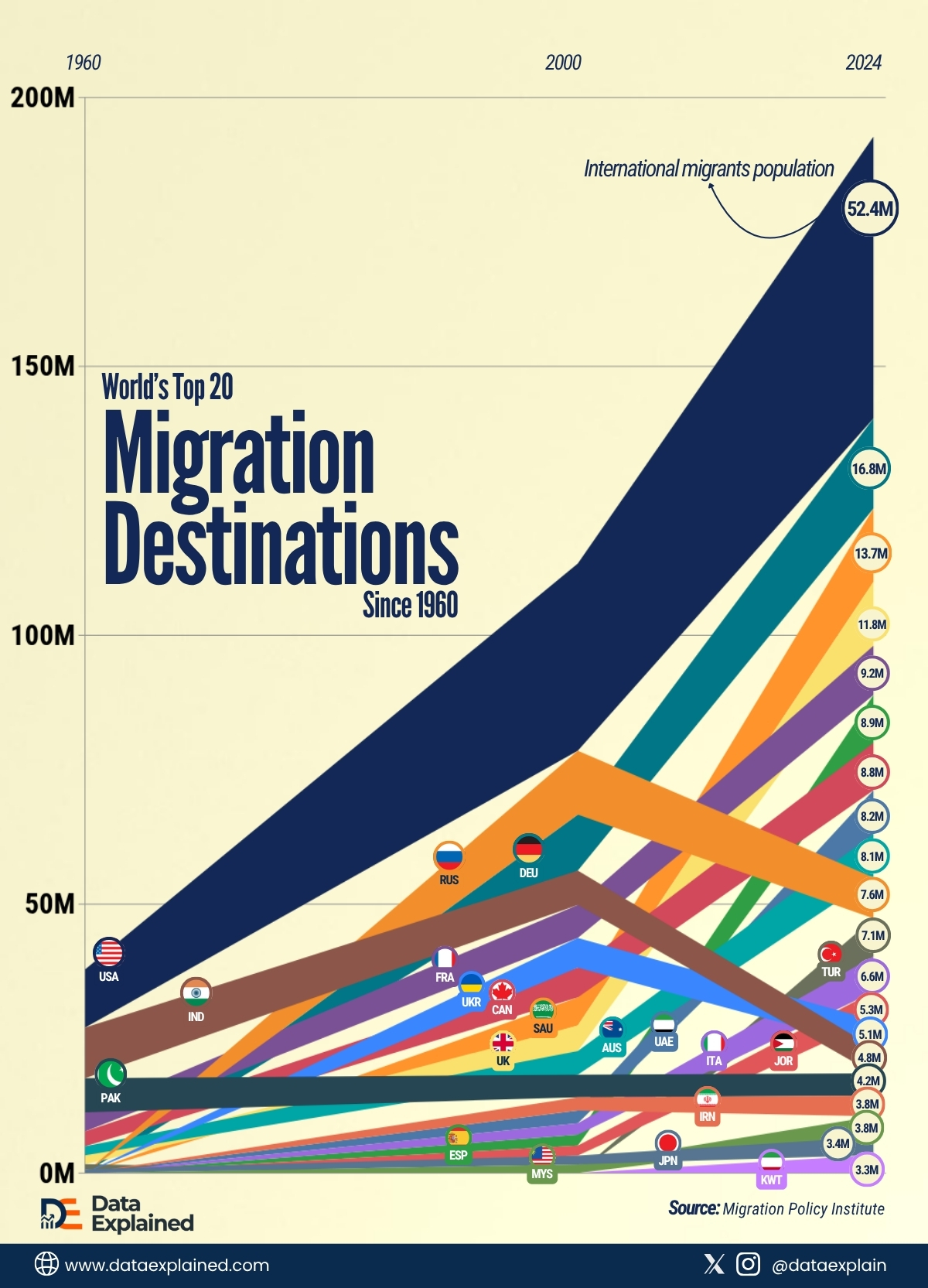
Using data from the Migration Policy Institute, the chart above shows the top 20 Countries with the most international migrants from 1960 to 2024.
TL;DR
- The United States remains the world’s largest migrant destination by an enormous margin at 52,375,000 in 2024.
- Japan’s international migrant population grew from 693,000 in 1960 to 3,410,000 in 2024, making it among the world’s fastest-growing destinations for international migration.
- South Korea’s Human Resources Development Service reports that Japan overtook the United States as the top destination for Korean overseas job seekers in 2024, with 2,257 Koreans securing jobs in Japan last year.
ALSO READ: Four Countries Hold 75% of South America’s Population
Where the global migration map sits
Note: Where there’s 0, it means the country’s figures were not registered in the top 25 list.
| wdt_ID | wdt_created_by | wdt_created_at | wdt_last_edited_by | wdt_last_edited_at | Country / Region | Migrant Population (1960) | Migrant Population (2000) | Migrant Population (2024) |
|---|---|---|---|---|---|---|---|---|
| 1 | emmanuel-ashemiriogwa | 14/08/2026 12:16 AM | emmanuel-ashemiriogwa | 14/08/2026 12:16 AM | United States of America | 10,826,000 | 34,807,000 | 52,375,000 |
| 2 | emmanuel-ashemiriogwa | 14/08/2026 12:16 AM | emmanuel-ashemiriogwa | 14/08/2026 12:16 AM | Germany | 0 | 10,397,000 | 16,750,000 |
| 3 | emmanuel-ashemiriogwa | 14/08/2026 12:16 AM | emmanuel-ashemiriogwa | 14/08/2026 12:16 AM | Saudi Arabia | 0 | 5,219,000 | 13,684,000 |
| 4 | emmanuel-ashemiriogwa | 14/08/2026 12:16 AM | emmanuel-ashemiriogwa | 14/08/2026 12:16 AM | United Kingdom | 1,662,000 | 4,748,000 | 11,845,000 |
| 5 | emmanuel-ashemiriogwa | 14/08/2026 12:16 AM | emmanuel-ashemiriogwa | 14/08/2026 12:16 AM | France | 3,507,000 | 6,141,000 | 9,187,000 |
| 6 | emmanuel-ashemiriogwa | 14/08/2026 12:16 AM | emmanuel-ashemiriogwa | 14/08/2026 12:16 AM | Spain | 0 | 2,024,000 | 8,871,000 |
| 7 | emmanuel-ashemiriogwa | 14/08/2026 12:16 AM | emmanuel-ashemiriogwa | 14/08/2026 12:16 AM | Canada | 2,766,000 | 5,525,000 | 8,806,000 |
| 8 | emmanuel-ashemiriogwa | 14/08/2026 12:16 AM | emmanuel-ashemiriogwa | 14/08/2026 12:16 AM | United Arab Emirates | 0 | 2,374,000 | 8,157,000 |
| 9 | emmanuel-ashemiriogwa | 14/08/2026 12:16 AM | emmanuel-ashemiriogwa | 14/08/2026 12:16 AM | Australia | 1,698,000 | 4,390,000 | 8,111,000 |
| 10 | emmanuel-ashemiriogwa | 14/08/2026 12:16 AM | emmanuel-ashemiriogwa | 14/08/2026 12:16 AM | Russian Federation | 0 | 11,900,000 | 7,606,000 |
As shown in the table above, the United States has 52,375,000 international migrants in 2024.
It’s the highest of any country in the world and more than three times Germany’s second-place total of 16,750,000.
However, the most dramatic shifts in the record sit outside the traditional Western destinations.
- Saudi Arabia had no meaningful recorded migrant presence in 1960. By 2024, it held 13,684,000, the third-largest in the world.
- The UAE went from near-zero to 8,157,000.
- Kuwait enters the 2024 top 25 for the first time at 3,323,000.
Three Gulf states that barely registered on the global migration map in 1960 now collectively host approximately 25 million international migrants, entirely on the back of the oil economy’s demand for foreign labor.
ALSO READ: How Abu Dhabi’s Population Has Boomed Over the Past Decade
Nations moving in the other direction
Russia held nearly 12 million international migrants in 2000, which was the second-largest total in the world at the time.
By 2024, it had fallen to 7.6 million
It is the only country in the top ten to record a significant absolute decline.
Sanctions, economic contraction, and the consequences of the 2022 invasion of Ukraine have made Russia a country migrants are leaving rather than arriving in.
India and Pakistan both had enormous migrant populations in 1960 (9.4 million and 6.4 million, respectively) primarily due to mass population movements following the partition in 1947.
Both have declined significantly since. India had 4.8 million in 2024, and Pakistan had 4.2 million. Both countries have transitioned from receivers to senders over the dataset’s timeframe.
ALSO READ: Ukraine War in Data (Part 1): Every Confirmed Civilian Death Since 2014
Japan and the Korean signal
Japan overtook the United States as the top destination for Korean overseas job seekers in 2024 and has widened that lead since.
Korean workers are choosing Japan for reasons that are clear in the broader context of migration data:
- Proximity
- Cultural familiarity
- A labor market actively seeking foreign workers
- A country whose population decline has created genuine opportunities in sectors that were previously closed.
ELI5
Japan used to accept almost no immigrants, but it now has 3.4 million foreign residents because its population is shrinking and it needs workers.
South Korean workers are choosing Japan over the U.S. as their top overseas destination for jobs.
The U.S. is still the world’s biggest destination for migrants by far, with 52 million.
The biggest surprises in the global data are how much the Gulf states, such as Saudi Arabia, have grown and how Russia has actually lost migrants since 2000.
Source: