

It’s safe to say the world now awaits the “robot in every home” era.
However, factory floors of 2026 tell a different story.
Global humanoid shipments reached 13,317 units last year. The most notable detail is that two Chinese giants accounted for nearly 70% of them.
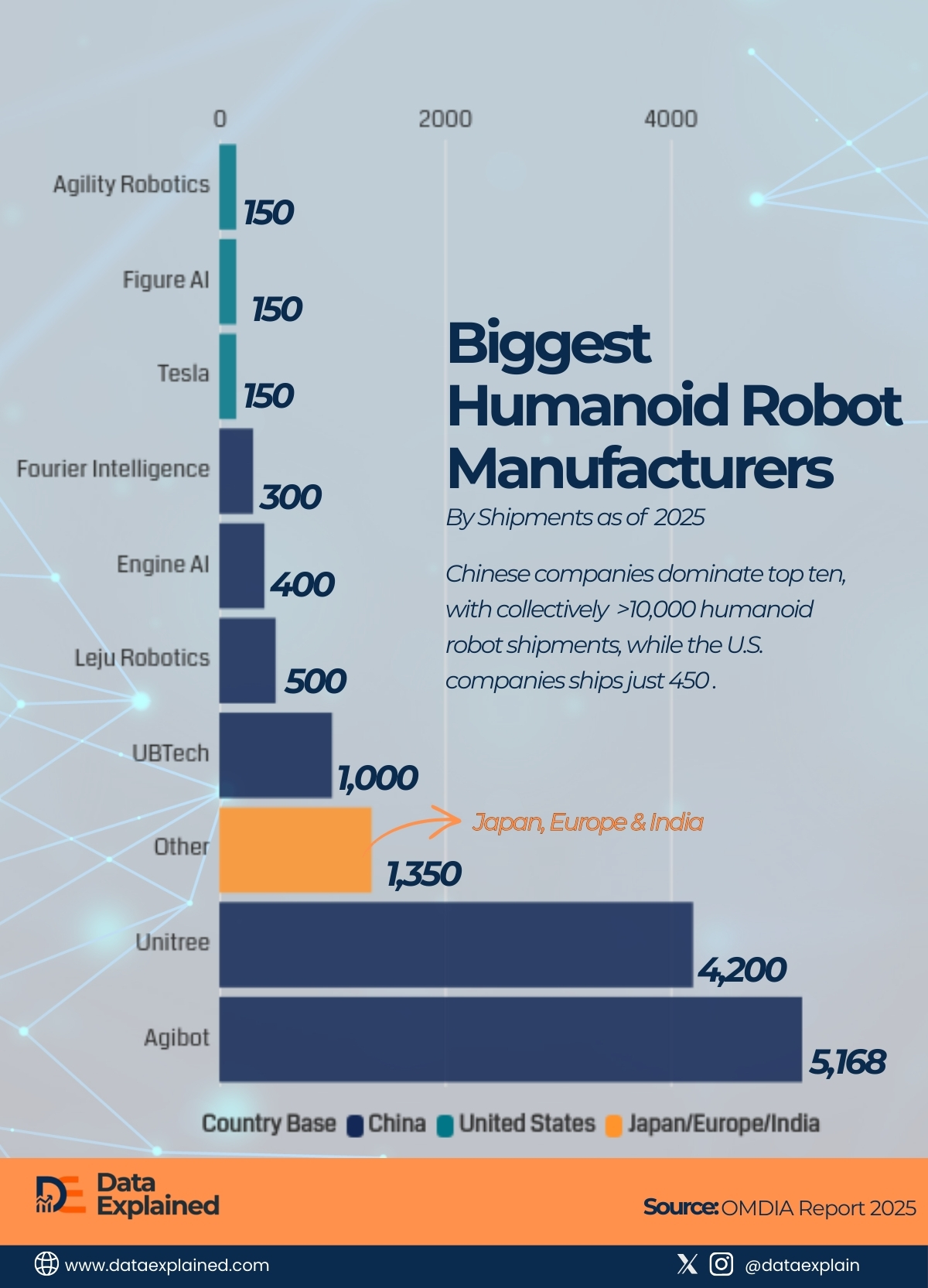
Based on the latest data from the Omdia 2026 report, the visualization above shows the top humanoid robot manufacturers by shipments in 2025.
TL;DR
- Agibot and Unitree from China top the list of humanoid robot shipments in 2025, with more than 900 units.
- Countries with shrinking workforces are the top adopters of humanoids and other robots, as they are needed to fill labour gaps.
Top 10 Humanoid Robot Companies by Shipments
| wdt_ID | wdt_created_by | wdt_created_at | wdt_last_edited_by | wdt_last_edited_at | Robot Companies | Number of Shipments | Country Base |
|---|---|---|---|---|---|---|---|
| 1 | emmanuel-ashemiriogwa | 02/02/2026 04:21 PM | emmanuel-ashemiriogwa | 02/02/2026 04:21 PM | Agibot | 5,168 | China |
| 2 | emmanuel-ashemiriogwa | 02/02/2026 04:21 PM | emmanuel-ashemiriogwa | 02/02/2026 04:21 PM | Unitree | 4,200 | China |
| 3 | emmanuel-ashemiriogwa | 02/02/2026 04:21 PM | emmanuel-ashemiriogwa | 02/02/2026 04:21 PM | UBTech | 1,000 | China |
| 4 | emmanuel-ashemiriogwa | 02/02/2026 04:21 PM | emmanuel-ashemiriogwa | 02/02/2026 04:21 PM | Leju Robotics | 500 | China |
| 5 | emmanuel-ashemiriogwa | 02/02/2026 04:21 PM | emmanuel-ashemiriogwa | 02/02/2026 04:21 PM | Engine AI | 400 | China |
| 6 | emmanuel-ashemiriogwa | 02/02/2026 04:21 PM | emmanuel-ashemiriogwa | 02/02/2026 04:21 PM | Fourier Intelligence | 300 | China |
| 7 | emmanuel-ashemiriogwa | 02/02/2026 04:21 PM | emmanuel-ashemiriogwa | 02/02/2026 04:21 PM | Figure AI | 150 | United States |
| 8 | emmanuel-ashemiriogwa | 02/02/2026 04:21 PM | emmanuel-ashemiriogwa | 02/02/2026 04:21 PM | Agility Robotics | 150 | United States |
| 9 | emmanuel-ashemiriogwa | 02/02/2026 04:21 PM | emmanuel-ashemiriogwa | 02/02/2026 04:21 PM | Tesla | 150 | United States |
| 10 | emmanuel-ashemiriogwa | 02/02/2026 04:21 PM | emmanuel-ashemiriogwa | 02/02/2026 04:21 PM | Other | 1,350 | Japan/Europe/India |
The Volume Kings: Agibot and Unitree
Agibot and Unitree alone accounted for more than 9,000 units in 2025, representing roughly two-thirds of total shipments among the top players.
Western companies do not come close, as U.S. firms such as Tesla, Figure AI, and Agility Robotics ship about 150 units each.
China’s lead comes from manufacturing scale and lower price positioning. In total, all Chinese brands in the top ten shipped 11,568 humanoid robots.
While Western companies remain focused on smaller, premium, or prototype-level outputs, China is winning the robotics race through high-volume production and cost efficiency.
Approximately six Chinese companies are among the top ten, and shipment volumes far exceed those of competitors in the U.S. and Europe.
They collectively ship more than 10,000 robots, whereas the U.S. trio ships only 450 units.
U.S. Robotics Companies Seem to Prioritize Strategy over Speed
Surprisingly, U.S. humanoid-robot makers such as Tesla, Figure AI, and Agility Robotics are currently far behind Chinese leaders in shipment volume, with each reporting 150 units.
Compared with the thousands from Agibot and Unitree, this appears low.
But rather than competing on numbers, these U.S. companies are focusing on advanced AI reasoning, autonomy, and long-term capabilities that require more development time and testing.
It is a slower pace, but it reflects a strategic choice rather than a production gap.
Rather than a rapid mass production, most U.S. developers value complex decision-making, safety, and real-world adaptability. The result is fewer units shipped today, but more capable and versatile robots in future markets.
The Demographic Urgency
The World Economic Forum projected that China’s working-age population would decline by nearly 200 million between 2025 and 2050.
It creates pressure on its manufacturing and service sectors to automate work as fewer people are available.
Countries facing shrinking workforces are among the biggest early adopters of humanoid and other robots, because they need machines to help fill labour gaps that humans once filled.
Another example is Japan.
About 29% of its population is over 65, prompting companies and the government to invest in automation and robotics, including factory robots and eldercare support systems.
This is simply to help address the rapidly ageing society.
Additionally, Germany faces a shrinking workforce, projected to lose approximately 7.8 million workers by 2050. This increases its interest in adopting robots to maintain productivity despite demographic decline.
Demographic factors, such as declining birth rates and ageing populations, make humanoid robots and other automation a strategic economic necessity in these countries.
Is 2.6 Million Shipments of Humanoid Possible By 2035?
Humanoid robot shipments are expected to grow from about 13,000 units in 2025 to about 2.6 million by 2035, according to Omdia’s projections.
This is a more than 200-fold increase over ten years, driven by deeper automation and broader use cases across industries.
Early adoption is being driven by sectors with labour shortages and high automation value.
That includes warehousing/logistics, heavy manufacturing, and hazardous-environment support such as mining, chemical plants, and disaster response.
These fields combine repetitive tasks, safety risks, and economic incentives strong enough to drive rapid robot deployment, resulting in much larger market growth through the 2030s.
But it’s too early to say whether the projection is feasible.
ELI5
China’s Agibot and Unitree are leading the humanoid robot market, shipping over 9,000 units in 2025 and accounting for the largest share of global production.
The U.S. is trailing in volume, but American companies are focusing on making robots smarter, with better AI, decision-making, and long-term capabilities rather than merely producing more.
At the same time, countries such as China, Japan, and Germany, with declining workforces, are purchasing these robots at the fastest rate, using them to fill gaps in factories, warehouses, and other industries with insufficient human labor.
This combination of mass production in China, advanced AI in the U.S., and high demand from labour-short nations is shaping the global humanoid robotics market.
Source:
Omdia | China briefing | world economic forum | weforum | rebobank