

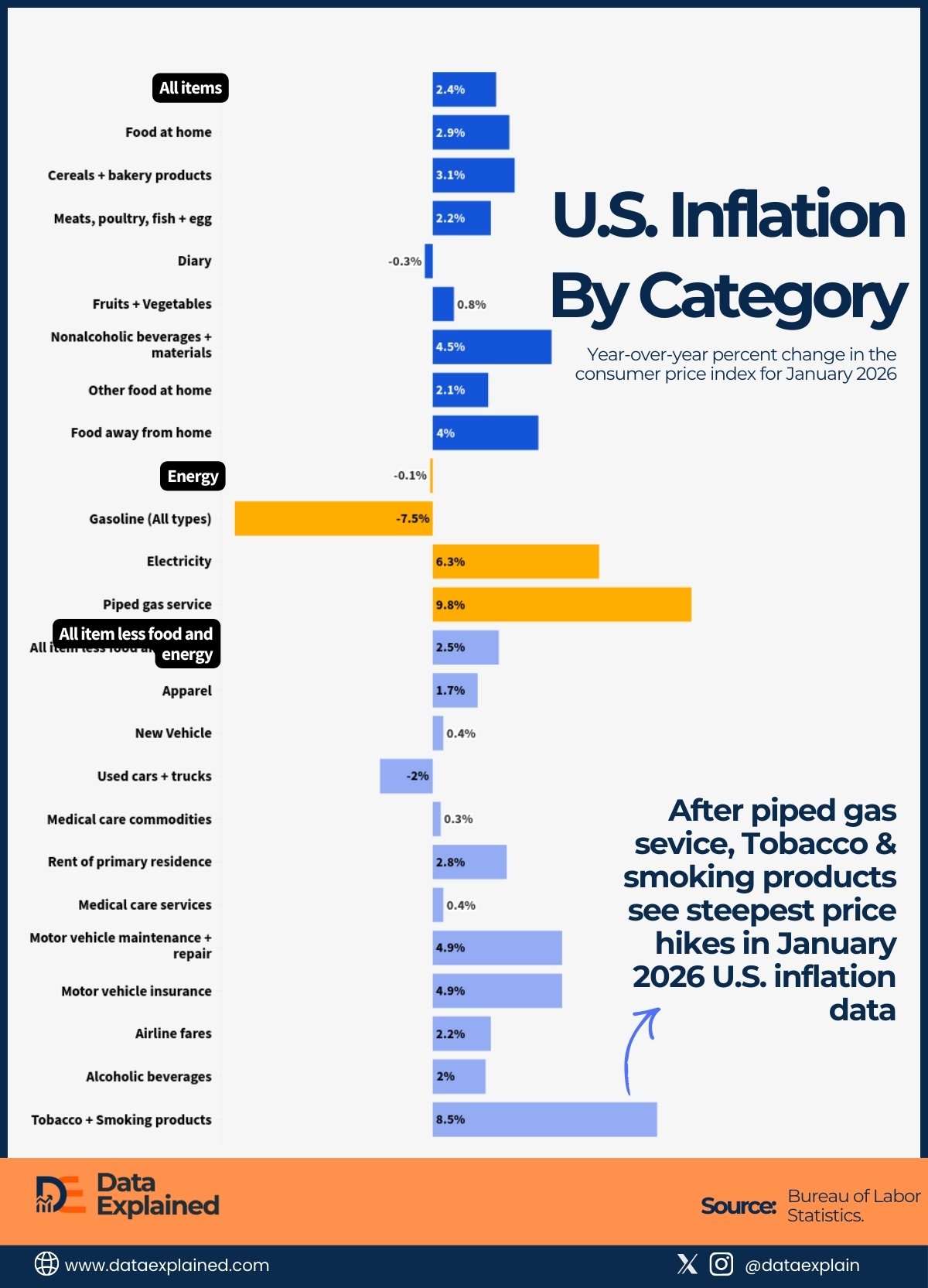
Tobacco and smoking products posted the steepest price increases behind piped gas services, among all consumer categories of the United State in January 2026.
The graphics above show year-over-year inflation rates by category for January 2026 (compared to January 2025), based on the Consumer Price Index (CPI) from the U.S. Bureau of Labor Statistics.
Tobacco and smoking products surged 8.5% year-over-year and outpaced even piped gas service as inflation’s top driver.
The spike, more than triple the overall 2.4% inflation rate, affects millions of American smokers and vapers while flying under the radar of broader inflation discussions dominated by energy, food, and housing costs.
TL;DR
- Cigarettes and Vaping Products see steepest price hikes in January 2026 Inflation Data
- U.S inflation is at 2.4%. Household staples are rising, while dairy and used cars are declining.
U.S Inflation by Category (As of January 2026)
| wdt_ID | wdt_created_by | wdt_created_at | wdt_last_edited_by | wdt_last_edited_at | Category | 12-Month % Change (Jan 2026) |
|---|---|---|---|---|---|---|
| 1 | emmanuel-ashemiriogwa | 16/02/2026 02:36 PM | emmanuel-ashemiriogwa | 16/02/2026 02:36 PM | All item | 2.40 |
| 2 | emmanuel-ashemiriogwa | 16/02/2026 02:36 PM | emmanuel-ashemiriogwa | 16/02/2026 02:36 PM | Food at home | 2.90 |
| 3 | emmanuel-ashemiriogwa | 16/02/2026 02:36 PM | emmanuel-ashemiriogwa | 16/02/2026 02:36 PM | Cereals + bakery products | 3.10 |
| 4 | emmanuel-ashemiriogwa | 16/02/2026 02:36 PM | emmanuel-ashemiriogwa | 16/02/2026 02:36 PM | Meats, poultry, fish + egg | 2.20 |
| 5 | emmanuel-ashemiriogwa | 16/02/2026 02:36 PM | emmanuel-ashemiriogwa | 16/02/2026 02:36 PM | Diary | -0.30 |
| 6 | emmanuel-ashemiriogwa | 16/02/2026 02:36 PM | emmanuel-ashemiriogwa | 16/02/2026 02:36 PM | Fruits + Vegetables | 0.80 |
| 7 | emmanuel-ashemiriogwa | 16/02/2026 02:36 PM | emmanuel-ashemiriogwa | 16/02/2026 02:36 PM | Nonalcoholic beverages + materials | 4.50 |
| 8 | emmanuel-ashemiriogwa | 16/02/2026 02:36 PM | emmanuel-ashemiriogwa | 16/02/2026 02:36 PM | Other food at home | 2.10 |
| 9 | emmanuel-ashemiriogwa | 16/02/2026 02:36 PM | emmanuel-ashemiriogwa | 16/02/2026 02:36 PM | Food away from home | 4.00 |
| 10 | emmanuel-ashemiriogwa | 16/02/2026 02:36 PM | emmanuel-ashemiriogwa | 16/02/2026 02:36 PM | Energy | -0.10 |
U.S. Inflation Holds at 2.4%
In January 2026, U.S. inflation was steady at 2.4% , highlighting a stable overall price environment despite the differences across categories.
Falling energy costs give strong price gains in food away from home, non-alcoholic beverages, and rent of primary residence.
All items excluding food and energy are slightly higher at 2.5%, indicating that price pressures remain even as fuel prices ease.
The balance between falling transportation costs and rising service-related expenses keeps inflation near the mid-2%.
Cigarettes and Vaping Products See Steepest Price Hikes in January Inflation Data
Tobacco and smoking products experienced one of the largest price increases among major CPI categories, rising by approximately 8.5% over the past year.
This reflects how the costs of cigarettes and related products are rising faster than most other consumer prices.
The rise in tobacco pricing shows continued excise tax increases, regulatory levies, and industry cost pass-throughs that affect tobacco and smoking goods.
Just as consumers face higher costs at the register for cigarettes and related items, these products now add to inflationary pressures in the latest CPI release, even as energy costs like gasoline fall.
Restaurant Prices Outpace Grocery Inflation by 38%
The price of dining out, as seen in the “food away from home” is about 4.0%, compared with grocery inflation of around 2.1% for food at home.
This means restaurant and eating-out costs increase almost twice as much as supermarket food prices, putting more pressure on consumers who eat out regularly.
This gap indicates a trend in inflation, as services and prepared food sectors are experiencing stronger price momentum than staple groceries.
This means higher labor, rent, and ingredient costs that restaurants pass on to customers.
Rent and Car Insurance Drive Inflation Higher Despite Falling Gas Prices
Rent for primary residences increased by about 2.8%, and motor vehicle insurance by about 4.9%, both contributing to the pressure.
The increase in housing and insurance costs is one reason inflation remains high despite declining energy prices.
While volatile fuel costs provide temporary relief at the pump, base inflation, driven by housing and essential services, continues to rise, making everyday living more expensive for many households.
Trend of U.S Inflation in the Last 3 Years
Over the past three years, U.S. core inflation has gradually fallen from its post-pandemic peak above 5% in early 2023 to around 2.6% by the end of 2025 and into early 2026.
This indicates a broad cooling in price pressures.
However, inflation looks better on paper than in reality due to a quirk in the data from the government shutdown in the fall.
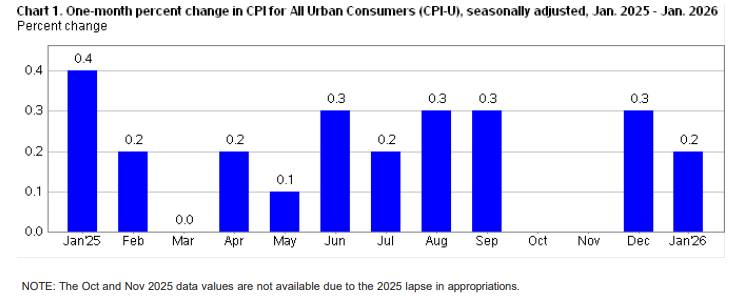
Politically, this trend has taken on significance as the 2026 election cycle approaches.
President Trump’s administration has used lower inflation figures as evidence of economic stewardship.
Though critics point to factors such as tariffs and interest rates that complicate the picture.
As inflation intensifies, inflation performance may become a central campaign issue, shaping voter sentiment on economic leadership and cost-of-living concerns.
ELI5
U.S. inflation is about 2.4%, but excluding food and energy, the rate is higher at 2.5%, indicating that everyday essentials are getting more expensive even as some items, such as dairy and used cars, are actually cheaper.
People feel the heat most when eating out, as restaurant prices are rising faster than grocery prices, making meals away from home more expensive.
With the 2026 elections approaching, inflation has become a hot political topic, shaping debates over who can best manage the economy and keep costs under control for the citizens.
Source:
U.S. Bureau of Labor Statistics | CNBC | Trading economics