As Russian and Ukrainian officials concluded their latest round of talks in Geneva this week, both sides struck cautiously optimistic tones.
Moscow described the discussions as “difficult, but business-like.” Kyiv called them substantive and said progress had been made.
But seven decades of data on how wars end suggest these diplomats are battling steep historical odds.
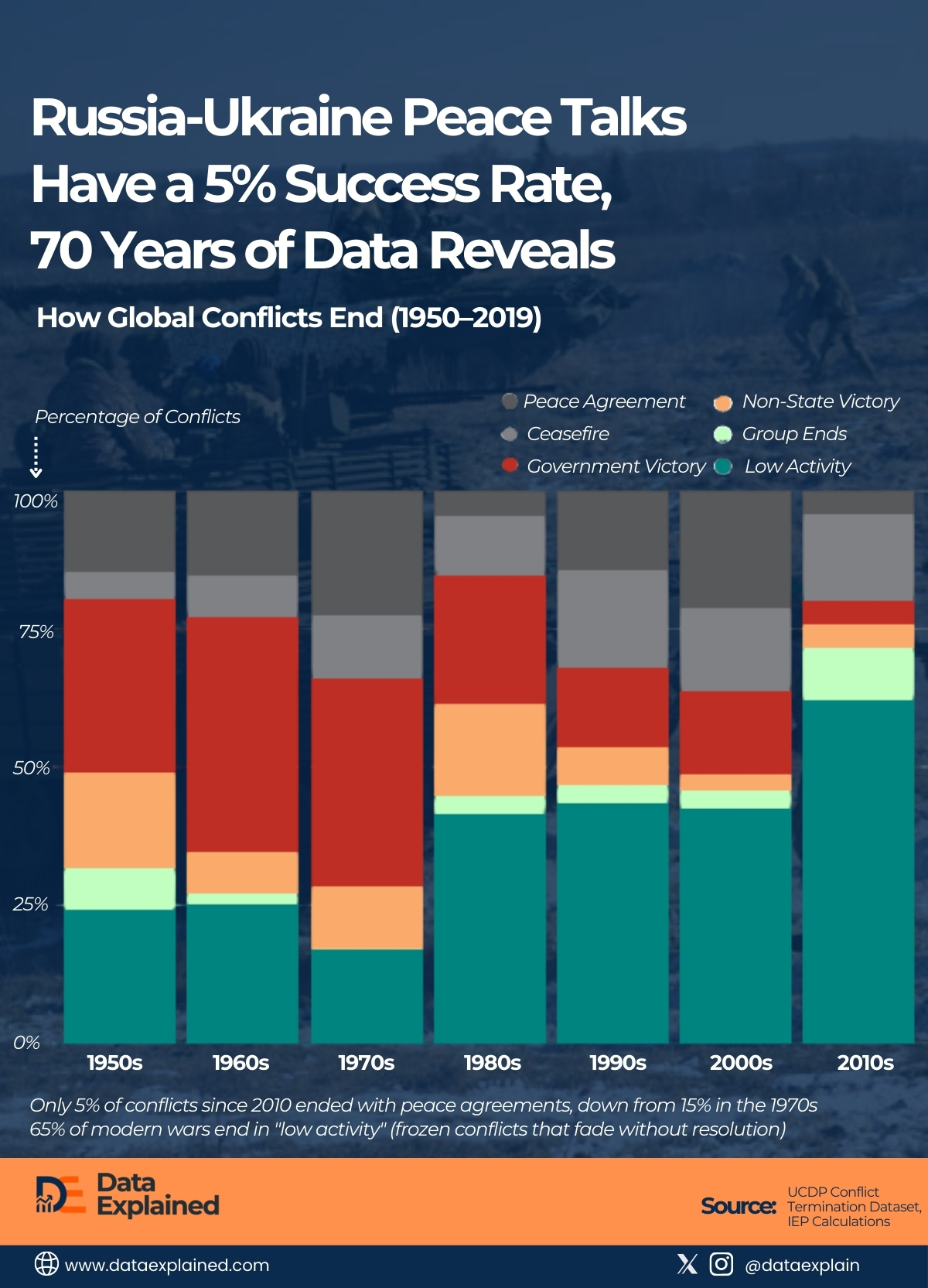
Research tracking conflicts from 1950 to 2019 reveals that only 5% of wars in the 2010s ended with peace agreements.
That means 95 out of every 100 modern conflicts fail to produce the kind of negotiated settlement that Russia and Ukraine are ostensibly pursuing in Switzerland.
TL;DR
- Only 5% of conflicts since 2010 ended with peace agreements, down from 15% in the 1970s
- 65% of modern wars end in “low activity” (frozen conflicts that fade without resolution)
- Decisive victories by either governments or rebels dropped from 55% in the 1950s to just 15% in the 2010s
The data, compiled by the Uppsala Conflict Data Program and analyzed by the Institute for Economics and Peace (IEP), shows something even more troubling.
Most modern wars don’t end at all (at least not in any meaningful sense).
They just fade away.
The rise of the frozen conflict
In the 2010s, a staggering 65% of conflicts ended in what researchers call “low activity.”
This means the fighting didn’t stop because of a peace deal, a ceasefire, or one side winning decisively. It stopped because the war simply became less intense over time, often settling into a frozen stalemate.
Think Syria. Think Yemen. Think of the dozens of conflicts that no longer make headlines but continue to simmer, displacing millions and claiming lives sporadically for years.
This represents a dramatic shift from how wars used to end.
Back to the data. In the 1950s, just 25% of conflicts fizzled out this way. Back then, wars typically had clear outcomes: one side won, or the parties signed a formal agreement.
The numbers tell the story of that change.
In the 1950s, governments won 30% of the conflicts they fought. By the 2010s, that figure had dropped to just 10%.
Rebel groups and insurgents have fared even worse. They achieved victory in 35% of conflicts during their peak decade, the 1970s. By the 2010s, non-state actors won only 5% of the time.
Add those together, and the pattern becomes clear. In the 1950s, 55% of conflicts ended with someone winning decisively. In the 2010s, that figure collapsed to just 15%.
Why peace is harder than ever
What happened? Why have negotiated settlements become so rare and decisive victories nearly extinct?
Experts point to several factors.
1. Modern conflicts involve more parties than ever before.
A 2024 report found that 92 countries were involved in conflicts beyond their borders (the highest number since World War II).
When multiple countries, militias, and external backers pursue different goals, reaching a comprehensive peace agreement becomes exponentially more difficult.
2. The nature of warfare has also changed.
Insurgencies, proxy wars, and asymmetric conflicts don’t lend themselves to the kind of clear battlefield victories that marked earlier eras.
A government can control a capital city while rebels control the countryside, creating stalemates that can last for decades.
3. External involvement further complicates matters.
When major powers back different sides (as in Syria, Yemen, or Ukraine), neither party has an incentive to compromise.
As long as weapons and money keep flowing, they can sustain low-intensity conflict indefinitely.
What the numbers say about Russia-Ukraine
Russia’s war in Ukraine fits the modern conflict pattern perfectly.
It involves direct participation from multiple countries (Western military aid to Ukraine, Iranian drones to Russia), complex territorial disputes, and great power competition.
The Geneva talks are the third attempt at negotiations, following earlier sessions in Abu Dhabi and Istanbul.
Each round produces statements about progress, but no breakthroughs.
If historical patterns hold, this is exactly what we should expect.
Peace agreements in the 1970s (when they peaked at 15% of conflict endings) often involved simpler bilateral disputes.
The Soviet-Afghan war, the Vietnam War, and various decolonization conflicts eventually produced agreements because the core issues, while difficult, were more clearly defined.
Today’s conflicts rarely have such clarity.
- Russia demands Ukraine abandon NATO aspirations and cede territory.
- Ukraine demands full territorial restoration and security guarantees.
- Both positions are incompatible, and neither side faces immediate military collapse that would force acceptance of the other’s terms.
So, what now?
Ceasefires offer little hope either.
As you see in today’s data, Ceasefires accounted for just 5% of conflict endings in the 2010s, and history shows they’re fragile. Most collapse within months or years.
There’s also a new category in recent decades: “group ends,” in which fighting stops when one of the armed groups dissolves or disbands.
This accounts for roughly 10% of recent conflict endings but rarely applies to state-on-state wars such as Russia-Ukraine.
That leaves the 5% who beat the odds (conflicts that do end with negotiated peace agreements). They’re not impossible. Colombia’s peace deal with FARC guerrillas in 2016 and Northern Ireland’s Good Friday Agreement in 1998 show it can happen.
But they’re rare.
And they typically require years of sustained effort, external pressure, mutual exhaustion, and face-saving compromises that both sides can sell domestically.
As this week’s Geneva talks demonstrate, Russia and Ukraine aren’t there yet.
Sources:
Vision of Humanity Report | Wikipedia | Al Jazeera