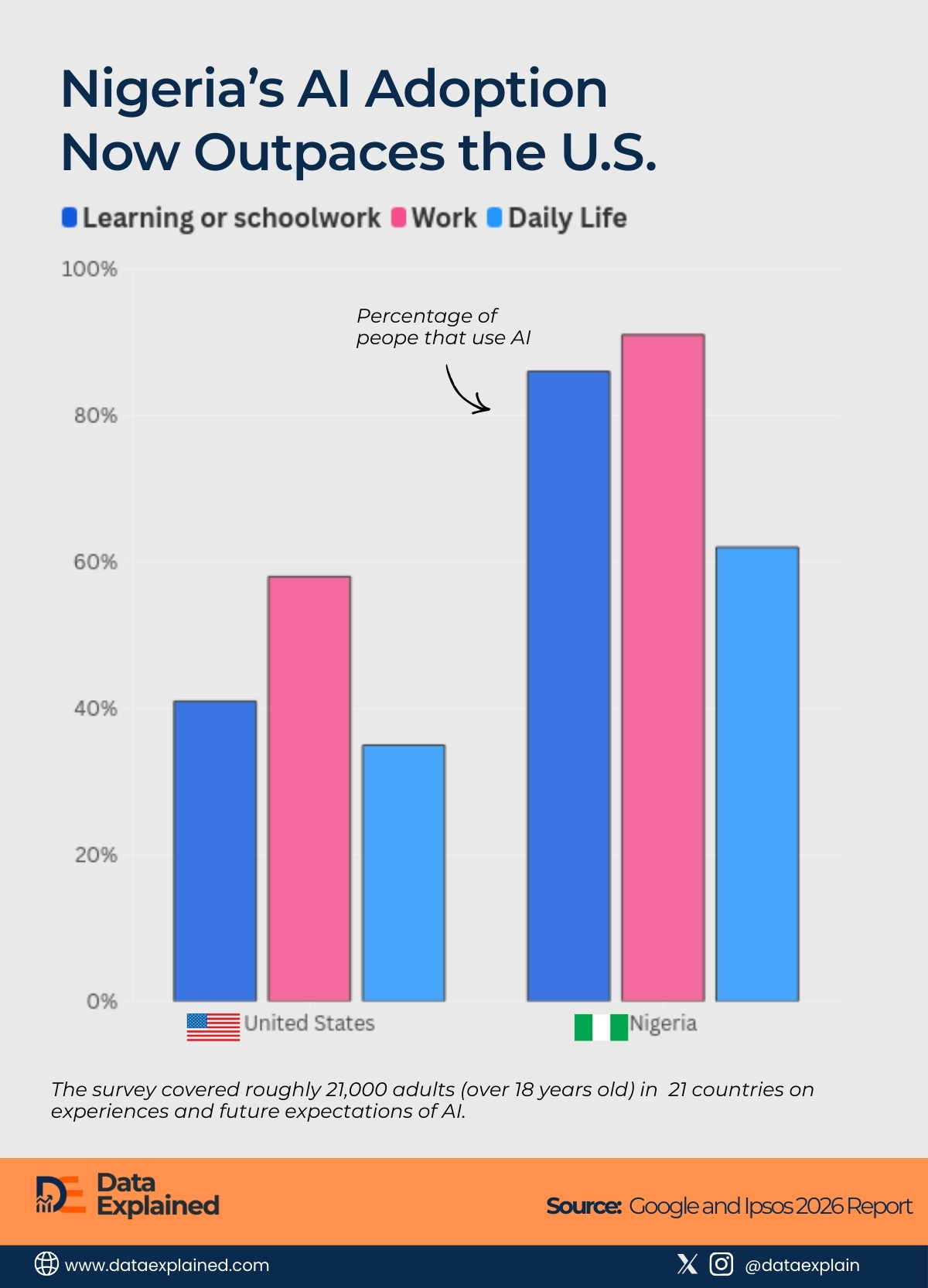
Nigeria now leads the world in using artificial intelligence for work, learning, and daily tasks, while the United States ranks near the bottom (despite being home to the companies that created the technology).
Using the data from Google and Ipsos 2026 Report, this visualisation shows AI adoption trends between Nigeria and the U.S.
TL;DR
- Approximately 91% of Nigerians use AI for work, which is higher than any of the 21 major economies
- Developing nations are adopting AI at rates far higher than wealthy Western countries.
The survey covered roughly 21,000 adults (over 18 years old) in 21 countries on experiences and future expectations of AI.
Below is a table showing the percentage of population adopting AI in each of these countries.
| wdt_ID | wdt_created_by | wdt_created_at | wdt_last_edited_by | wdt_last_edited_at | Countries | Personal communications | Learning or schoolwork | Work | Daily Life | Learning new topics |
|---|---|---|---|---|---|---|---|---|---|---|
| 1 | emmanuel-ashemiriogwa | 22/01/2026 11:31 AM | emmanuel-ashemiriogwa | 22/01/2026 11:31 AM | United States | 37% | 41% | 58% | 35% | 61% |
| 2 | emmanuel-ashemiriogwa | 22/01/2026 11:31 AM | emmanuel-ashemiriogwa | 22/01/2026 11:31 AM | Nigeria | 80% | 86% | 91% | 62% | 93% |
| 3 | emmanuel-ashemiriogwa | 22/01/2026 11:31 AM | emmanuel-ashemiriogwa | 22/01/2026 11:31 AM | Canada | 44% | 42% | 62% | 40% | 67% |
| 4 | emmanuel-ashemiriogwa | 22/01/2026 11:31 AM | emmanuel-ashemiriogwa | 22/01/2026 11:31 AM | Belgium | 45% | 37% | 60% | 46% | 68% |
| 5 | emmanuel-ashemiriogwa | 22/01/2026 11:31 AM | emmanuel-ashemiriogwa | 22/01/2026 11:31 AM | France | 41% | 34% | 60% | 41% | 71% |
| 6 | emmanuel-ashemiriogwa | 22/01/2026 11:31 AM | emmanuel-ashemiriogwa | 22/01/2026 11:31 AM | Germany | 41% | 35% | 59% | 40% | 62% |
| 7 | emmanuel-ashemiriogwa | 22/01/2026 11:31 AM | emmanuel-ashemiriogwa | 22/01/2026 11:31 AM | Poland | 46% | 47% | 63% | 53% | 69% |
| 8 | emmanuel-ashemiriogwa | 22/01/2026 11:31 AM | emmanuel-ashemiriogwa | 22/01/2026 11:31 AM | Spain | 45% | 46% | 62% | 58% | 72% |
| 9 | emmanuel-ashemiriogwa | 22/01/2026 11:31 AM | emmanuel-ashemiriogwa | 22/01/2026 11:31 AM | Italy | 40% | 40% | 61% | 44% | 71% |
| 10 | emmanuel-ashemiriogwa | 22/01/2026 11:31 AM | emmanuel-ashemiriogwa | 22/01/2026 11:31 AM | United Kingdom | 49% | 44% | 74% | 48% | 68% |
Nigeria Dominates Every Category
Nigerian workers top the global rankings with 91 percent using AI applications at work in the past year.
That’s 33 percentage points higher than American workers, where only 58 percent reported using AI for their jobs.
The gap extends across all five categories measured in the survey.
For learning new topics, 93 percent of Nigerians use AI compared to just 61 percent of Americans.
In daily life tasks like planning meals or workout routines, 62 percent of Nigerians use AI versus only 36 percent of Americans (the lowest rate among all 21 countries surveyed).
“We’re seeing a complete reversal of what people expected,” said the survey’s findings. “The countries building AI aren’t the ones using it most.”
The Global South Embraces AI
The pattern repeats across developing nations.
India ranks second globally with 80 percent of workers using AI, followed by Brazil at 75 percent and South Africa at 75 percent. The United Arab Emirates, despite its small population, shows 83 percent adoption among workers.
By contrast, wealthy Western nations lag far behind. Canada sits at 62 percent for work usage, Germany at 59 percent, and France at 60 percent.
The United States ranks second-to-last among developed economies.
The gap is widest in education.
Nigerian students use AI for schoolwork at an 86 percent rate, while only 41 percent of American students do the same.
Indian students follow at 72 percent, more than 30 points ahead of their U.S. counterparts.
Why the Divide?
Several factors explain why developing nations adopt AI faster than wealthy countries.
Younger populations play a key role.
Nigeria’s median age is 18 compared to 38 in the United States. Younger people generally embrace new technology more quickly.
Economic pressure also drives adoption.
Workers in developing economies see AI as a tool to compete globally and overcome gaps in infrastructure.
Nigerian professionals use AI to access world-class education and business tools that might otherwise be unavailable.
Privacy concerns create hesitation in Western countries.
American workers worry about data security and job displacement, leading many to avoid AI tools despite their availability.
Europe’s strict privacy laws appear to slow adoption rates as well.
What It Means for Business
The survey reveals where AI companies should focus their efforts.
While firms like OpenAI, Google, and Anthropic are based in the United States, their biggest growth opportunities lie elsewhere.
With Nigeria’s over 200 million population and 91 percent work adoption rate (based on the survey), potentially 40 to 50 million Nigerians are already AI power users.
India’s numbers are even larger (80 percent adoption among 1.4 billion people means hundreds of millions of active AI users).
Current AI products mainly support English and a handful of European languages.
They rarely work well in Hindi, Yoruba, Igbo, or Portuguese.
Pricing also creates barriers.
Most AI subscriptions cost $20 to $30 per month, affordable in wealthy nations but expensive in developing markets where adoption rates are highest.
ELI5
AI innovation and AI adoption are two different things.
America leads in creating AI technology, with companies like OpenAI and Google at the forefront. But Nigeria, India, and Brazil lead in actually using that technology.
History suggests that widespread use matters more than invention.
China didn’t invent e-commerce but built the world’s largest online shopping market. Africa didn’t create mobile money but leads the world in mobile payments through services like M-Pesa.
Sources: