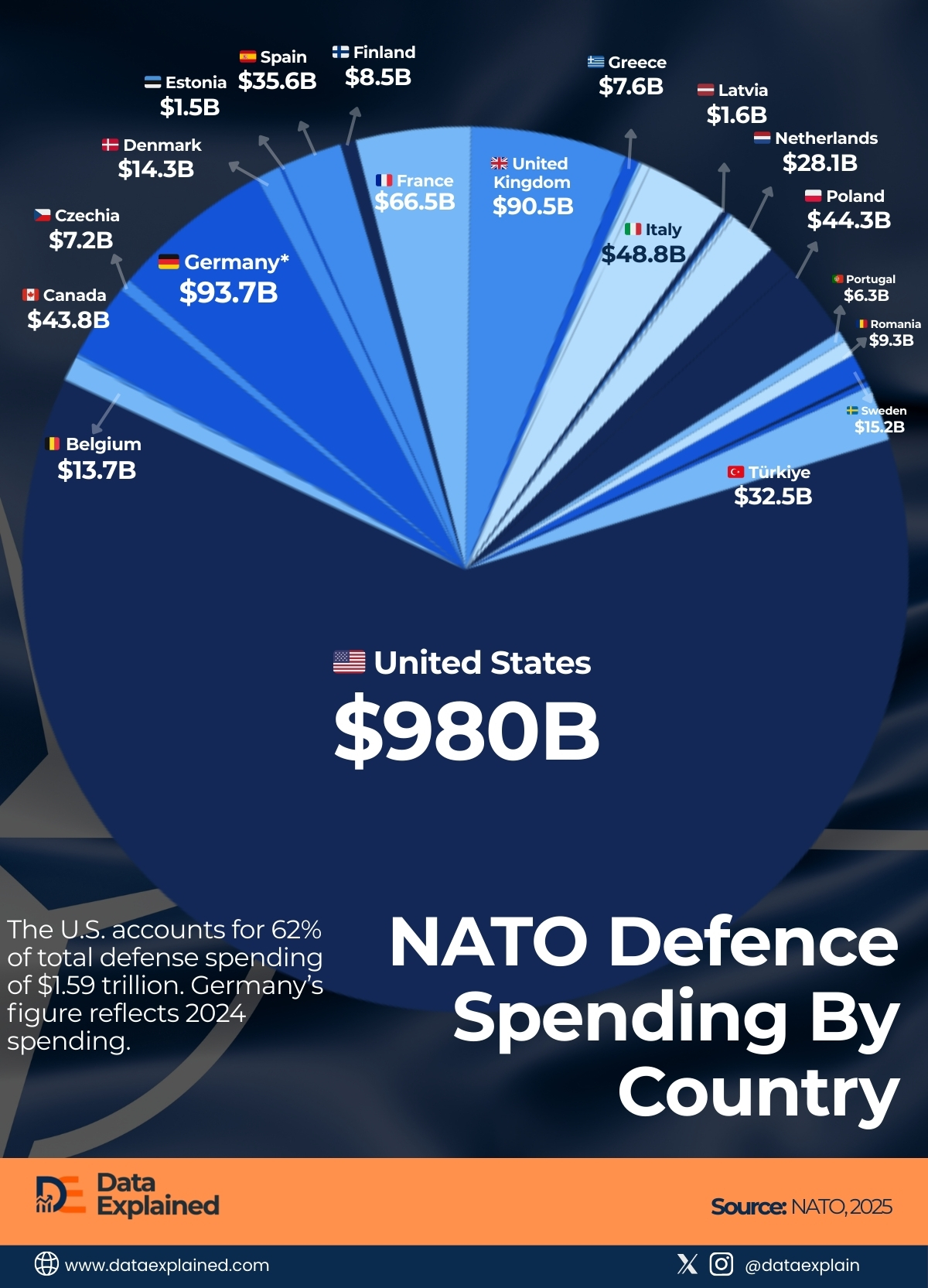
As President Donald Trump threatens to pull back America’s security umbrella, new NATO defense spending figures show a European military buildup unlike anything seen since the Cold War.
Using data from the latest NATO report on spending, the visualization above shows how much each member country spends on the group’s military in 2025.
TL;DR
- The U.S. accounts for 62% of NATO’s total defense spending of $1.59 trillion.
- European leaders and politicians fear the U.S has become a less reliable ally.
- In 2025, all NATO members were estimated to spend at least 2% of GDP on defense.
Ranked: Estimated Spending of NATO Countries in 2025
*Only Germany’s figure reflects 2024 spending, the most recent data available.
| wdt_ID | wdt_created_by | wdt_created_at | wdt_last_edited_by | wdt_last_edited_at | Country | 2025e Spending (USD, millions) |
|---|---|---|---|---|---|---|
| 1 | emmanuel-ashemiriogwa | 26/01/2026 11:31 AM | emmanuel-ashemiriogwa | 26/01/2026 11:31 AM | Albania | 570.00 |
| 2 | emmanuel-ashemiriogwa | 26/01/2026 11:31 AM | emmanuel-ashemiriogwa | 26/01/2026 11:31 AM | Belgium | 11,759.00 |
| 3 | emmanuel-ashemiriogwa | 26/01/2026 11:31 AM | emmanuel-ashemiriogwa | 26/01/2026 11:31 AM | Bulgaria | 3,380.00 |
| 4 | emmanuel-ashemiriogwa | 26/01/2026 11:31 AM | emmanuel-ashemiriogwa | 26/01/2026 11:31 AM | Canada | 43,486.00 |
| 5 | emmanuel-ashemiriogwa | 26/01/2026 11:31 AM | emmanuel-ashemiriogwa | 26/01/2026 11:31 AM | Croatia | 2,006.00 |
| 6 | emmanuel-ashemiriogwa | 26/01/2026 11:31 AM | emmanuel-ashemiriogwa | 26/01/2026 11:31 AM | Czechia* | 7,253.00 |
| 7 | emmanuel-ashemiriogwa | 26/01/2026 11:31 AM | emmanuel-ashemiriogwa | 26/01/2026 11:31 AM | Denmark* | 14,303.00 |
| 8 | emmanuel-ashemiriogwa | 26/01/2026 11:31 AM | emmanuel-ashemiriogwa | 26/01/2026 11:31 AM | Estonia* | 1,504.00 |
| 9 | emmanuel-ashemiriogwa | 26/01/2026 11:31 AM | emmanuel-ashemiriogwa | 26/01/2026 11:31 AM | Finland | 8,587.00 |
| 10 | emmanuel-ashemiriogwa | 26/01/2026 11:31 AM | emmanuel-ashemiriogwa | 26/01/2026 11:31 AM | France* | 66,531.00 |
The Big Spenders Pull Ahead
The United States remains NATO’s financial heavyweight at $980 billion, but the real story is Europe’s transformation.
Germany, long criticized as a “free rider,” is now NATO’s second-largest spender at $93.7 billion (2024).
This is up from just $43.4 billion in 2014. That’s a 116% increase in a decade.
The United Kingdom holds third place with $90.5 billion, followed by France at $66.5 billion. But the most dramatic shift is happening in Eastern Europe, where the memory of Russian aggression drives unprecedented military investment.
Poland leads this charge with $44.3 billion in defense spending. That makes it NATO’s sixth-largest military budget despite having just 38 million people.
That’s more than Canada ($43.8 billion), a country with a similar population but sitting 5,000 miles from any serious threat.
Poland is on track to spend over 4% of GDP on defense in 2025, double NATO’s official target.
The Regional Divide Gets Deeper
Geography determines spending patterns.
Eastern European members facing Russia directly are spending at wartime levels.
Poland, Romania, Estonia, Latvia, Lithuania, and Finland (NATO’s newest member) all exceed or approach the 2% GDP target.
Western Europe is different.
Germany’s massive $93.7 billion budget sounds impressive until you realize it represents only about 2.1% of German GDP (barely crossing NATO’s threshold after decades of underspending).
Southern Europe lags furthest behind.
Portugal manages just $6.3 billion despite sharing the Atlantic with potential adversaries.
Money Splashes on Military Equipments
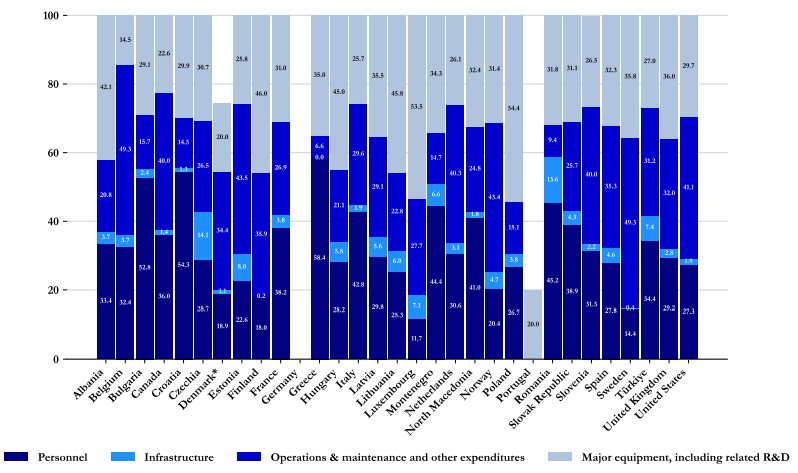
Beyond total spending, NATO’s 2025 data reveals a crucial shift in how funds are allocated.
The alliance recommends that members dedicate at least 20% of their defense budgets to major equipment and research.
This means investing in tanks, jets, missiles, and next-generation technology rather than just salaries and pensions.
Poland, Estonia, Romania, and other Eastern European states are meeting or exceeding this threshold, buying American F-35 fighters, Patriot missile systems, and HIMARS rocket launchers.
Germany recently committed to purchasing 35 F-35s and ordered additional Leopard 2 tanks.
The 2025 spike in U.S.-made weapon acquisitions by European allies is unprecedented.
Poland signed deals worth tens of billions for Abrams tanks, HIMARS systems, and Apache helicopters. Romania, the Netherlands, Finland, and Germany are all buying F-35s.
The American defense industry is enjoying a European windfall.
What This Means for the U.S.-NATO Crisis
The U.S. and 11 other countries in North America and Europe founded NATO in 1949, following World War II.
NATO has since grown its membership to include 32 countries in Europe and North America.
But now, European leaders and politicians fear the United States has become a less reliable ally, posing major challenges for Europe and, by implication, NATO.
This concern comes from a thread of events:
- President Donald Trump has repeatedly expressed a desire to seize Greenland, an autonomous territory of Denmark, a NATO member.
- He has declared that Canada, another NATO member, should become “the 51st state.”
- Trump has also sided with Russia at the United Nations.
- He has said that the European Union (the political and economic group uniting 27 European countries) was designed to “screw” the U.S.
- Every U.S. president since Eisenhower has complained about European “free riding.” Trump is the first willing to act on it.
Sources: