

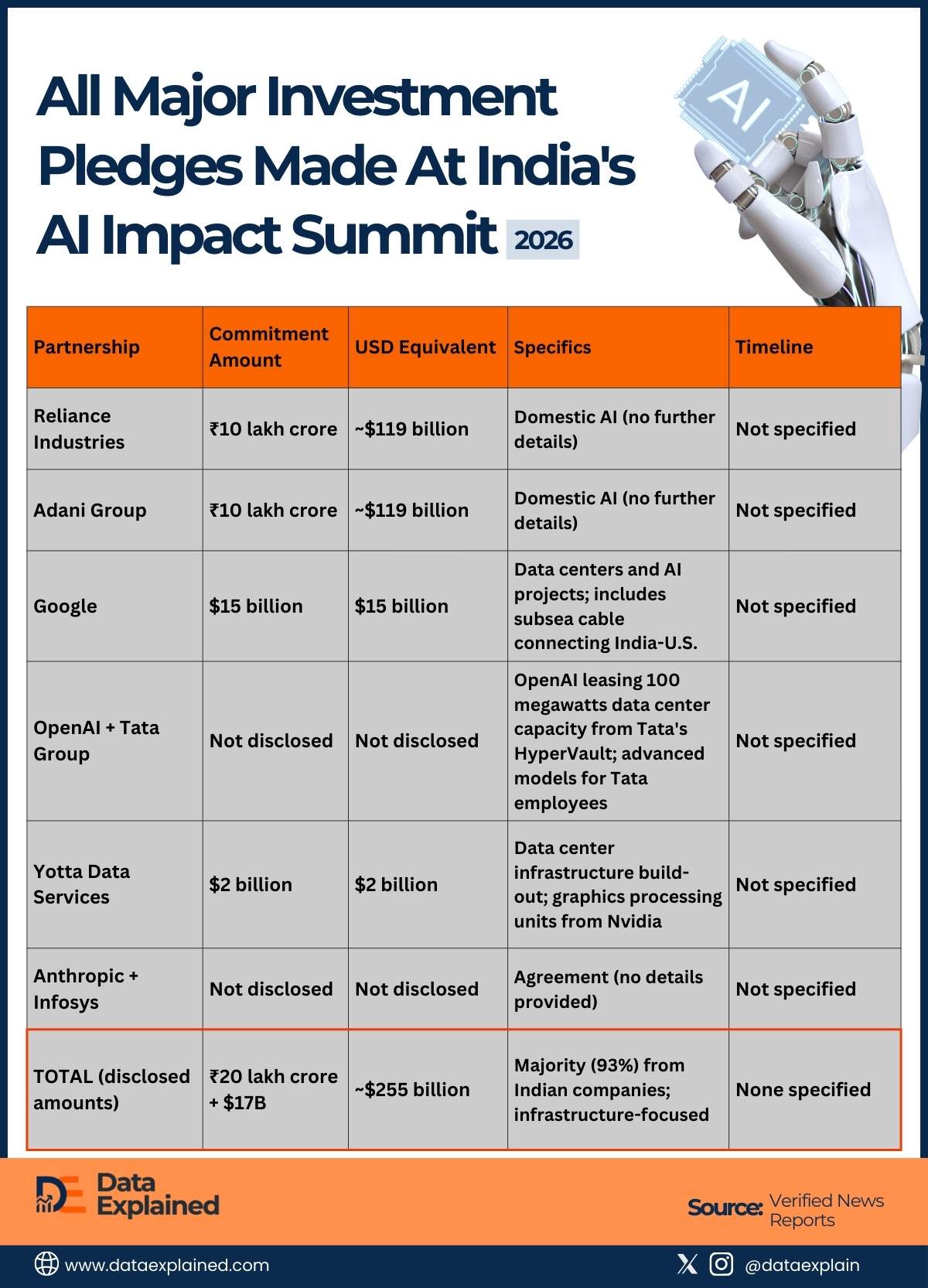
India’s AI Impact Summit concluded Saturday with approximately $255 billion in investment commitments.
About 88 countries and international organizations signed the New Delhi Declaration on AI, stressing that artificial intelligence must be democratized to make a global difference.
But the summit’s most striking feature wasn’t the massive dollar figures. It was what those figures didn’t say.
The graphic above, based on a report on the one-week event, shows the major investment commitments made during the summit.
TL;DR
- Indian firms pledged $238B (93% of total) versus $17B from foreign companies, yet provided zero timelines or specifics.
- All deals focus on infrastructure (data centers, subsea cables, power capacity) rather than AI innovation, positioning India as a low-cost processing hub for American AI technology rather than as a creator of models.
Reliance Industries announced commitments of ₹10 lakh crore (roughly $119 billion) in domestic AI.
The Adani Group followed with a nearly identical pledge described as “only slightly more” than Reliance’s commitment.
Together, these two Indian conglomerates account for approximately $238 billion, or 93% of all disclosed commitments from the five-day summit.
Neither provided any specifics on what would actually be built, when the money would be deployed, or how progress would be measured.
| wdt_ID | wdt_created_by | wdt_created_at | wdt_last_edited_by | wdt_last_edited_at | Company/Partnership | Commitment Amount | USD Equivalent | Specifics | Timeline |
|---|---|---|---|---|---|---|---|---|---|
| 1 | emmanuel-ashemiriogwa | 23/02/2026 10:31 AM | emmanuel-ashemiriogwa | 23/02/2026 10:31 AM | Reliance Industries | ₹10 lakh crore | ~$119 billion | Domestic AI (no further details) | Not specified |
| 2 | emmanuel-ashemiriogwa | 23/02/2026 10:31 AM | emmanuel-ashemiriogwa | 23/02/2026 10:31 AM | Adani Group | ₹10 lakh crore | ~$119 billion | Domestic AI (no further details) | Not specified |
| 3 | emmanuel-ashemiriogwa | 23/02/2026 10:31 AM | emmanuel-ashemiriogwa | 23/02/2026 10:31 AM | $15 billion | $15 billion | Data centers and AI projects; includes subsea cable connecting India-U.S. | Not specified | |
| 4 | emmanuel-ashemiriogwa | 23/02/2026 10:31 AM | emmanuel-ashemiriogwa | 23/02/2026 10:31 AM | OpenAI + Tata Group | Not disclosed | Not disclosed | OpenAI leasing 100 megawatts data center capacity from Tata's HyperVault; advanced models for Tata employees | Not specified |
| 5 | emmanuel-ashemiriogwa | 23/02/2026 10:31 AM | emmanuel-ashemiriogwa | 23/02/2026 10:31 AM | Yotta Data Services | $2 billion | $2 billion | Data center infrastructure build-out; graphics processing units from Nvidia | Not specified |
| 6 | emmanuel-ashemiriogwa | 23/02/2026 10:31 AM | emmanuel-ashemiriogwa | 23/02/2026 10:31 AM | Anthropic + Infosys | Not disclosed | Not disclosed | Agreement (no details provided) | Not specified |
| 7 | emmanuel-ashemiriogwa | 23/02/2026 10:31 AM | emmanuel-ashemiriogwa | 23/02/2026 10:31 AM | TOTAL | (disclosed amounts)₹20 lakh crore + $17B | ~$255 billion | Majority (93%) from Indian companies; infrastructure-focused | None specified |
The asymmetry of capital and technology
The investment breakdown reveals an interesting pattern.
Indian companies pledged $238 billion for AI development, 14 times the $17 billion committed by foreign firms.
Yet India lacks major homegrown AI models and relies entirely on American technology from companies such as OpenAI, Google, and Anthropic.
While Reliance and Adani made sweeping commitments to “domestic AI” without elaboration, foreign firms announced smaller but highly specific infrastructure deals.
Google detailed its existing $15 billion investment in data centers and AI projects in India, including a subsea cable system that would directly connect India and the United States.
The company emphasized this wasn’t a new commitment but a clarification of ongoing investments.
Yotta Data Services, a domestic data center operator, announced a $2 billion infrastructure build-out, specifically mentioning Nvidia graphics processing units, the American chipmaker that dominates AI hardware globally.
Partnership pattern emerges
High-profile partnerships between American AI labs and Indian conglomerates followed a clear template, too.
- OpenAI announced it would lease 100 megawatts of data center capacity from Tata Group’s HyperVault facility and provide advanced AI models to the firm’s employees.
- Anthropic, maker of the Claude AI assistant, announced an agreement with Infosys, though no details about the partnership’s scope or value were provided.
The timeline problem
Perhaps the most significant omission across all announcements was the absence of timelines.
Is Reliance’s ₹10 lakh crore commitment planned for deployment over one year? Five years? Twenty years?
Without specified timeframes, these impressive figures become aspirational targets rather than binding commitments, with no mechanism to track whether promised investments actually materialize.
The lack of timelines also makes comparison difficult.
A $2 billion commitment over two years carries far more weight than a $119 billion pledge spread across three decades.
Infrastructure, not innovation
The specific deals announced at the summit reveal where money is actually flowing:
- Data centers
- Subsea cables
- Processing capacity.
Google’s subsea cable connecting India directly to the United States isn’t designed primarily to serve the Indian market.
It’s infrastructure to use India as a low-cost processing center for American AI operations, where data can cross the ocean, get processed more cheaply, and return via private cable.
OpenAI’s focus on securing 100 megawatts of power capacity highlights the real constraint on AI development: energy.
India’s advantage isn’t capital or technical talent (it’s cheap electricity and cooling capacity for energy-hungry AI systems.
Yotta’s specific mention of Nvidia GPUs underscores another reality: India’s massive AI infrastructure will run almost entirely on American silicon.
No alternative chip makers were mentioned. NVIDIA’s monopoly in AI hardware remains unchallenged.
What democratization means
The New Delhi Declaration’s emphasis on democratizing AI creates an uncomfortable tension with the investment data.
Indian companies are providing massive capital. American companies control the underlying technology (the models, algorithms, and chips that actually power artificial intelligence).
The partnerships announced at the summit largely involve Indian firms gaining access to American AI in exchange for providing infrastructure capacity.
Whether this represents democratization or a new form of technological dependence remains an open question.
ELI5
The summit generated impressive headlines with its total of $255 billion. But until the largest commitments gain specifics, timelines, and accountability mechanisms, they remain promises rather than plans.
The smaller, more detailed announcements from Google, OpenAI, and Yotta may ultimately prove more significant than the attention-grabbing Indian pledges that dwarf them in dollar terms but trail them in substance.
Sources: