

Gold serves as a safe-haven asset, helping protect a nation’s economy from extreme volatility and global crises.
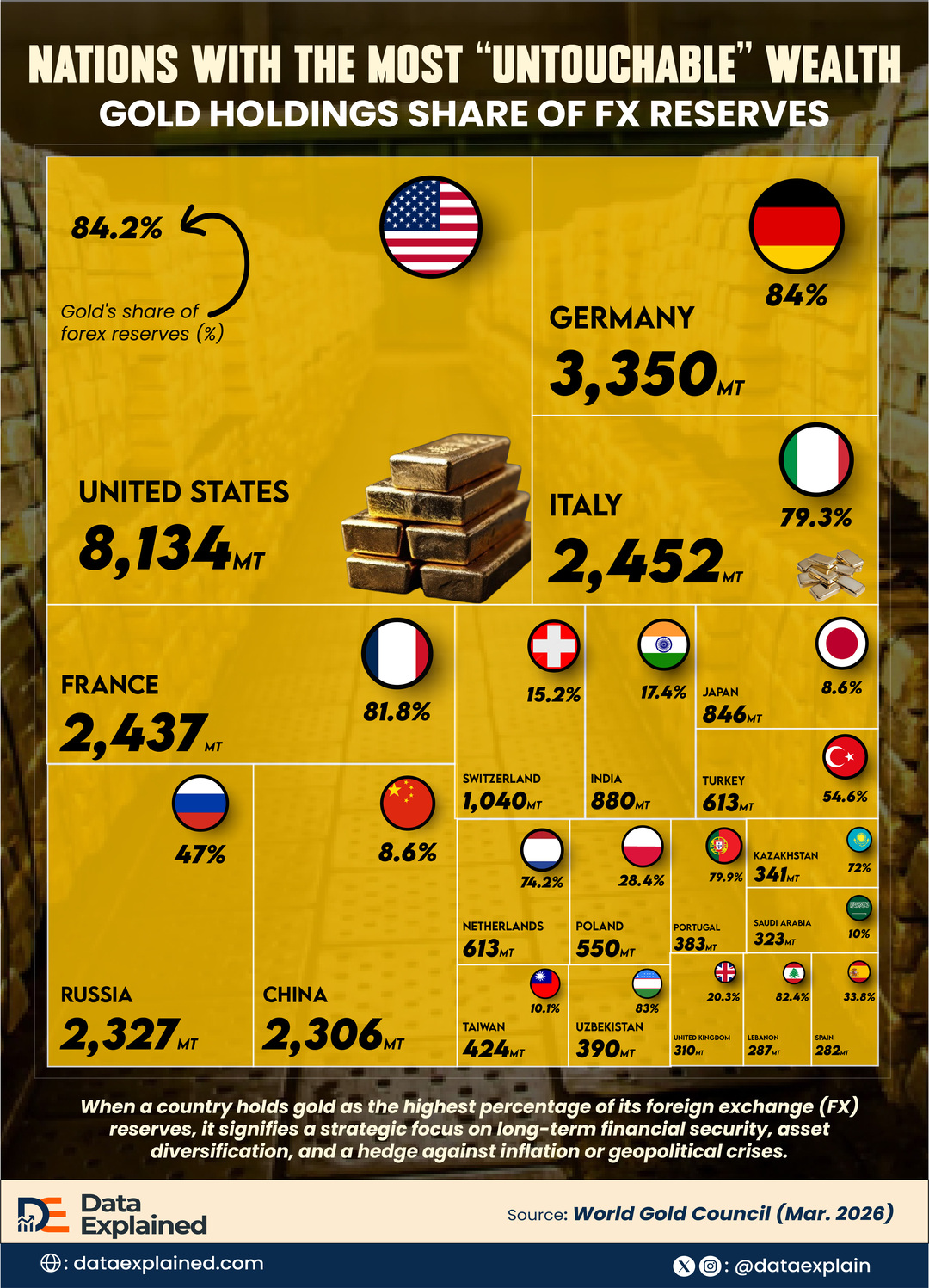
In today’s visualization, we show the top 30 countries with the most gold reserves in metric tonnes (figures rounded). But most importantly, their share of gold in foreign exchange (FX) reserves.
When a country holds gold as the highest percentage of its FX reserves, it signifies a strategic focus on long-term financial security, asset diversification, and a hedge against inflation or geopolitical crises.
This approach often indicates a lack of faith in major fiat currencies and a desire to minimize counterparty risk.
The data comes from the World Gold Council, as of March 3, 2026.
TL;DR
- The United States, with the highest holdings, holds 8,133.5 tonnes of gold. That gold accounts for 84.2% of its foreign exchange reserve base.
- Most Asian economies’ forex reserves are held largely in currencies and bonds, with gold in a minor position.
| wdt_ID | wdt_created_by | wdt_created_at | wdt_last_edited_by | wdt_last_edited_at | Rank | Country | Gold holdings (in metric tons) | Gold\'s share of forex reserves (%) |
|---|---|---|---|---|---|---|---|---|
| 1 | emmanuel-ashemiriogwa | 24/03/2026 10:51 AM | emmanuel-ashemiriogwa | 24/03/2026 10:51 AM | 1 | United States | 8,133.50 | 84.20 |
| 2 | emmanuel-ashemiriogwa | 24/03/2026 10:51 AM | emmanuel-ashemiriogwa | 24/03/2026 10:51 AM | 2 | Germany | 3,350.30 | 84.00 |
| 3 | emmanuel-ashemiriogwa | 24/03/2026 10:51 AM | emmanuel-ashemiriogwa | 24/03/2026 10:51 AM | 3 | Italy | 2,451.80 | 79.30 |
| 4 | emmanuel-ashemiriogwa | 24/03/2026 10:51 AM | emmanuel-ashemiriogwa | 24/03/2026 10:51 AM | 4 | France | 2,437.00 | 81.80 |
| 5 | emmanuel-ashemiriogwa | 24/03/2026 10:51 AM | emmanuel-ashemiriogwa | 24/03/2026 10:51 AM | 5 | Russia | 2,326.50 | 47.00 |
| 6 | emmanuel-ashemiriogwa | 24/03/2026 10:51 AM | emmanuel-ashemiriogwa | 24/03/2026 10:51 AM | 6 | China | 2,306.30 | 8.60 |
| 7 | emmanuel-ashemiriogwa | 24/03/2026 10:51 AM | emmanuel-ashemiriogwa | 24/03/2026 10:51 AM | 7 | Switzerland | 1,039.90 | 15.20 |
| 8 | emmanuel-ashemiriogwa | 24/03/2026 10:51 AM | emmanuel-ashemiriogwa | 24/03/2026 10:51 AM | 8 | India | 880.10 | 17.40 |
| 9 | emmanuel-ashemiriogwa | 24/03/2026 10:51 AM | emmanuel-ashemiriogwa | 24/03/2026 10:51 AM | 9 | Japan | 845.90 | 8.60 |
| 10 | emmanuel-ashemiriogwa | 24/03/2026 10:51 AM | emmanuel-ashemiriogwa | 24/03/2026 10:51 AM | 10 | Turkey | 613.10 | 54.60 |
As you see in the table above, some countries structured their entire financial safety net around gold. Others have placed their trust almost entirely in the dollar-based financial system instead.
The tonnage giants
At 8,133.5 tonnes, the United States holds more gold. Germany holds 3,350.3 tonnes, Italy 2,451.8, and France 2,437.0, totalling 8,239.1 tonnes.
The margin is razor-thin, but the American lead is real and has been for decades.
That concentration of gold in the United States and Western Europe is not the result of a recent strategy. It is history made physical.
These countries accumulated gold during the Bretton Woods era of the 1940s through 1970s, when the global monetary system ran on a fixed exchange rate tied to the U.S. dollar, which was itself tied to gold.
When that system collapsed in 1971, they kept what they had. Germany, Italy, France, the Netherlands, and Portugal all hold gold at above 74% of their total forex reserves today.
Asia’s paper bet
The contrast with Asia is striking.
- China, ranked sixth globally with 2,306.3 tonnes, holds gold at just 8.6% of its forex reserves.
- Japan, ranked ninth with 845.9 tonnes, also sits at 8.6%.
- South Korea, 38th with 104.4 tonnes, is at 3.3%.
- Singapore holds 193.5 tonnes—6.2% of reserves.
- The UAE, one of the world’s most active gold-trading hubs and home to the Dubai Gold Souk, holds 74.5 tonnes, accounting for just 4.1%.
These are economies that built their post-war wealth through exports, dollar earnings, and financial instruments rather than hard asset accumulation.
Their forex reserves are largely held in currencies and bonds, with gold as a minor position.
That strategy delivered extraordinary growth.
It also created a structural exposure: every dollar-denominated asset they hold is, in theory, subject to sanctions that could make it inaccessible.
When the G7 froze approximately $300 billion in Russian foreign reserves in 2022, the lesson was not lost on countries holding large dollar-denominated positions.
Gold, by contrast, cannot be frozen by a foreign government. It carries no counterparty risk. It cannot be blocked by a sanctions order.
Outliers that demand attention
Uzbekistan ranks 14th globally, with 390.3 tonnes of gold, accounting for 83% of its total foreign exchange reserves.
That is more gold, in absolute terms, than the United Kingdom (310.3 tonnes) and, as a share of reserves, more than any G7 nation except the United States.
Uzbekistan is not a G20 member. It is not a major global financial centre. It is a Central Asian nation of approximately 36 million people that has made a deliberate, structural decision to hold physical assets over paper ones.
- Belarus, ranked 50th with 53.8 tonnes, holds 49.3% of its forex in gold.
- Kazakhstan holds 341.0 tonnes at 72%. Russia holds 2,326.5 tonnes at 47%.
These are countries operating under Western sanctions or in their immediate orbit.
The pattern is consistent: isolation from Western financial systems pushes reserve strategy toward assets that cannot be weaponised from outside.
The producer who keeps nothing
Perhaps the most quietly ironic entry in the dataset is Australia.
The World Gold Council data places Australia 41st globally, with 79.8 tonnes of gold representing 15.3% of forex reserves.
Australia is the world’s second-largest gold producer, extracting hundreds of tonnes annually from mines in Western Australia and Queensland.
It supplies the world’s bullion and keeps almost none of it for itself.
It’s actually a policy that reflects a long-standing national decision to treat gold as an export commodity rather than a strategic reserve asset.
ELI5
Today’s visualization shows two metrics.
- First, raw gold reserves are listed by tonnage by country, which shows who has accumulated the most.
- Second, the ratio tells you who trusts gold, and by extension, who has doubts about the system that gold sits outside of.
By that measure, the world is split along a fault line that runs roughly between post-Bretton Woods Western economies with deep gold foundations and post-war export-driven Asian and Gulf economies that built their reserves in dollars and bonds.
As of March 24, 2026, gold is trading above $4,000 per ounce; global central bank buying has hit record levels for three consecutive years, according to the World Gold Council; and the question of whether the second group made the right bet is no longer rhetorical.
Sources: