

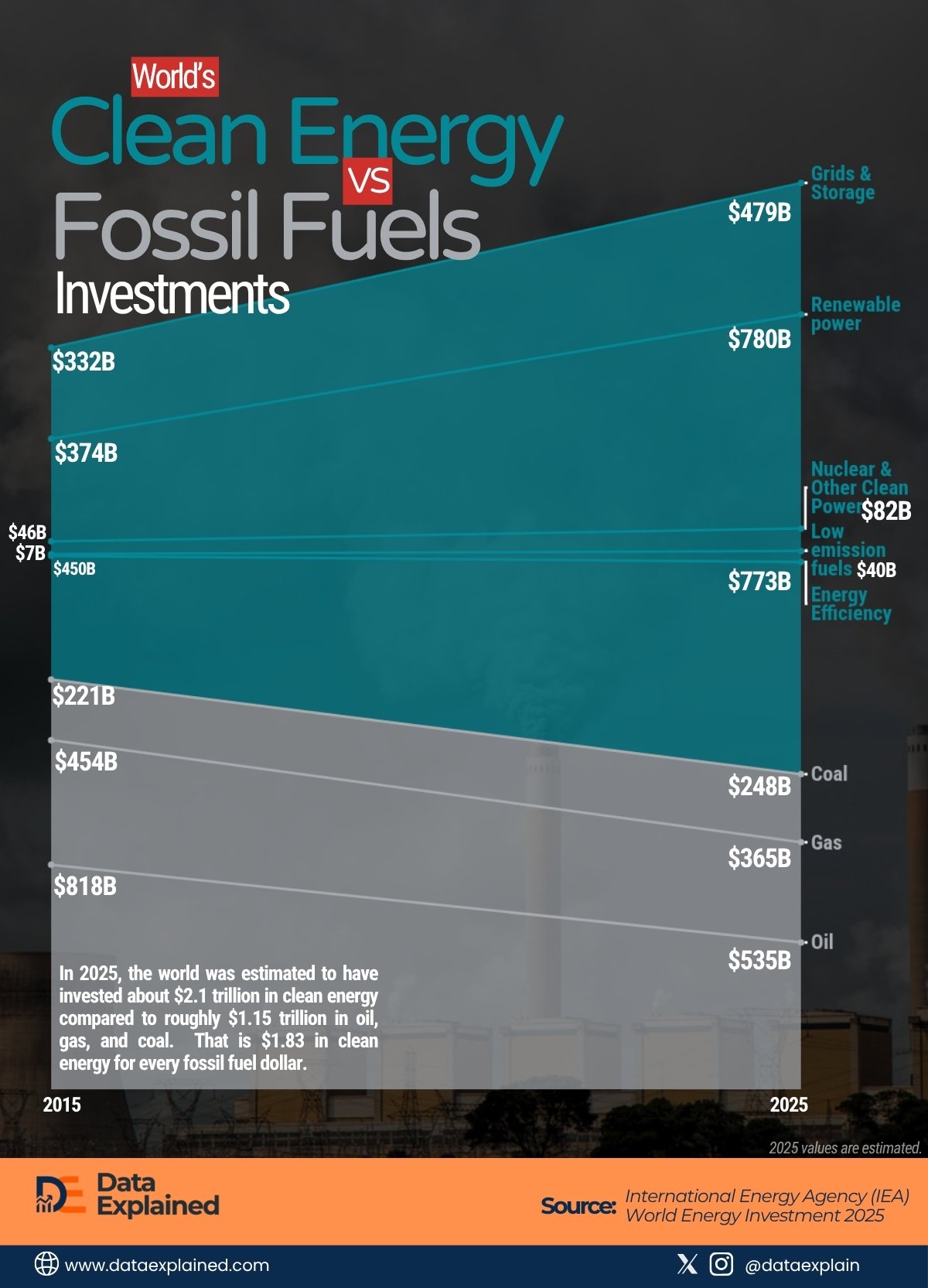
In 2015, global fossil fuel investment stood at around $820 billion, comfortably ahead of clean energy at about $500 billion. That translates to roughly 61 cents invested in clean energy for every $1 going into fossil fuels.
Fast forward to 2025, and that ratio has flipped to $1.83 in clean energy for every fossil fuel dollar.
In other words, the world currently invests about $2.1 trillion in clean energy compared to roughly $1.15 trillion in oil, gas, and coal.
Today’s visualization and explainer are based on data from the International Energy Agency (IEA).
TL;DR
- Clean energy investment flipped from $0.61 per $1 fossil (2015) to $1.83 per $1 (2025)
- The world is now spending a record $3.25 trillion yearly on global energy systems.
| wdt_ID | wdt_created_by | wdt_created_at | wdt_last_edited_by | wdt_last_edited_at | Year | 2015 ($bn) | 2025 ($bn) |
|---|---|---|---|---|---|---|---|
| 1 | emmanuel-ashemiriogwa | 02/04/2026 12:28 PM | emmanuel-ashemiriogwa | 02/04/2026 12:28 PM | Oil | 818 | 535 |
| 2 | emmanuel-ashemiriogwa | 02/04/2026 12:28 PM | emmanuel-ashemiriogwa | 02/04/2026 12:28 PM | Gas | 454 | 365 |
| 3 | emmanuel-ashemiriogwa | 02/04/2026 12:28 PM | emmanuel-ashemiriogwa | 02/04/2026 12:28 PM | Coal | 221 | 248 |
| 4 | emmanuel-ashemiriogwa | 02/04/2026 12:28 PM | emmanuel-ashemiriogwa | 02/04/2026 12:28 PM | Energy Efficiency | 450 | 773 |
| 5 | emmanuel-ashemiriogwa | 02/04/2026 12:28 PM | emmanuel-ashemiriogwa | 02/04/2026 12:28 PM | Low emission fuels | 7 | 40 |
| 6 | emmanuel-ashemiriogwa | 02/04/2026 12:28 PM | emmanuel-ashemiriogwa | 02/04/2026 12:28 PM | Nuclear & Other Clean Power | 46 | 82 |
| 7 | emmanuel-ashemiriogwa | 02/04/2026 12:28 PM | emmanuel-ashemiriogwa | 02/04/2026 12:28 PM | Renewable power | 374 | 780 |
| 8 | emmanuel-ashemiriogwa | 02/04/2026 12:28 PM | emmanuel-ashemiriogwa | 02/04/2026 12:28 PM | Grids & Storage | 332 | 479 |
What’s Happening to Fossil Fuel Investments?
Fossil fuel investment has not collapsed. In fact, it has grown in absolute terms, rising from about $820 billion in 2015 to approximately $1.15 trillion in 2025.
What has changed is the pace of growth.
Clean energy investment has expanded far more rapidly, effectively outpacing fossil fuels rather than displacing them.
This means the global economy is now funding two energy systems at once.
On one hand, it continues to invest heavily in oil and gas to sustain current energy demand. On the other, it is pouring record amounts into building a cleaner system.
Combined, total energy investment reached roughly $3.25 trillion in 2025, the highest level ever recorded.
What’s Driving the Investment?
Russia’s invasion of Ukraine in 2022 forced Europe to accelerate efforts toward energy independence.
In the United States, the Inflation Reduction Act unlocked around $370 billion in clean energy incentives, driving private and public investment.
At the same time, China ramped up its already aggressive push into renewables as part of its plan to peak carbon emissions by 2030.
Within clean energy itself, the composition of spending is also changing.
Renewable power (primarily solar and wind) has emerged as the largest and fastest-growing segment since around 2020. It has overtaken energy efficiency, which had long been the biggest category.
But building more solar panels and wind farms is only part of the story.
A growing share of investment is now going into electricity grids and storage, visible as an expanding layer in recent years.
China at the Center of this Shift
In January 2026, the State Grid Corporation of China announced plans to invest 4 trillion yuan, or about $574 billion, into grid infrastructure between 2026 and 2030.
That is a 40% increase from its previous five-year spending plan.
The scale is enormous. Spread over five years, it represents a substantial share of current global annual grid investment.
The bottleneck in the clean energy transition is no longer just generation capacity. It is the ability to move electricity from where it is produced to where it is needed.
Without sufficient grid expansion, new renewable capacity risks becoming stranded.
Where the Money Comes From
Government incentives, falling technology costs, and shifting capital from institutional investors have all contributed to the surge in clean energy funding.
The IEA data shows where the money is going, even if it does not fully capture the sources behind it.
Looking ahead, the trajectory suggests the gap between clean energy and fossil fuel investment will continue to widen.
Major policy frameworks in the United States, Europe, and China are multi-year commitments already in motion.
China’s massive grid investment plan alone signals that the next phase of the transition will be defined not just by generating clean energy, but by building the infrastructure to support it.
ELI5
Global energy investment has flipped over the past decade. In 2015, fossil fuels dominated spending, but by 2025, clean energy took the lead at about $2.1 trillion versus $1.15 trillion for fossil fuels, according to IEA data. That’s $1.83 invested in clean energy for every $1 in fossil fuels. But the shift isn’t replacing fossil fuels; it’s adding on top of them. The world is now funding two energy systems at once, pushing total energy investment to a record $3.25 trillion.
Sources:
International Energy Agency (IEA).