

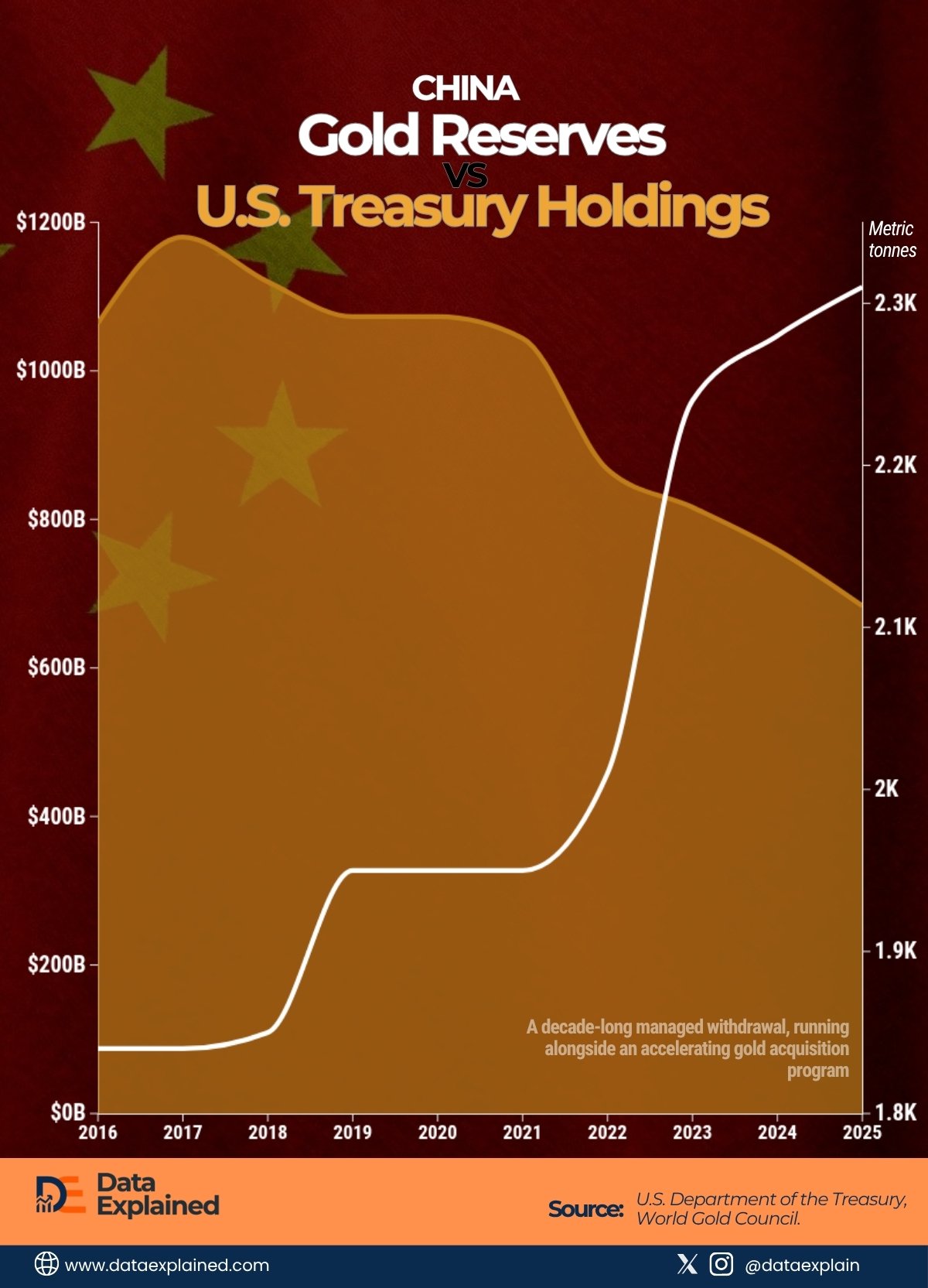
China held $1.32 trillion in U.S. government debt at its peak in 2013. It now holds $682.6 billion, the lowest figure in over a decade.
In the same period, its gold reserves have climbed from roughly 1,054 tonnes to 2,309 tonnes, a stockpile now valued at approximately $388 billion.
That is 57 cents worth of gold for every dollar of the U.S. Treasuries Beijing still holds. A decade ago, that ratio was closer to 10 cents.
Today’s visualization shows a 10-year trend of China’s gold reserves versus its Treasury holdings.
We gathered the data from the U.S. Department of the Treasury and the World Gold Council.
TL;DR
- China still holds $683.9 billion in U.S. Treasuries as of December 2025, making it the second-largest foreign creditor to the United States after Japan. But nearly $500 billion of its peak exposure has been quietly unwound over 12 years.
| wdt_ID | wdt_created_by | wdt_created_at | wdt_last_edited_by | wdt_last_edited_at | Year | Gold Reserves (Thousand tonnes) | U.S. Treasury Holdings ($ billion) |
|---|---|---|---|---|---|---|---|
| 1 | emmanuel-ashemiriogwa | 23/03/2026 12:40 AM | emmanuel-ashemiriogwa | 23/03/2026 12:40 AM | 2016 | 1.84 | 1,064.00 |
| 2 | emmanuel-ashemiriogwa | 23/03/2026 12:40 AM | emmanuel-ashemiriogwa | 23/03/2026 12:40 AM | 2017 | 1.84 | 1,180.00 |
| 3 | emmanuel-ashemiriogwa | 23/03/2026 12:40 AM | emmanuel-ashemiriogwa | 23/03/2026 12:40 AM | 2018 | 1.85 | 1,120.00 |
| 4 | emmanuel-ashemiriogwa | 23/03/2026 12:40 AM | emmanuel-ashemiriogwa | 23/03/2026 12:40 AM | 2019 | 1.95 | 1,073.00 |
| 5 | emmanuel-ashemiriogwa | 23/03/2026 12:40 AM | emmanuel-ashemiriogwa | 23/03/2026 12:40 AM | 2020 | 1.95 | 1,073.00 |
| 6 | emmanuel-ashemiriogwa | 23/03/2026 12:40 AM | emmanuel-ashemiriogwa | 23/03/2026 12:40 AM | 2021 | 1.95 | 1,044.00 |
| 7 | emmanuel-ashemiriogwa | 23/03/2026 12:40 AM | emmanuel-ashemiriogwa | 23/03/2026 12:40 AM | 2022 | 2.01 | 867.10 |
| 8 | emmanuel-ashemiriogwa | 23/03/2026 12:40 AM | emmanuel-ashemiriogwa | 23/03/2026 12:40 AM | 2023 | 2.24 | 816.30 |
| 9 | emmanuel-ashemiriogwa | 23/03/2026 12:40 AM | emmanuel-ashemiriogwa | 23/03/2026 12:40 AM | 2024 | 2.28 | 759.00 |
| 10 | emmanuel-ashemiriogwa | 23/03/2026 12:40 AM | emmanuel-ashemiriogwa | 23/03/2026 12:40 AM | 2025 | 2.31 | 683.50 |
A slow exit that started before anyone was watching
According to Treasury data, Beijing’s holdings peaked around 2013-2014, hovered near $1.18 trillion through 2016 and 2017, then entered a gradual but consistent decline.
Quarter after quarter, year after year, the number moved in one direction.
Think of it like a landlord quietly reducing exposure to a single tenant over many years, lowering the lease a little each renewal cycle rather than evicting them all at once.
By the time anyone notices the pattern, half the lease is already gone.
China still holds $682.6 billion in U.S. Treasuries as of November 2025, making it the second-largest foreign creditor to the United States after Japan.
But nearly $500 billion of its peak exposure has been quietly unwound over 12 years.
2022 was the acceleration point
World Gold Council data shows that China’s gold reserves grew modestly from roughly 1,850 tonnes in 2016 to about 1,960 tonnes by 2019, then plateaued for three years.
That plateau ended abruptly in 2022, when the buying pace shifted from gradual to aggressive.
The timing matters.
In February 2022, the United States and its G7 allies froze approximately $300 billion in Russian foreign currency reserves following the invasion of Ukraine.
It was the largest weaponization of dollar-denominated assets in modern financial history.
For any central bank holding U.S. Treasuries, the message was clear: those assets could, under the right political conditions, be made inaccessible overnight.
China was watching.
Within months, its gold accumulation entered near-vertical territory on the World Gold Council chart. From roughly 1,980 tonnes in early 2022, reserves climbed to 2,309 tonnes by early 2026, an increase of more than 300 tonnes in under four years.
Since November 2024 alone, the People’s Bank of China has added 1.4 million ounces of gold, equivalent to the entire gold reserve of a country like Thailand, added in just over a year.
Buying at the top… on purpose
Gold is currently trading near record highs, above $4,000 per ounce.
China is still buying. This is unusual behavior for an investor, but rational behavior for a country trying to sanction-proof its savings.
- Gold cannot be frozen by a foreign government.
- It cannot be blocked by a sanctions order or rendered inaccessible by a geopolitical dispute.
- It pays no interest, making it a poor-yield investment, but it carries no counterparty risk, making it an effective financial bunker.
The fact that the People’s Bank of China is paying a premium for that bunker suggests the priority is protection, not profit.
The crossover calculation
At current gold prices and buying rates, China’s gold reserves, measured in dollars, could overtake its remaining U.S. Treasury holdings within 12 to 18 months.
That crossover would be largely symbolic but historically significant: the moment Beijing’s hard-asset holdings surpass its paper claims on the U.S. government for the first time in the modern era.
China is not alone in this direction.
According to World Gold Council data, Russia, India, Turkey, and Poland have all been expanding gold reserves in recent years, reflecting a broader unease among non-Western economies about the reliability of dollar-denominated assets as neutral stores of value.
What the data doesn’t show
The People’s Bank of China does not publish a forward-looking reserve strategy.
Its gold holdings are reported quarterly, with known reporting lags, meaning the actual figures may already exceed those reflected in the World Gold Council data.
The Treasury data, meanwhile, captures only direct holdings and may not fully account for Chinese debt held through third-party custodians in countries like Belgium and Luxembourg, a long-documented feature of China’s reserve management.
ELI5
Beijing has not dumped the U.S. Treasuries. A true dump would crater the value of the $682.6 billion it still holds, effectively destroying part of its own balance sheet.
What the data shows instead is a decade-long managed withdrawal, running alongside an accelerating gold acquisition program that began in earnest the moment Washington demonstrated it could freeze a rival nation’s financial assets at will.
The two data trends do not prove intent. They do not need to.
The numbers speak for themselves: half the Treasuries gone, gold reserves at an all-time high, and the gap between the two closing by the month.
Sources:
U.S. Department of the Treasury | World Gold Council