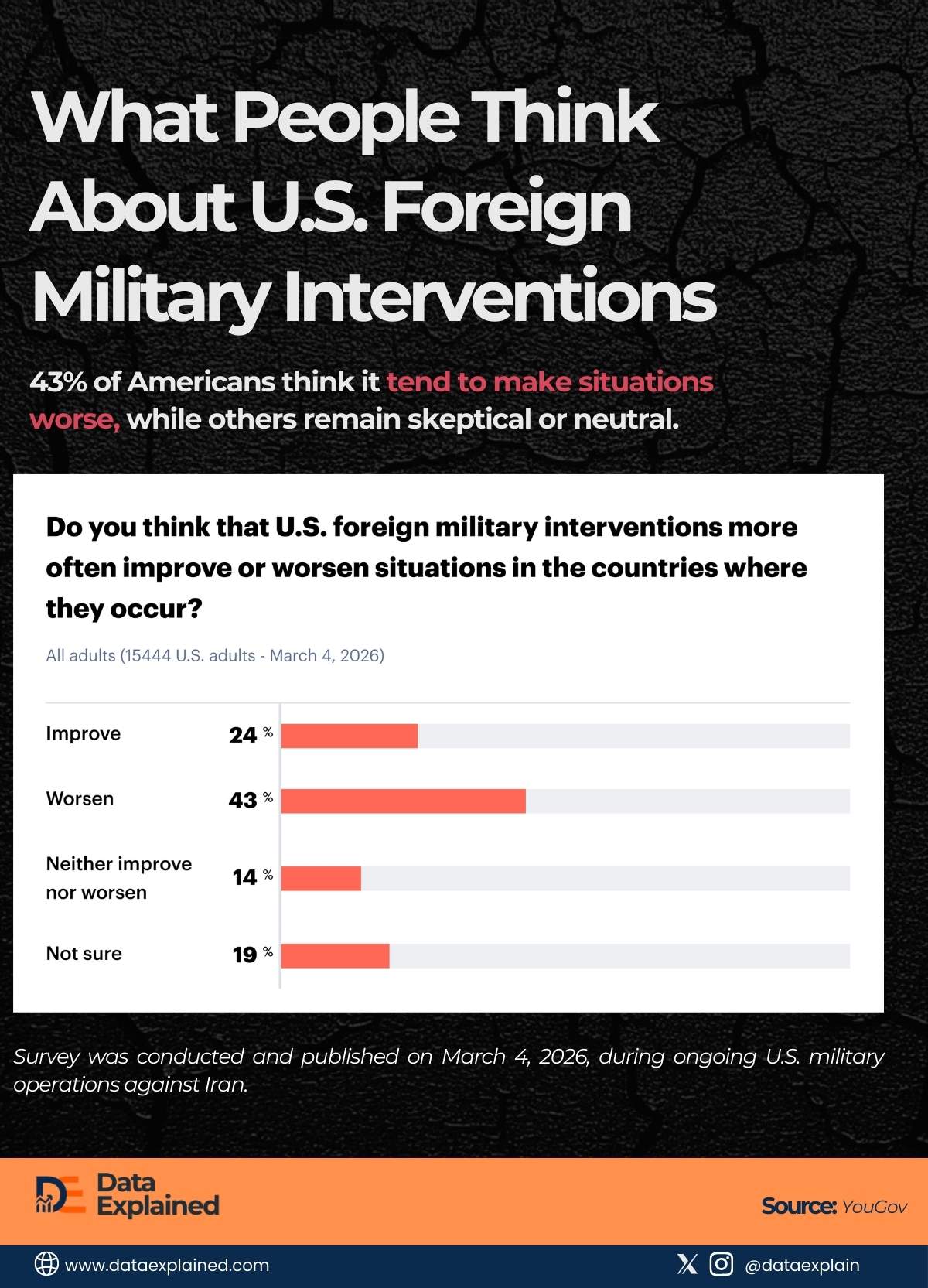
Nearly twice as many Americans believe U.S. military actions make situations worse (43%) than those who think it’s better (24%).
The data is based on a YouGov survey of 15,444 U.S. adults
It was conducted and published on March 4, 2026, during ongoing U.S. military operations against Iran.
The data show that most Americans are skeptical of these military actions.
The timing and results of this survey highlight concerns that U.S. military actions may fuel anti-American sentiment in the Global South.
TL;DR
- Approximately 43% of Americans think that U.S. military interventions tend to make situations worse, while others remain skeptical or neutral.
- This skepticism is rooted in past failures in Afghanistan, Iraq, Libya, Syria, and Yemen, which have diminished public confidence.
- The argument is that this could create diplomatic openings for China and Russia to present themselves as peaceful alternatives to Western military dominance.
| wdt_ID | wdt_created_by | wdt_created_at | wdt_last_edited_by | wdt_last_edited_at | Response | All | Democrats | Ind | Republicans |
|---|---|---|---|---|---|---|---|---|---|
| 1 | emmanuel-ashemiriogwa | 08/03/2026 10:19 PM | emmanuel-ashemiriogwa | 08/03/2026 10:19 PM | Improve | 24% | 7% | 15% | 50% |
| 2 | emmanuel-ashemiriogwa | 08/03/2026 10:19 PM | emmanuel-ashemiriogwa | 08/03/2026 10:19 PM | Worsen | 43% | 69% | 47% | 14% |
| 3 | emmanuel-ashemiriogwa | 08/03/2026 10:19 PM | emmanuel-ashemiriogwa | 08/03/2026 10:19 PM | Neither improve nor worsen | 14% | 12% | 15% | 15% |
| 4 | emmanuel-ashemiriogwa | 08/03/2026 10:19 PM | emmanuel-ashemiriogwa | 08/03/2026 10:19 PM | Not sure | 19% | 12% | 23% | 21% |
Three-Quarters Don’t Believe It Works
A significant 76% of Americans believe that U.S. military interventions either worsen situations (43%), have no impact (14%), or are uncertain about their effects (19%).
Only 24% think these interventions are helpful.
This broad skepticism reflects a crisis of trust, with the government proceeding despite considerable public doubt. Interventions often last weeks with minimal public support.
The survey reveals clear divides.
Here, 50% of Republicans see benefits, while 69% of Democrats see harm. Independents are nearly evenly split, unsure whether effects are getting worse.
The Historical Context
The 2021 U.S. withdrawal from Afghanistan remains fresh in public memory, marked by chaotic evacuations and the Taliban’s swift return to power.
The Council on Foreign Relations provides a comprehensive overview of events from the 1999 escalation to America’s withdrawal in 2021. This event, which ended America’s longest war, exposed strategic failures and diminished confidence in military interventions.
The Iraq War from 2003 to 2011 is widely regarded as a costly failure, with initial public support fading amidst revelations of deceptive reasons and ongoing instability.
It fueled anti-American sentiment worldwide and caused divisions among U.S. allies.
Interventions in Libya and Syria show no clear successes, often criticized for creating power vacuums and worsening civil conflicts.
The International Crisis Group’s report highlights how U.S. actions in Yemen have contributed to a humanitarian disaster, drawing condemnation for enabling widespread suffering.
This poor track record is reflected in the 43% of Americans who believe interventions make situations worse, indicating increasing skepticism about overseas military involvement.
Connecting to Global South Sentiment
If 43% of Americans believe that U.S. military interventions tend to worsen situations, the percentage is likely much higher among Iranians, Yemenis, and Iraqis who are directly affected by these actions.
Those living through bombings are understandably more skeptical than those overseeing or authorizing them.
This American public opinion reflects and supports longstanding criticisms from the Global South regarding U.S. overreach and interventionism.
Pew Research indicates a decline in U.S. favorability in 2025 across many countries, with Mexico experiencing drops of over 20 points, particularly amid low confidence in leadership.
In Turkey, 87% of the population lacks confidence in how the U.S. manages regional conflicts, demonstrating that interventions often increase local resentment and anti-American sentiment.
The China/Russia Opening
Due to U.S. military actions, it is open season for China and Russia to deepen their alliances within the Global South.
These nations leverage perceptions of U.S. overreach to expand their influence through economic and security ties.
Beijing and Moscow employ straightforward propaganda to gain support, emphasizing that even Americans acknowledge that interventions often fail to influence public opinion.
The Quincy Institute report observes that this message resonates, positioning China and Russia as alternatives to American dominance.
The Global South increasingly favors China’s Belt and Road Initiative over U.S. military interventions, seeking development without political conditions.
A TrT News article suggested that by damaging its soft power through interventions, the U.S. unintentionally boosts its rivals’ appeal in crucial regions.
ELI5
Many people in the United States think that when the military gets involved in other countries, it often makes things worse instead of better. About three out of four people are unsure or think it’s not good either way.
This is because in the past, countries like Afghanistan, Iraq, Libya, Syria, and Yemen had problems after the U.S. got involved, so people don’t trust that it works.
People in other parts of the world, especially in Africa, Asia, and South America, also see these actions and sometimes don’t like the U.S. for them.
Instead, they might even start believing more in countries like China and Russia than in the U.S.
Sources:
You.Gov, CFR, ICG, Pew Research, Quincy Institute, China Diplomacy, TRT World News