

Nigeria’s Dangote Petroleum Refinery has stepped up gasoline exports across Africa as disruptions to energy flows due to the Iran conflict squeeze traditional fuel supply routes.
What the map shows
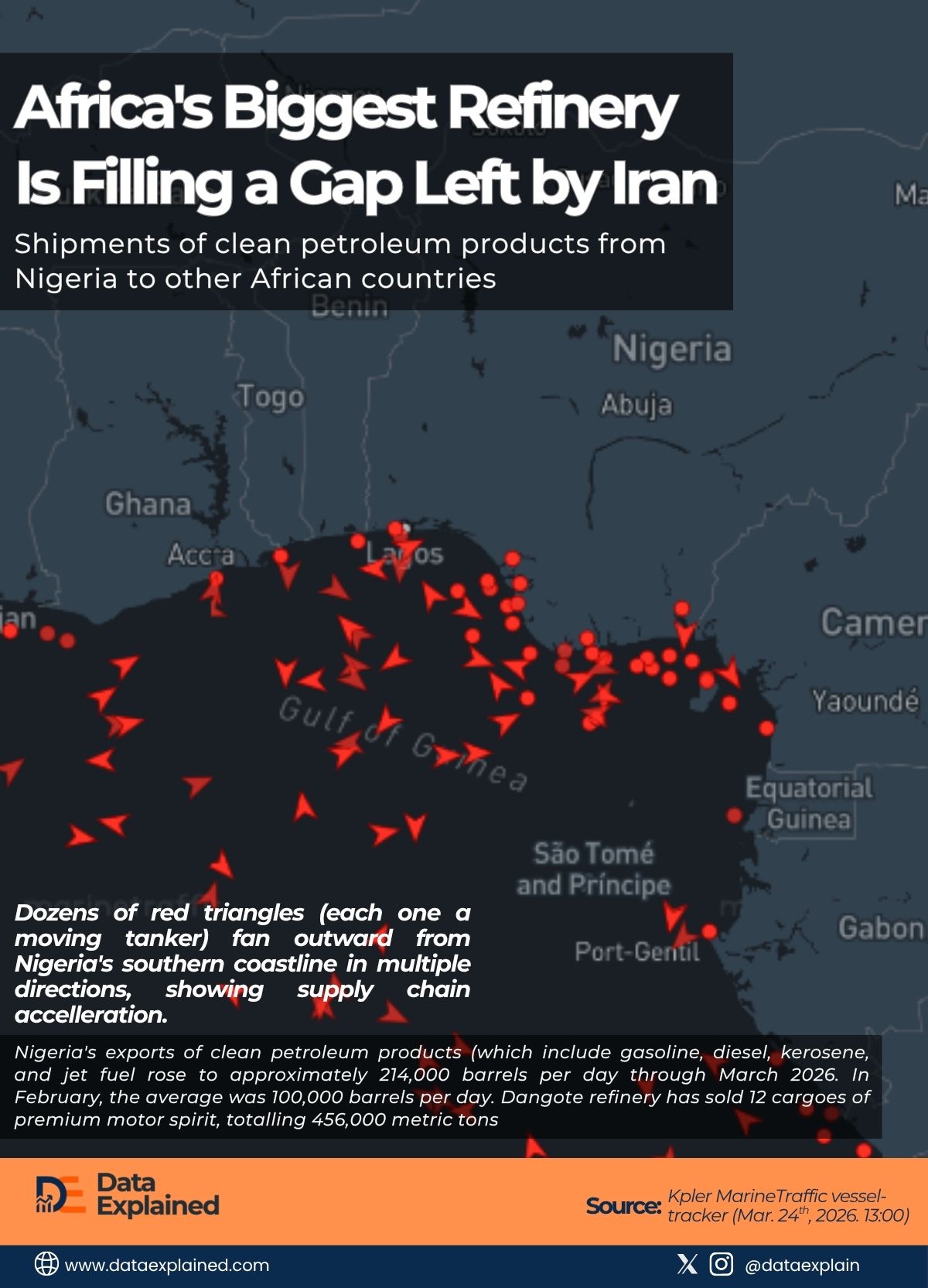
The visualization above shows a real-time MarineTraffic vessel-tracking map of the Gulf of Guinea as of March 24, 2026.
As you see, dozens of red triangles (each one a moving tanker) fan outward from Nigeria’s southern coastline in multiple directions:
- West toward Ghana, Cote d’Ivoire, and Togo.
- East toward Cameroon and Equatorial Guinea.
- South toward São Tomé and Príncipe and into Gabonese waters, where vessels typically anchor before redistributing cargo deeper into sub-Saharan Africa.
Scattered among the moving vessels are stationary red dots (ships anchored offshore, awaiting berth clearance near the Lekki peninsula, east of Lagos).
The map shows a supply chain accelerating.
The numbers behind the map
According to tanker-tracking firm Kpler, Nigeria’s exports of clean petroleum products (which include gasoline, diesel, kerosene, and jet fuel rose to approximately 214,000 barrels per day through March 2026.
In February, the average was 100,000 barrels per day. That is a 114% increase in 30 days.
Shipments from Nigeria to other African countries climbed from 38,000 barrels per day in February to approximately 90,000 barrels per day in March (a 137% jump in a single month).
Five countries have already received confirmed Dangote cargoes: Cote d’Ivoire, Cameroon, Tanzania, Ghana, and Togo. This is according to a confirmed source familiar with the deals who spoke to Reuters.
The refinery has sold 12 cargoes of premium motor spirit totalling 456,000 metric tons to international traders on a free-on-board basis, meaning the traders collect the fuel at the Lekki terminal and handle distribution themselves.
The refinery behind those numbers is the largest on the African continent.
With a nameplate capacity of 650,000 barrels per day, the Dangote facility at Lekki is larger than the refining capacity of most African nations.
What opened the door?
The timing of the export surge is not coincidental.
Disruptions to energy flows linked to the Iran conflict have squeezed the traditional fuel supply routes that West African markets have depended on for generations.
Refined petroleum from the Middle East and from European refineries in Rotterdam and the Mediterranean has historically dominated fuel imports into countries like Ghana, Togo, and Cote d’Ivoire, often undercutting locally produced alternatives on price.
That price advantage has narrowed sharply as the situation in Iran disrupts established supply chains. The gap those disruptions created is the gap the MarineTraffic map shows Dangote filling in real time.
Reading the map more carefully
The MarineTraffic map in today’s visualization captures two distinct types of vessel activity.
- The red triangles moving outward from the Nigerian coast are loaded tankers in transit (the export volumes Kpler is counting).
- The stationary red dots clustered in the offshore anchorage zone near Lagos represent a different story: vessels waiting for berth space at the Lekki terminal.
Port congestion at Lekki is a known operational constraint for the refinery.
When export demand accelerates faster than port throughput capacity can handle, vessels queue offshore.
The density of stationary markers on the map at the time of reporting suggests that terminal capacity, not product availability, may currently be the binding limit on how fast Dangote can move fuel.
If that constraint eases through infrastructure upgrades or improved berth scheduling, the export ceiling rises further.
There’s a catch, though
Africa has long faced a paradox at the centre of its energy economy.
The continent holds significant crude oil reserves (Nigeria alone produces over 1.5 million barrels per day), yet it has historically imported most of its refined fuel from Europe, Asia, and the Middle East.
The infrastructure to turn its own crude into usable fuel has been chronically underdeveloped, leaving African consumers exposed to international price swings and supply disruptions originating thousands of kilometres away.
Dangote was designed specifically to break that dependency.
The catch is the Iran factor.
The supply disruption that handed Dangote this opening is geopolitical and therefore temporary.
If the situation in Iran stabilises, traditional fuel flows from the Middle East and Europe resume, and the price advantage currently directing African buyers toward Lekki-refined product narrows again.
Cheap imports have historically been the ceiling on African refining ambition. That ceiling has not been removed. It has been temporarily raised.
Sources: