

Methane is a greenhouse gas that traps heat in the atmosphere, thereby warming the planet. Its effects touch everyday life: hotter summers, extreme storms, and even changes in food and water supply.
Environmentalists fear that recent progress in curbing emissions of the planet-warming gas is now in jeopardy.
Trump’s “big, beautiful bill” delayed the fee imposed on methane emissions by Biden’s Inflation Reduction Act by 10 years until 2034.
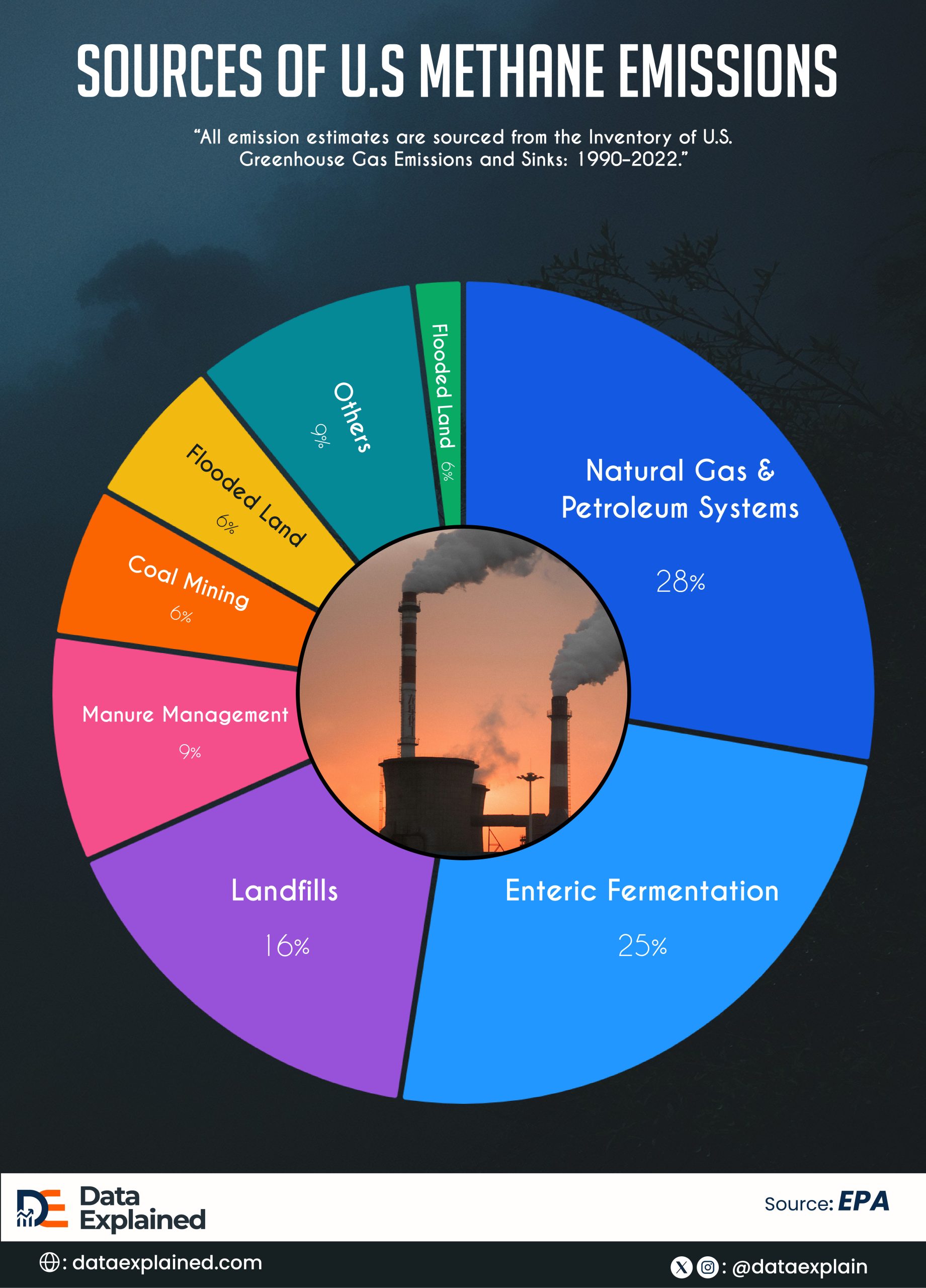
This visualization shows the top sources of methane emissions in the United States, based on data from the US Environmental Protection Agency (EPA).
TL;DR
- Methane emissions account for about 12% of total U.S. greenhouse gas emissions.
- Over the years, emissions from the energy, waste, and coal sectors have declined, while agricultural emissions, such as enteric fermentation and manure management, have increased.
- Overall, U.S. methane emissions have fallen by 19% between 1990 and 2022
U.S. Methane Emissions by Source
wdt_ID wdt_created_by wdt_created_at wdt_last_edited_by wdt_last_edited_at Source Percentage
1
Monica Ebunoluwa
03/02/2026 03:27 PM
Monica Ebunoluwa
03/02/2026 03:27 PM
Natural Gas and Petroleum Systems
28
2
Monica Ebunoluwa
03/02/2026 03:27 PM
Monica Ebunoluwa
03/02/2026 03:27 PM
Enteric Fermentation
25
3
Monica Ebunoluwa
03/02/2026 03:27 PM
Monica Ebunoluwa
03/02/2026 03:27 PM
Landfills
16
4
Monica Ebunoluwa
03/02/2026 03:27 PM
Monica Ebunoluwa
03/02/2026 03:27 PM
Manure Management
9
5
Monica Ebunoluwa
03/02/2026 03:27 PM
Monica Ebunoluwa
03/02/2026 03:27 PM
Coal Mining
6
6
Monica Ebunoluwa
03/02/2026 03:27 PM
Monica Ebunoluwa
03/02/2026 03:27 PM
Flooded Land
6
7
Monica Ebunoluwa
03/02/2026 03:27 PM
Monica Ebunoluwa
03/02/2026 03:27 PM
Other
9
8
Monica Ebunoluwa
03/02/2026 03:27 PM
Monica Ebunoluwa
03/02/2026 03:27 PM
Other (LULUCF)
2
According to the Inventory of U.S. Greenhouse Gas Emissions and Sinks, methane accounted for 12% of U.S. greenhouse gas emissions in 2022, including emissions linked to land-use changes.
Methane may not linger in the atmosphere as long as carbon dioxide, but it is far more potent at trapping heat.
Over 100 years, methane warms the planet almost 80 times more than CO₂. Because of this strength, even minor releases can make a big difference, which is why it is essential to understand its origins.
How Petroleum Systems Emit the Most Methane
The largest share in the U.S. comes from natural gas and petroleum systems.
Methane escapes at several stages – during drilling, processing, storage, and even through pipelines that carry gas across the country.
Each part of this system creates opportunities for leaks, making energy production a major driver of methane emissions.
Agriculture also plays a significant role. Animals such as cows produce methane naturally during digestion, a process known as enteric fermentation.
With millions of livestock nationwide, these small individual emissions add up quickly.
Manure management also contributes to this, as stored animal waste releases methane as it decomposes.
How Has It Been In The Last 10 Years?
According to the Inventory of the U.S. Greenhouse Gas Emissions and Sinks, total methane emissions fell by 19% between 1990 and 2022.
Over this period, emissions declined in key industrial and waste sectors, including:
- Natural gas and petroleum systems (declined by 28%)
- Landfills (declined by 16%)
- Coal mining (declined by 6%)
Meanwhile, emissions increased from agricultural sources, including enteric fermentation (25%) and manure management (9%).
Much of the progress in industrial reductions is linked to targeted policies and regulations.
Under the Clean Air Act, the U.S. Environmental Protection Agency finalized rules requiring stricter methane leak detection and repair standards, as well as limits on venting and flaring from oil and gas operations.
These rules are expected to reduce methane from energy systems over the coming decade.
In addition, federal support through the Methane Emissions Reduction Program has expanded access to monitoring and mitigation technologies, particularly for smaller operators that struggle with high compliance costs.
So, What?
The way methane emissions have shifted over time has important implications for how the United States tackles climate change.
Because sectors like energy and waste historically contributed large shares of methane, they also offer some of the most cost-effective opportunities for reductions.
Cutting methane leaks from oil and gas systems, improving landfill gas capture, and reducing emissions from coal mines are all areas where available technologies and regulatory policies can deliver relatively fast climate benefits.
Recent federal investment builds on decades of coordinated action and is expected to deepen reductions in the coming years.
For example, EPA and DOE announced roughly $850 million for projects to reduce and measure methane emissions across the oil and gas sector.
This bolsters efforts that could cut methane by up to 80% compared to projected levels without new rules.
At the same time, agriculture remains a harder-to-abate source of methane. Enteric fermentation and manure management are tied to biological processes in livestock, and emissions from these activities have grown even as industrial and waste emissions have declined.
This means that strategies focused solely on energy and waste won’t be enough to reach deep methane cuts.
Agricultural solutions, such as improved manure handling, dietary changes for livestock, and methane capture technologies, will be critical components of a comprehensive mitigation plan.
ELI5: Methane in the U.S.
Think of methane as a super-strong blanket around the Earth. Even though it accounts for only about 12% of U.S. greenhouse gas emissions, it traps much more heat than CO₂ over the same period, making it especially powerful.
Over the years, various activities have contributed to atmospheric methane levels. The biggest contributors are natural gas and petroleum systems, enteric fermentation from livestock, landfills, and manure management.
U.S. methane emissions have fallen by about 19% between 1990 and 2022. While some areas have seen real progress, others still need attention to curb methane’s full impact on our climate.
Sources:
EPA | Financial Times |