

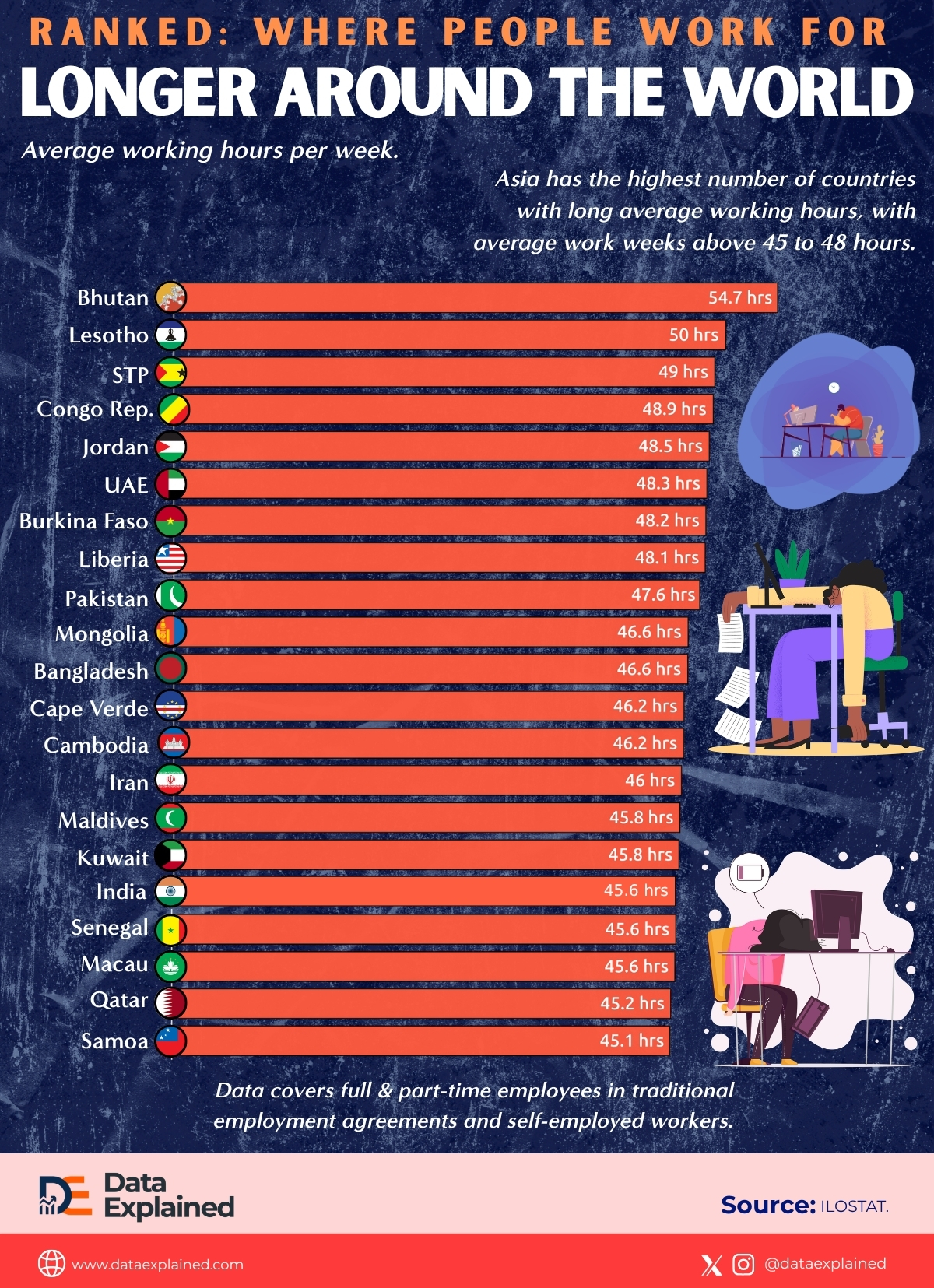
Countries with high dependence on labour-intensive jobs often have long work hours.
In today’s visualization, we show the hardest-working countries around the world, based on average weekly working hours.
On the surface, Asian countries work the longest hours.
TL;DR
- The average weekly working hours in Bhutan are 54.68, making it the highest globally.
- Shorter work hours are found in well-developed countries with automation and high work efficiency, because they offer part-time and flexible jobs.
The insights of this article are obtained from ILOSTAT via World Population Review’s presentation.
The International Labour Organization (ILO) projected 2025 values based on the latest available data as of 2024.
Also, the data includes both full- and part-time employees under traditional employment agreements, as well as self-employed workers.
Top 21 Countries with Average Weekly Working Hours
| wdt_ID | wdt_created_by | wdt_created_at | wdt_last_edited_by | wdt_last_edited_at | Rank | Countries | Average Weekly Working Hours |
|---|---|---|---|---|---|---|---|
| 1 | Monica Ebunoluwa | 30/03/2026 02:07 PM | Monica Ebunoluwa | 30/03/2026 02:07 PM | 1 | Bhutan | 54.68 |
| 2 | Monica Ebunoluwa | 30/03/2026 02:07 PM | Monica Ebunoluwa | 30/03/2026 02:07 PM | 2 | Lesotho | 49.98 |
| 3 | Monica Ebunoluwa | 30/03/2026 02:07 PM | Monica Ebunoluwa | 30/03/2026 02:07 PM | 3 | São Tomé and Príncipe | 49.00 |
| 4 | Monica Ebunoluwa | 30/03/2026 02:07 PM | Monica Ebunoluwa | 30/03/2026 02:07 PM | 4 | Republic of the Congo | 48.86 |
| 5 | Monica Ebunoluwa | 30/03/2026 02:07 PM | Monica Ebunoluwa | 30/03/2026 02:07 PM | 5 | Jordan | 48.49 |
| 6 | Monica Ebunoluwa | 30/03/2026 02:07 PM | Monica Ebunoluwa | 30/03/2026 02:07 PM | 6 | United Arab Emirates | 48.28 |
| 7 | Monica Ebunoluwa | 30/03/2026 02:07 PM | Monica Ebunoluwa | 30/03/2026 02:07 PM | 7 | Burkina Faso | 48.19 |
| 8 | Monica Ebunoluwa | 30/03/2026 02:07 PM | Monica Ebunoluwa | 30/03/2026 02:07 PM | 8 | Liberia | 48.12 |
| 9 | Monica Ebunoluwa | 30/03/2026 02:07 PM | Monica Ebunoluwa | 30/03/2026 02:07 PM | 9 | Pakistan | 47.63 |
| 10 | Monica Ebunoluwa | 30/03/2026 02:07 PM | Monica Ebunoluwa | 30/03/2026 02:07 PM | 10 | Mongolia | 46.58 |
The differences between Bhutan and many developed countries show how work culture, economic structures, and labor laws affect day‑to‑day life globally.
Most of the top 21 are in Asia or Africa, which often rely on labor‑intensive industries, agriculture, or informal economies. Longer workweeks may result in lower automation, fewer worker protections, and a need for higher income.
Countries with shorter workweeks don’t always mean less output; rather, they mean better work-life balance.
Why Bhutan Works The Longest
Bhutan is at the top globally. Most workers there put in over 54 hours a week, revealing an economy in which labor-intensive sectors are the backbone of employment.
Bhutan’s economy is based on agriculture and forestry, which provide the main livelihoods for over 60% of the population.
Also, Lesotho’s high average hours show its reliance on agriculture and manual labor, where extended working hours are common due to a lack of automation and labor protections.
The countries at the top are developing nations, where many jobs are labor-intensive, social safety nets are weaker, and part-time work is not common. This means more time at work, often across multiple jobs.
Where People Work for Shorter Hours
| wdt_ID | wdt_created_by | wdt_created_at | wdt_last_edited_by | wdt_last_edited_at | Rank | Countries | Average weekly work hours |
|---|---|---|---|---|---|---|---|
| 1 | Monica Ebunoluwa | 30/03/2026 02:00 PM | Monica Ebunoluwa | 30/03/2026 02:00 PM | 1 | Vanuatu | 28.31 |
| 2 | Monica Ebunoluwa | 30/03/2026 02:00 PM | Monica Ebunoluwa | 30/03/2026 02:00 PM | 2 | Syria | 27.90 |
| 3 | Monica Ebunoluwa | 30/03/2026 02:00 PM | Monica Ebunoluwa | 30/03/2026 02:00 PM | 3 | Norway | 26.58 |
| 4 | Monica Ebunoluwa | 30/03/2026 02:00 PM | Monica Ebunoluwa | 30/03/2026 02:00 PM | 4 | Netherlands | 26.57 |
| 5 | Monica Ebunoluwa | 30/03/2026 02:00 PM | Monica Ebunoluwa | 30/03/2026 02:00 PM | 5 | Yemen | 22.95 |
Countries with the shortest working hours are Norway, the Netherlands, and Yemen, where people work an average of under 27 hours per week.
Strong social and labor policies, such as regulated working hours and high part-time employment rates, can lead to short working hours.
This indicates that labour standards support work–life balance.
Countries with very low figures, such as the Netherlands, show that most people work part-time or on shifts.
It is common to see high rates of flexible employment, part-time work, or shared jobs in these countries, reducing the official average workweek.
In most high-income countries, there is an emphasis on work–life balance and economic structures for high-tech sectors.
This results in the social expectation and support of fewer working hours as the norm.
People in Asian Countries Generally Work Longer
Among the countries listed in the dataset, Asia has the most countries with long average working hours.
These countries all show average workweeks of 45 to 48 hours.
This pattern aligns with fast-growing economies where labor-intensive industries are prevalent and where regulations on maximum working hours are less strict.
In contrast, Europe has the most countries with the shortest average weekly hours. These countries fall within the 26- to 33-hour range.
ELI5: Working Hours Around the World
Countries where people rely heavily on manual labor, such as factories, construction, or agriculture, tend to have longer workweeks because these industries require long shifts and have fewer rules limiting work hours. Bhutan currently tops in that category.
However, more developed countries work fewer hours because they use more technology and automation, which makes work faster and more efficient.
These countries also have stronger labor protections and more part-time or flexible jobs, pulling weekly averages down.
Sources:
World population review | ILO | Wikipedia