Agriculture remains a cornerstone of many national economies, but its impact is often misunderstood.
The global agribusiness market size is projected to reach $2.87 trillion by 2030.
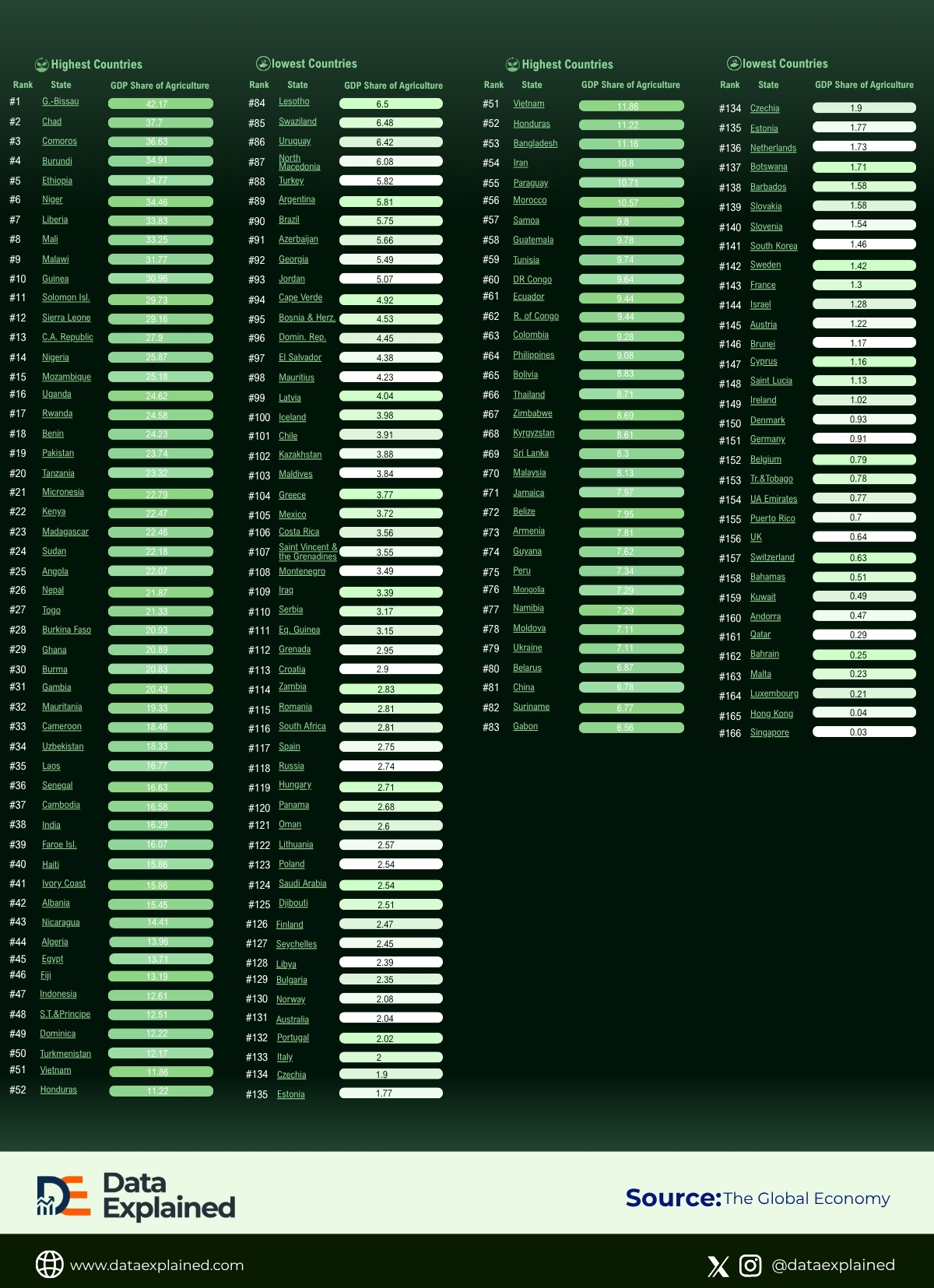
Today’s visualization shows the top countries by the share of GDP from agricultural activities.
It is based on data from The World Bank, gathered by TheGlobalEconomy as of 2023.
TL;DR
- Approximately 36% of Comoros’ GDP is contributed by agriculture, making it the top country in the ranking.
- Regionally, Africa and Asia show higher agricultural GDP shares due to large rural populations and limited industrial diversification, compared to Europe, North America, and parts of Asia.
- One pattern we noticed is that high-income or developed countries have low agricultural shares of GDP, while low-income/developing countries have higher ones.
Top 30 countries ranked by their Agriculture Percentage of GDP
| wdt_ID | wdt_created_by | wdt_created_at | wdt_last_edited_by | wdt_last_edited_at | Rank | Country | GDP Share of Agriculture (%) |
|---|---|---|---|---|---|---|---|
| 1 | Monica Ebunoluwa | 19/05/2026 03:36 PM | Monica Ebunoluwa | 19/05/2026 03:36 PM | 1 | Comoros | 35.94 |
| 2 | Monica Ebunoluwa | 19/05/2026 03:36 PM | Monica Ebunoluwa | 19/05/2026 03:36 PM | 2 | Ethiopia | 35.79 |
| 3 | Monica Ebunoluwa | 19/05/2026 03:36 PM | Monica Ebunoluwa | 19/05/2026 03:36 PM | 3 | Chad | 35.04 |
| 4 | Monica Ebunoluwa | 19/05/2026 03:36 PM | Monica Ebunoluwa | 19/05/2026 03:36 PM | 4 | Afghanistan | 34.74 |
| 5 | Monica Ebunoluwa | 19/05/2026 03:36 PM | Monica Ebunoluwa | 19/05/2026 03:36 PM | 5 | Liberia | 34.56 |
| 6 | Monica Ebunoluwa | 19/05/2026 03:36 PM | Monica Ebunoluwa | 19/05/2026 03:36 PM | 6 | Guinea Bissau | 34.02 |
| 7 | Monica Ebunoluwa | 19/05/2026 03:36 PM | Monica Ebunoluwa | 19/05/2026 03:36 PM | 7 | Niger | 32.51 |
| 8 | Monica Ebunoluwa | 19/05/2026 03:36 PM | Monica Ebunoluwa | 19/05/2026 03:36 PM | 8 | Mali | 32.49 |
| 9 | Monica Ebunoluwa | 19/05/2026 03:36 PM | Monica Ebunoluwa | 19/05/2026 03:36 PM | 9 | Malawi | 30.38 |
| 10 | Monica Ebunoluwa | 19/05/2026 03:36 PM | Monica Ebunoluwa | 19/05/2026 03:36 PM | 10 | Sudan | 30.28 |
At the very top is Comoros, where agriculture (including fishing, forestry, and farming) accounts for roughly 36% of GDP and employs over 80% of the population.
This comes as no surprise since Comoros, one of the world’s poorest countries, has an economy based on subsistence agriculture and fishing.
In 2024, the EU funded and commissioned a new agricultural school in Comoros, signaling both the government’s and international partners’ commitment to modernizing farming and stabilizing long-term food production.
Similarly, Ethiopia and Chad are low-income economies where agriculture dominates due to limited industrial diversification.
Where is the GDP Share of Agriculture Low?
At the very bottom of the global ranking are Malta (0%), Singapore (0.03%), Hong Kong (0.04%), Bermuda (0.19%), and Luxembourg (0.21%).
These countries are all high-income, service-driven, highly urbanized economies with limited agricultural land and strong financial, commercial, and manufacturing sectors.
Agriculture contributes little to GDP, as growth comes from banking, insurance, logistics, tourism, real estate, digital services, and other high-value industries.
Agriculture in African and Asian Communities
When you look at agricultural share regionally, you’ll notice that low-income countries in Africa and Asia tend to have higher agricultural percentages.
A clear example is the top five countries on the table, all in Africa, where agriculture employs the majority of the workforce.
In contrast, high-income, developed economies in Europe, North America, and parts of Asia report the lowest agricultural shares, often under 1–2%, because they rely on imports and have diversified into complex industries and services.
Countries catching up economically, such as Morocco (11.06%) and Turkey (6.16%), fall in the middle, with agriculture still important but other sectors growing.
What Drives High or Low Agriculture Share?
Structural factors drive why some countries have very high or very low agricultural contributions.
These factors explain why countries like Ethiopia and Comoros remain highly agrarian, while nations such as Singapore and Luxembourg have negligible agricultural GDP shares.
Population size and agricultural employment are among the most direct drivers.
By contrast, in the United States, less than 2% of the labour force works in farming, and agriculture contributes less than 2% to GDP.
Industrialization, services growth, and economic diversification further reduce the agricultural share in advanced economies.
ELI5
Comoros tops the global ranking because about 36% of its entire economy comes from farming, the highest share in the world.
In 2023, the worldwide average was just 9.8%, showing how unusual Comoros is. At the other extreme, Malta recorded 0%, indicating that farming contributes little to its economy.
Across regions, African and Asian countries rely more on agriculture because many people still live in rural areas, and industries like manufacturing aren’t as prominent.
Meanwhile, Europe, North America, and richer Asian countries depend far less on farming for their GDP.
Sources: