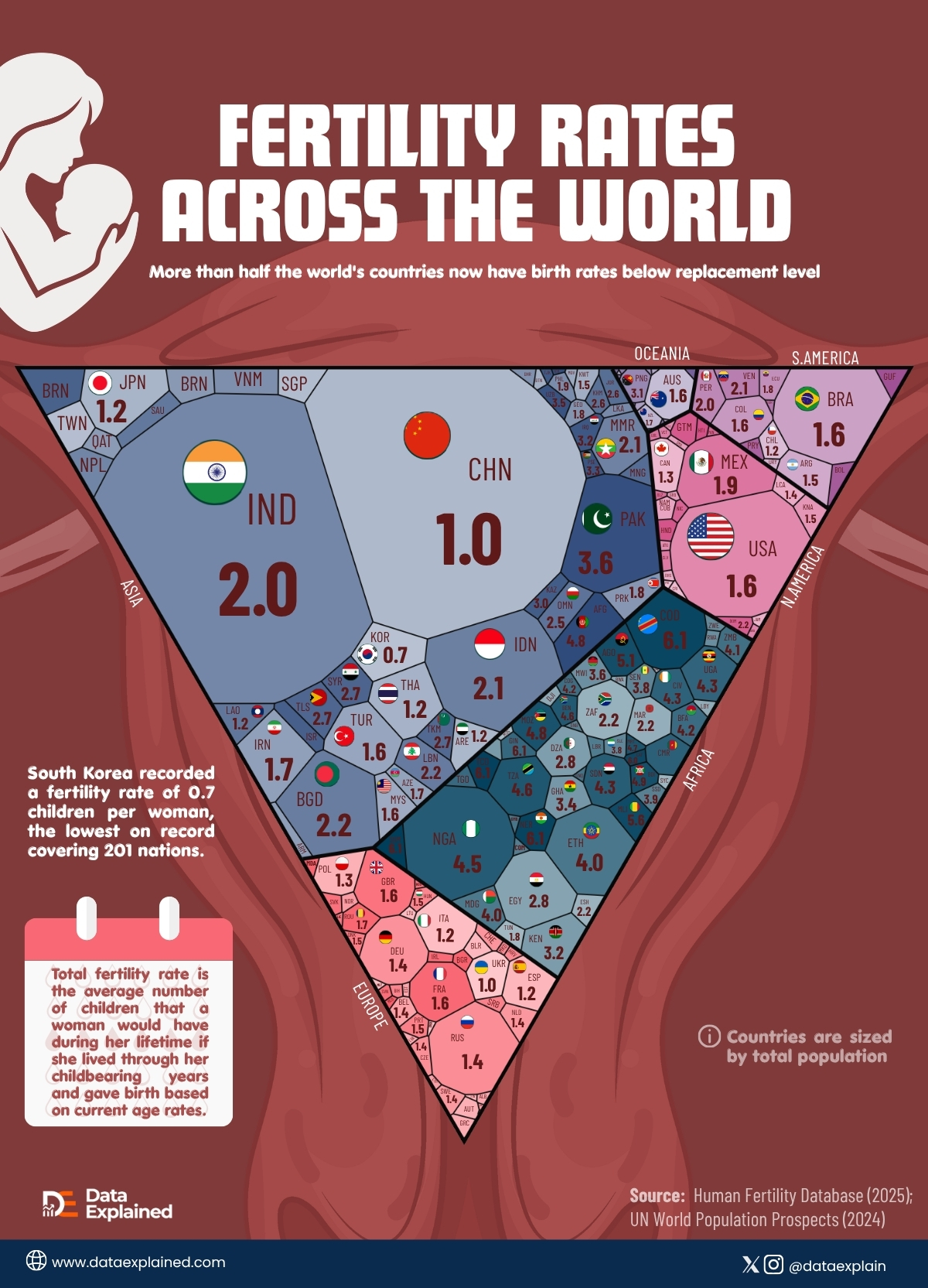
South Korea recorded a fertility rate of 0.720 children per woman in 2025, the lowest among 201 nations in a dataset covering 201 nations. That is less than a third of the 2.1 rate needed to keep a population stable over time.
This is based on data gathered from the Human Fertility Database (2025) and UN World Population Prospects (2024).
Taiwan is second at 0.870. Puerto Rico is third at 0.941. Singapore is fourth at 0.943. China, the world’s most populous country until recently, sits at 0.999.
Six countries in total have now fallen below 1.0, a level demographers treat as a full demographic emergency.
The world median is 1.984. South Korea sits 175% below it. At the other end of the table, Somalia’s rate of 6.132 is 8.52 times South Korea’s.
ALSO READ: Four Countries Hold 75% of South America’s Population
Global fertility rate by country
| wdt_ID | wdt_created_by | wdt_created_at | wdt_last_edited_by | wdt_last_edited_at | Country | Code | Total fertility rate |
|---|---|---|---|---|---|---|---|
| 1 | Patience | 25/09/2026 01:58 PM | Patience | 25/09/2026 01:58 PM | Somalia | SOM | 6.1 |
| 2 | Patience | 25/09/2026 01:58 PM | Patience | 25/09/2026 01:58 PM | Chad | TCD | 6.1 |
| 3 | Patience | 25/09/2026 01:58 PM | Patience | 25/09/2026 01:58 PM | Niger | NER | 6.1 |
| 4 | Patience | 25/09/2026 01:58 PM | Patience | 25/09/2026 01:58 PM | Democratic Republic of Congo | COD | 6.1 |
| 5 | Patience | 25/09/2026 01:58 PM | Patience | 25/09/2026 01:58 PM | Central African Republic | CAF | 6.0 |
| 6 | Patience | 25/09/2026 01:58 PM | Patience | 25/09/2026 01:58 PM | Mali | MLI | 5.6 |
| 7 | Patience | 25/09/2026 01:58 PM | Patience | 25/09/2026 01:58 PM | Angola | AGO | 5.1 |
| 8 | Patience | 25/09/2026 01:58 PM | Patience | 25/09/2026 01:58 PM | Burundi | BDI | 4.9 |
| 9 | Patience | 25/09/2026 01:58 PM | Patience | 25/09/2026 01:58 PM | Afghanistan | AFG | 4.8 |
| 10 | Patience | 25/09/2026 01:58 PM | Patience | 25/09/2026 01:58 PM | Mozambique | MOZ | 4.8 |
Source:
Human Fertility Database (2025); UN World Population Prospects (2024)