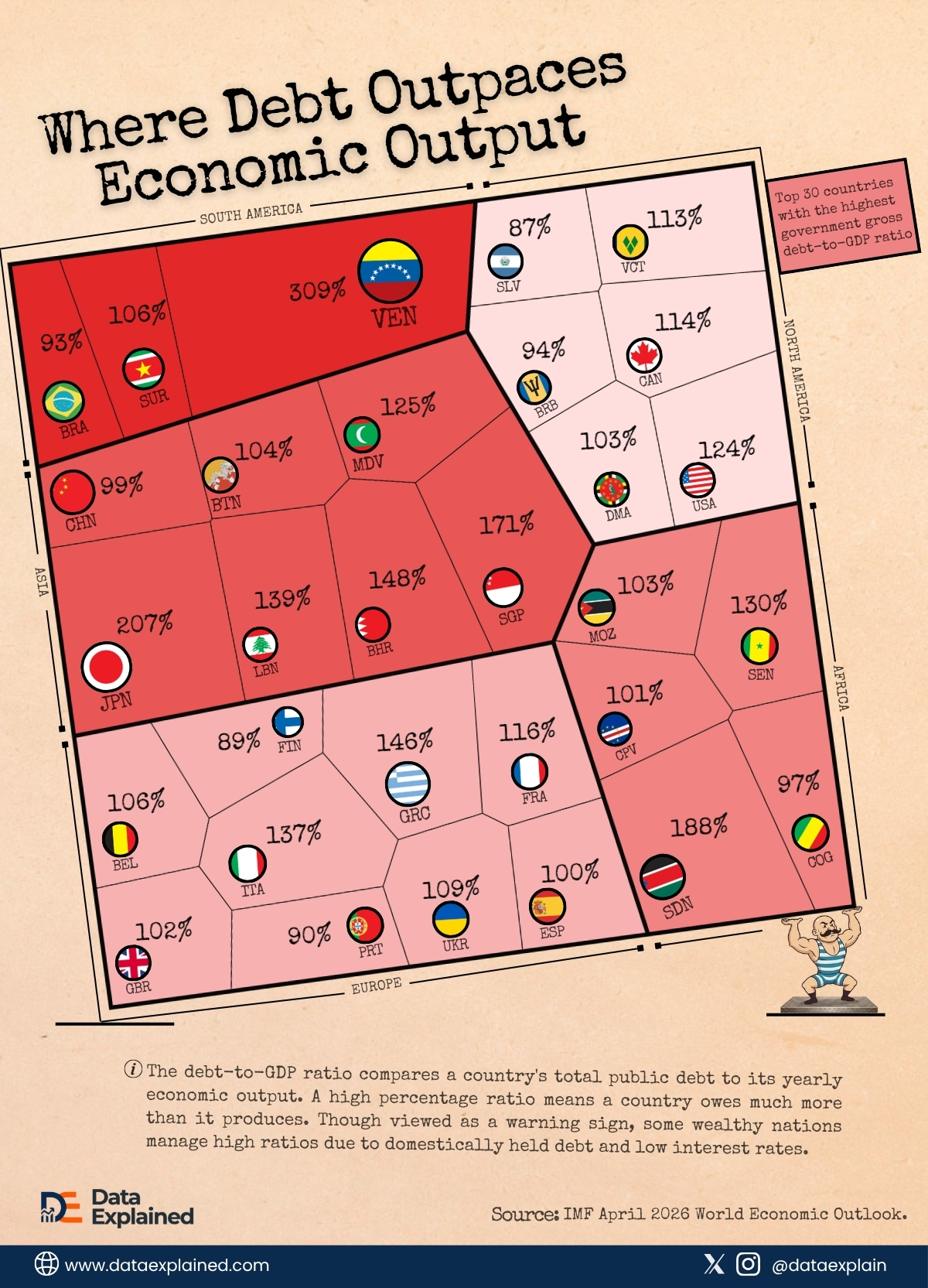
The debt-to-GDP ratio compares a country’s total public debt to its yearly economic output (Gross Domestic Product).
Hence, a high ratio means a country owes much more than it produces, signaling a higher risk of default or trouble paying loans.
The chart above presents 30 countries with the highest general government gross debt as a percentage of GDP.
It comes from the IMF April 2026 World Economic Outlook.
The perception of a high ratio is often a warning sign of financial stress or potential economic instability, though some wealthy nations (like Japan) manage high ratios due to domestically held debt and low interest rates.
TL;DR
- IMF April 2026 data shows 22 of the world’s 30 most indebted governments owe more than their entire economies produce in a single year
- Venezuela leads at a staggering 309% debt-to-GDP ratio.
- Six of the seven G7 nations, including the United States at 124%, Japan at 207%, and the United Kingdom at 102%, appear on the list.
| wdt_ID | wdt_created_by | wdt_created_at | wdt_last_edited_by | wdt_last_edited_at | Country and region | Debt-to-GDP Ratio (2025) (%) |
|---|---|---|---|---|---|---|
| 1 | emmanuel-ashemiriogwa | 24/08/2026 03:13 PM | emmanuel-ashemiriogwa | 24/08/2026 03:13 PM | Venezuela | 309 |
| 2 | emmanuel-ashemiriogwa | 24/08/2026 03:13 PM | emmanuel-ashemiriogwa | 24/08/2026 03:13 PM | Japan | 207 |
| 3 | emmanuel-ashemiriogwa | 24/08/2026 03:13 PM | emmanuel-ashemiriogwa | 24/08/2026 03:13 PM | Sudan | 188 |
| 4 | emmanuel-ashemiriogwa | 24/08/2026 03:13 PM | emmanuel-ashemiriogwa | 24/08/2026 03:13 PM | Singapore | 171 |
| 5 | emmanuel-ashemiriogwa | 24/08/2026 03:13 PM | emmanuel-ashemiriogwa | 24/08/2026 03:13 PM | Bahrain | 148 |
| 6 | emmanuel-ashemiriogwa | 24/08/2026 03:13 PM | emmanuel-ashemiriogwa | 24/08/2026 03:13 PM | Greece | 146 |
| 7 | emmanuel-ashemiriogwa | 24/08/2026 03:13 PM | emmanuel-ashemiriogwa | 24/08/2026 03:13 PM | Lebanon | 139 |
| 8 | emmanuel-ashemiriogwa | 24/08/2026 03:13 PM | emmanuel-ashemiriogwa | 24/08/2026 03:13 PM | Italy | 137 |
| 9 | emmanuel-ashemiriogwa | 24/08/2026 03:13 PM | emmanuel-ashemiriogwa | 24/08/2026 03:13 PM | Senegal | 130 |
| 10 | emmanuel-ashemiriogwa | 24/08/2026 03:13 PM | emmanuel-ashemiriogwa | 24/08/2026 03:13 PM | Maldives | 125 |
What the Numbers Mean
Gross debt-to-GDP is a starting point, not a verdict.
It does not account for government assets, the currency in which the debt is denominated, whether it is held domestically or externally, or the prevailing interest rate environment.
Singapore and Japan demonstrate that high ratios can coexist with stability.
Venezuela, Sudan, and Lebanon demonstrate that they can also coexist with collapse.
ALSO READ: One Dollar Buys 1.3 Million Iranian Rials; Here Are the World’s 30 Weakest Currencies
Venezuela Is in a Category of Its Own
At 309% of GDP, Venezuela holds the highest debt-to-GDP ratio on earth by an enormous margin.
The next closest country is Japan at 207%, a full 102 percentage points behind.
That gap is not simply a debt story.
Venezuela’s ratio has been driven upward as much by the collapse of its GDP as by the accumulation of debt.
When an economy implodes through hyperinflation, capital flight, and the destruction of productive capacity, the denominator of the ratio shrinks dramatically, and the ratio explodes even without significant new borrowing.
The Story Behind Japan’s Debt
Japan is arguably the world’s fourth-largest economy, and it carries a debt ratio that would trigger emergency interventions in almost any other country.
The reason it has not collapsed comes down to a set of conditions unique to Japan:
- Overwhelming majority of its debt is held domestically by Japanese banks, insurers, and pension funds.
- The government controls its own currency.
- The Bank of Japan has maintained ultra-low interest rates for decades.
Japan is simultaneously the strongest argument that high debt-to-GDP ratios do not automatically produce crisis, and the largest unresolved question about what happens when those unique conditions eventually change.
What About Singapore?
Singapore is at 171%, which will surprise anyone familiar with the city-state’s reputation for fiscal discipline and its AAA sovereign credit rating.
The explanation is that Singapore issues government bonds primarily to develop its domestic financial markets and provide investment instruments for its national pension system.
It is not to fund government spending it cannot otherwise afford.
Crucially, Singapore simultaneously holds assets through its sovereign wealth funds, Temasek and GIC, that far exceed its gross liabilities.
Its gross debt is high, but the net debt is effectively negative.
ALSO READ: What Exactly Is Government Debt? (and What It Costs)
ELI5
Imagine owing more on your credit card than you earn in an entire year. That is what 22 countries are doing right now with their national debt.
Some, like Venezuela, are in genuine crisis. Others, like Japan and the US, are managing it for now.
And Singapore looks bad on paper but actually has enough savings to cover what it owes.
The IMF’s latest data shows the line between these situations is thinner than most people realize.
Source: