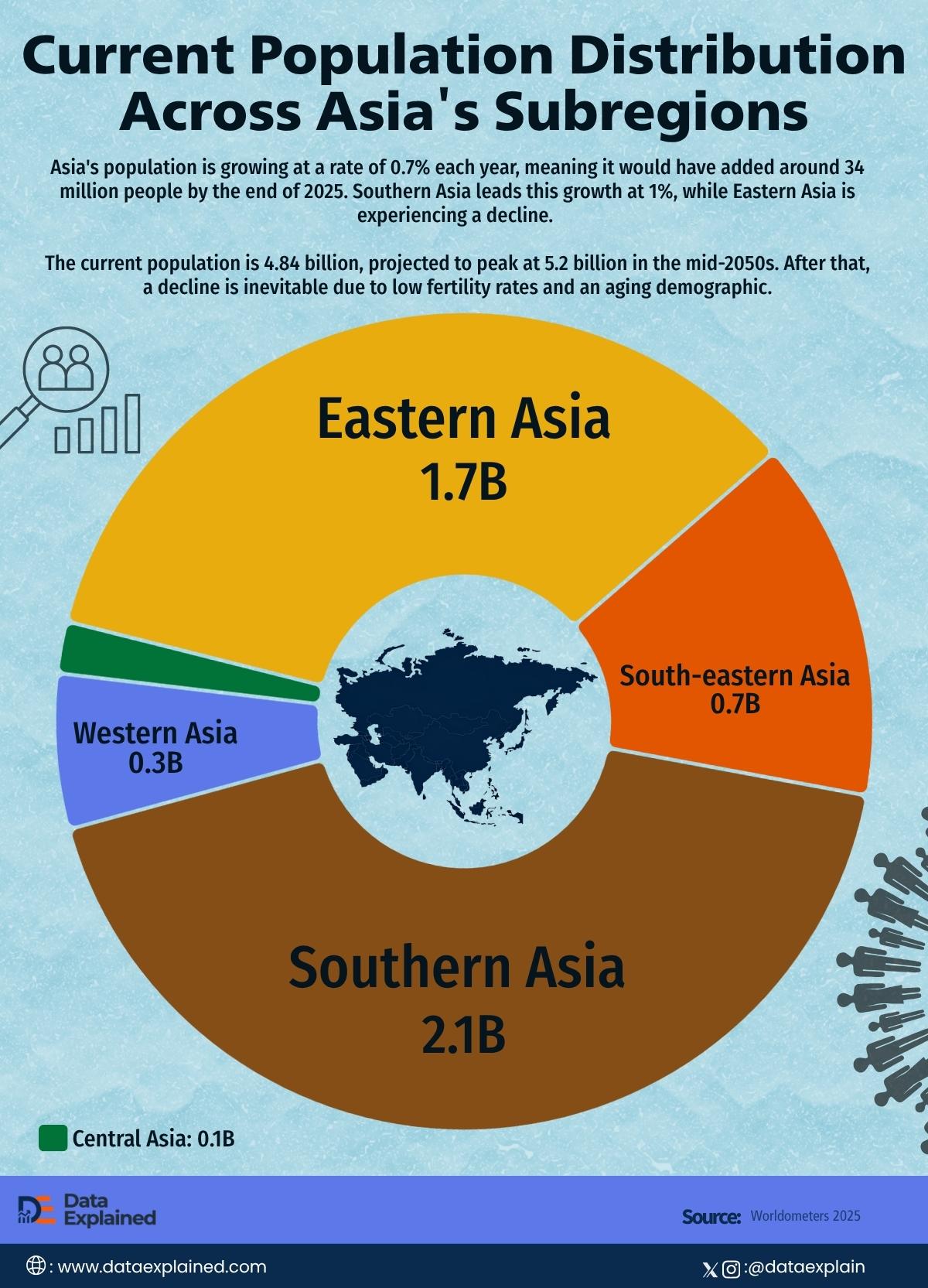
In 2025, Asia’s population is estimated at 4.84 billion. About half of that figure resides in Southern Asia, primarily due to high birth rates.
Cities like Mumbai and Manila are rapidly growing, absorbing half of new urban residents, which brings both opportunities and challenges.
A drop in birth rates signals potential trouble ahead.
TL;DR
- Asia’s population is projected to reach 4.84 billion by the end of 2025, growing at 0.7% annually, though the growth rate is expected to slow.
- Approximately 15% of East Asia’s population is over 65 years old.
- Southern Asia reaches 2.06 billion with a fertility rate of 2.2; Eastern Asia shrinks 0.2% due to Japan’s low rate of 1.3.
- The main population-related issues include a low fertility rate of 1.9 children per woman, pension issues, and workforce challenges.
Data for this insight are obtained from Worldometers and the Population Reference Bureau’s 2024 World Population Data Sheet.
Current Population Distribution Across Asia’s Subregions
| wdt_ID | wdt_created_by | wdt_created_at | wdt_last_edited_by | wdt_last_edited_at | Subregion | Population (Billion) |
|---|---|---|---|---|---|---|
| 1 | Monica Ebunoluwa | 29/07/2026 12:58 PM | Monica Ebunoluwa | 29/07/2026 12:58 PM | Central Asia | 0.1 |
| 2 | Monica Ebunoluwa | 29/07/2026 12:58 PM | Monica Ebunoluwa | 29/07/2026 12:58 PM | Eastern Asia | 1.7 |
| 3 | Monica Ebunoluwa | 29/07/2026 12:58 PM | Monica Ebunoluwa | 29/07/2026 12:58 PM | South-eastern Asia | 0.7 |
| 4 | Monica Ebunoluwa | 29/07/2026 12:58 PM | Monica Ebunoluwa | 29/07/2026 12:58 PM | Southern Asia | 2.1 |
| 5 | Monica Ebunoluwa | 29/07/2026 12:58 PM | Monica Ebunoluwa | 29/07/2026 12:58 PM | Western Asia | 0.3 |
| 6 | Monica Ebunoluwa | 29/07/2026 12:58 PM | Monica Ebunoluwa | 29/07/2026 12:58 PM | Asia Total | 4.8 |
| Subregion | Population (Billion) |
How Fast is Asia’s Population Growing?
| wdt_ID | wdt_created_by | wdt_created_at | wdt_last_edited_by | wdt_last_edited_at | Year | Population (billions) | Annual Growth Rate (%) |
|---|---|---|---|---|---|---|---|
| 1 | Monica Ebunoluwa | 29/07/2026 01:17 PM | Monica Ebunoluwa | 29/07/2026 01:17 PM | 2015 | 4.40 | 1.1 |
| 2 | Monica Ebunoluwa | 29/07/2026 01:17 PM | Monica Ebunoluwa | 29/07/2026 01:17 PM | 2020 | 4.64 | 0.9 |
| 3 | Monica Ebunoluwa | 29/07/2026 01:17 PM | Monica Ebunoluwa | 29/07/2026 01:17 PM | 2025 | 4.84 | 0.7 |
| 4 | Monica Ebunoluwa | 29/07/2026 01:17 PM | Monica Ebunoluwa | 29/07/2026 01:17 PM | 2030 | 5.00 | 0.6 |
| 5 | Monica Ebunoluwa | 29/07/2026 01:17 PM | Monica Ebunoluwa | 29/07/2026 01:17 PM | 2050 | 5.20 | 0.2 |
Asia’s population is growing at a rate of 0.7% each year, meaning it would have added around 34 million people by the end of 2025.
Southern Asia leads this growth at 1%, while Eastern Asia is experiencing a decline.
The current population is 4.84 billion, projected to peak at 5.2 billion in the mid-2050s.
After that, a decline is inevitable due to low fertility rates and an aging demographic.
Fertility Rates Below Replacement: What That Means
Asia’s total fertility rate has dropped to around 1.8 children per woman, which is below the replacement level (about 2.1) needed to keep populations stable without migration.
In Southern Asia, populations remain younger, and the average woman still has about 2 children.
In Eastern Asia, many places are already shrinking. Japan is leading that trend, with birth rates so low the population is starting to contract.
When fertility rates fall to 1.9 (or similar levels below 2.1), countries face tough challenges:
- Fewer young people to support pensions and health care for the elderly
- Potential for population decline over time
- Risk of “ghost towns” in places where people move away and fewer babies are born
This shift from many births to fewer creates big social and economic changes, and Asia is entering that phase now
Regional Differences: South Asia vs East Asia vs Western & Central Asia
South Asia, with over 2 billion people and a fertility rate of 2.2, is buzzing with young energy.
This youth is driving India’s fast-growing job market, leading to cool startups in Mumbai and innovative farming tech by women in Dhaka.
However, if jobs don’t keep up, there could be some serious unrest.
East Asia, with only 1.66 billion people, is facing a decline. Japan lost about 900,000 people last year, and Seoul’s “super-aged” status with a low fertility rate of 1.2, similar to China’s shrinking workforce and the region’s -0.2% annual decline, all point to an aging population.
Western and Central Asia stay steady at 391 million, with a fertility rate of 2.5, thanks to some growth and oil money.
For instance, Kazakhstan’s oil production fuels its economy and attracts migrants to Almaty, helping the region thrive.
East Asia’s decline to 1.3 children per woman could lead to a labor shortage by 2030.
In contrast, South Asia’s young population supports factories but puts pressure on resources.
Aging Populations & Shrinking Workforces in East Asia
| wdt_ID | wdt_created_by | wdt_created_at | wdt_last_edited_by | wdt_last_edited_at | Country | Population over 65 (2025) |
|---|---|---|---|---|---|---|
| 1 | Monica Ebunoluwa | 29/07/2026 01:34 PM | Monica Ebunoluwa | 29/07/2026 01:34 PM | Japan | 29.30% |
| 2 | Monica Ebunoluwa | 29/07/2026 01:34 PM | Monica Ebunoluwa | 29/07/2026 01:34 PM | Taiwan | 20.80% |
| 3 | Monica Ebunoluwa | 29/07/2026 01:34 PM | Monica Ebunoluwa | 29/07/2026 01:34 PM | South Korea | 20.30% |
| 4 | Monica Ebunoluwa | 29/07/2026 01:34 PM | Monica Ebunoluwa | 29/07/2026 01:34 PM | China | 14.90% |
| 5 | Monica Ebunoluwa | 29/07/2026 01:34 PM | Monica Ebunoluwa | 29/07/2026 01:34 PM | North Korea | 12.70% |
| 6 | Monica Ebunoluwa | 29/07/2026 01:34 PM | Monica Ebunoluwa | 29/07/2026 01:34 PM | Mongolia | 5.10% |
Source: Taipei Times
According to the United Nations’ Population Prospects, East Asia’s median age is 41, and by 2050, 28% of the population is expected to be over 65.
Japan’s 29.3% elderly are draining pensions.
China’s workforce is shrinking by 0.5% annually, leading to a surge in the demand for robots and calls for immigration.
South Korea’s fertility rate was 0.75 in 2024, the lowest in the world.
Urbanization Trends: More Asians Live in Cities Each Year
According to the Population Reference Bureau, more than half of Asia’s population lives in large cities such as Tokyo and Delhi.
It’s a 5% increase since 2015, as young people from rural areas migrate to these busy hubs in search of employment.
While South Asia’s urbanization rate is 37%, East Asia’s is significantly higher at 65%, placing a considerable strain on public transportation and air travel.
The reality is that these concrete jungles are taking over villages, leading to either innovation or chaos.
According to the Urban Century, in 2020, 2.4 billion people lived in Asian cities, and this number is expected to rise to 3.5 billion by 2050.
This move to urban life strains resources but fosters innovation.
ELI5
Asia’s population will reach 4.84 billion in 2025, with South Asia still growing while East Asia begins to decline due to aging.
About half of all Asians now live in big cities like Mumbai, Manila, Tokyo, and Delhi, reflecting a major shift from rural to urban life.
With fewer kids being born, many areas are preparing for older populations and potential labor shortages.
Source: