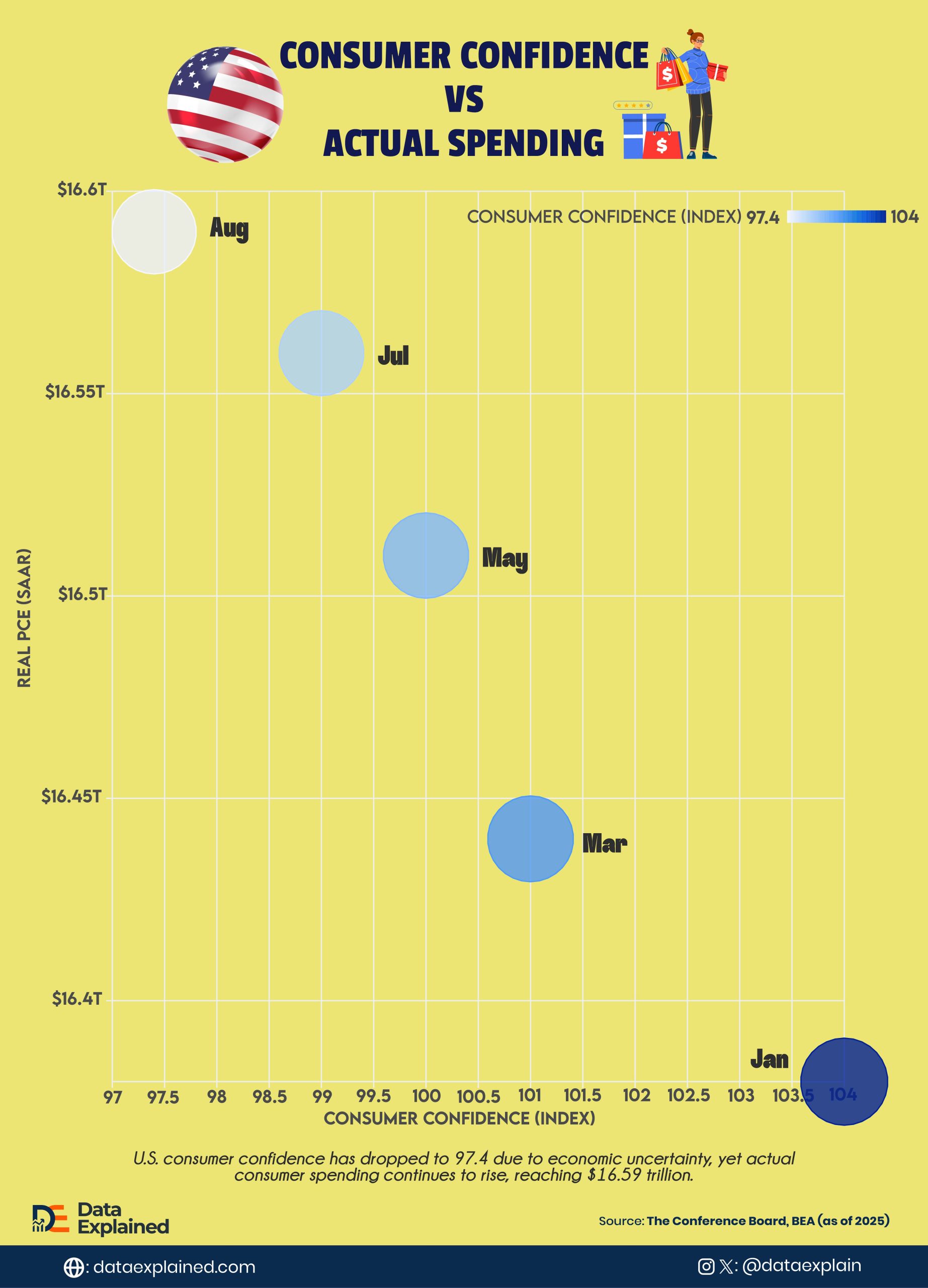
This is a mood-versus-money conversation.
Consumer Confidence measures how households feel about jobs, income, and business conditions. It’s a forward-looking sentiment indicator.
Real personal consumption expenditure (PCE) measures what households actually spend, adjusted for inflation.
It’s the backbone of U.S. GDP (about two-thirds of it).
Data has shown that Americans feel gloomier than they did in January, but they’re still swiping cards at a slightly faster clip.
TL;DR
- Consumer confidence is down to 97.4, showing people feel less sure about the economy.
- Spending is still rising (up 0.2% to $16.6 trillion in August).
- Most (69%) expect prices to keep climbing, but many are still spending anyway
Usually, confidence leads spending by several months: when sentiment weakens, spending eventually softens.
The current disconnect suggests either that households are unusually resilient or that the slowdown simply hasn’t arrived yet.
Confidence Down, Spending Up
| wdt_ID | wdt_created_by | wdt_created_at | wdt_last_edited_by | wdt_last_edited_at | Month (2025) | Consumer Confidence (Index) | Real PCE (SAAR) | Change vs previous period in PCE (%) |
|---|---|---|---|---|---|---|---|---|
| 1 | Monica Ebunoluwa | 24/07/2026 10:22 AM | Monica Ebunoluwa | 24/07/2026 10:22 AM | Jan | 104.3 | $16.38 trillion | 0.2 |
| 2 | Monica Ebunoluwa | 24/07/2026 10:22 AM | Monica Ebunoluwa | 24/07/2026 10:22 AM | Mar | 101.2 | $16.44 trillion | 0.3 |
| 3 | Monica Ebunoluwa | 24/07/2026 10:22 AM | Monica Ebunoluwa | 24/07/2026 10:22 AM | May | 99.6 | $16.51 trillion | 0.2 |
| 4 | Monica Ebunoluwa | 24/07/2026 10:22 AM | Monica Ebunoluwa | 24/07/2026 10:22 AM | Jul | 98.7 | $16.56 trillion | 0.3 |
| 5 | Monica Ebunoluwa | 24/07/2026 10:22 AM | Monica Ebunoluwa | 24/07/2026 10:22 AM | Aug | 97.4 | $16.59 trillion | 0.2 |
Source: The Conference Board, BEA
Note: Figures are historical snapshots as of the time of reporting. A full year has passed, and consumer confidence has since declined further before partially rebounding.
According to the Conference Board, U.S. consumer confidence slipped to 97.4 in August 2025, its third straight monthly decline.
Confidence is still above pandemic lows but well below its long-term average of around 110.
Meanwhile, the Bureau of Economic Analysis (BEA) reports that real personal consumption expenditures reached $16.59 trillion at the Seasonally Adjusted Annual Rate (SAAR) in August, up 0.3% from July and 1.8% higher than a year earlier.
So, even as sentiment sours, spending continues to edge upward.
The Trend Since 2020
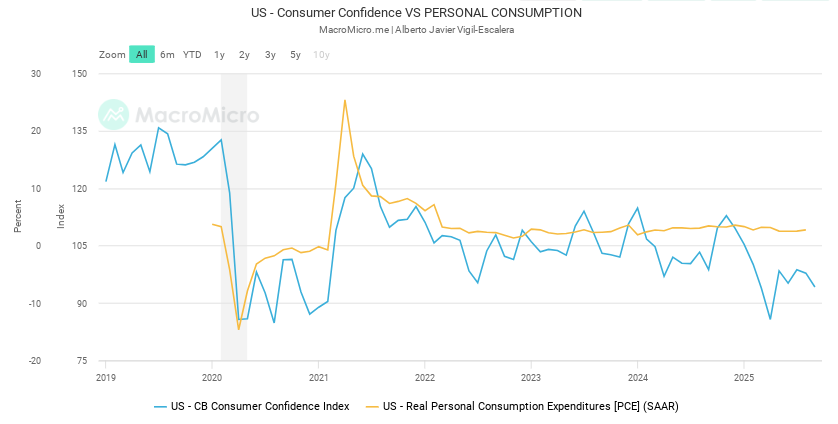
The chart below compares these two lines since 2020, showing a widening gap: confidence began to drift downward after mid-2024, while real spending held steady.
 Source: MacroMicro
You can see that the global pandemic led to a collapse in both metrics (2020).
Then, the stimulus rebound happened between 2021 and 2022. Consumer confidence recovered, and spending significantly surged.
The post-inflation hangover of 2024–2025 weakened confidence again, but spending leveled off rather than fell.
That plateau hints that consumers in the U.S. have adjusted expectations. They dislike prices but have normalized them.
How Americans Feel vs What They Do
| wdt_ID | wdt_created_by | wdt_created_at | wdt_last_edited_by | wdt_last_edited_at | Indicator (Aug 2025) | Latest Value | Trend vs 2024 | What It Means |
|---|---|---|---|---|---|---|---|---|
| 1 | emmanuel-ashemiriogwa | 24/07/2026 12:03 PM | emmanuel-ashemiriogwa | 24/07/2026 12:03 PM | Consumer Confidence | 97.4 pts | -7% | Mood is cooling |
| 2 | emmanuel-ashemiriogwa | 24/07/2026 12:03 PM | emmanuel-ashemiriogwa | 24/07/2026 12:03 PM | Real PCE growth YoY | 1.80% | from 2.7% | Spending growth is slower but still positive |
| 3 | emmanuel-ashemiriogwa | 24/07/2026 12:03 PM | emmanuel-ashemiriogwa | 24/07/2026 12:03 PM | Deloitte Well-Being Index | 100 | -3 pts | Finances feel tighter |
| 4 | emmanuel-ashemiriogwa | 24/07/2026 12:03 PM | emmanuel-ashemiriogwa | 24/07/2026 12:03 PM | % expecting higher grocery prices | 69% | 4% | Inflation fears persist |
| 5 | emmanuel-ashemiriogwa | 24/07/2026 12:03 PM | emmanuel-ashemiriogwa | 24/07/2026 12:03 PM | Average credit-card balance | $6,200 | 0.04 | More spending on credit |
| 6 | emmanuel-ashemiriogwa | 24/07/2026 12:03 PM | emmanuel-ashemiriogwa | 24/07/2026 12:03 PM | Personal saving rate | 4.80% | 0.6 (per person) | Households rebuilt a small buffer |
Sources: Deloitte ConsumerSignals, BEA.
Deloitte’s ConsumerSignals survey paints a similar picture of cautious endurance.
- The firm’s Financial Well-Being Index hovered around 99.5 in July 2025, down three points from a year earlier.
- 69% of consumers expect grocery prices to rise further.
- Yet spending intentions for restaurants, travel, and recreation have risen for three straight months.
In other words, Americans say they’re anxious, but they still want to enjoy life. They just choose carefully.
So, What?
Confidence usually dips before spending does. If this cycle follows history, weaker consumption could show up by late 2025.
During the pandemic and early recovery, households amassed extra savings. Even after inflation, many still have enough buffer to maintain spending for a few more months.
Credit-card balances and personal loans are up about 4–5% year-on-year, allowing consumers to stretch their budgets even as real incomes stagnate.
Meanwhile, consumers have shifted dollars from big-ticket items to experiences.
Services spending is up 3.2% year-on-year (YoY), while goods spending is roughly flat.
The data shows that eating out, travel, and entertainment are carrying the total PCE.
Deloitte’s analysis notes higher optimism and spending in the South and Midwest, where job growth and housing affordability remain stronger than on the coasts.
ELI5: Consumer Confidence vs Actual Spending
Right now, Americans are less cheerful about the economy than they were a year ago, but they’re still spending.
That’s sustainable for a while because of savings and the pull-forward of purchases when consumers expect prices to rise.
The relationship is not one-to-one.
High confidence does not guarantee high spending if other factors, like the high cost of living or a tightening job market, suppress spending.
Sources:
The Conference Board | BEA | Deloitte, State of the U.S. Consumer: August 2025