Referees rarely attract as much attention as players before a FIFA World Cup begins.
But even ahead of the 2026 tournament, FIFA’s appointment of 52 match referees had become part of a broader conversation about confidence in football’s officiating.
The spotlight on referees has intensified in recent months.
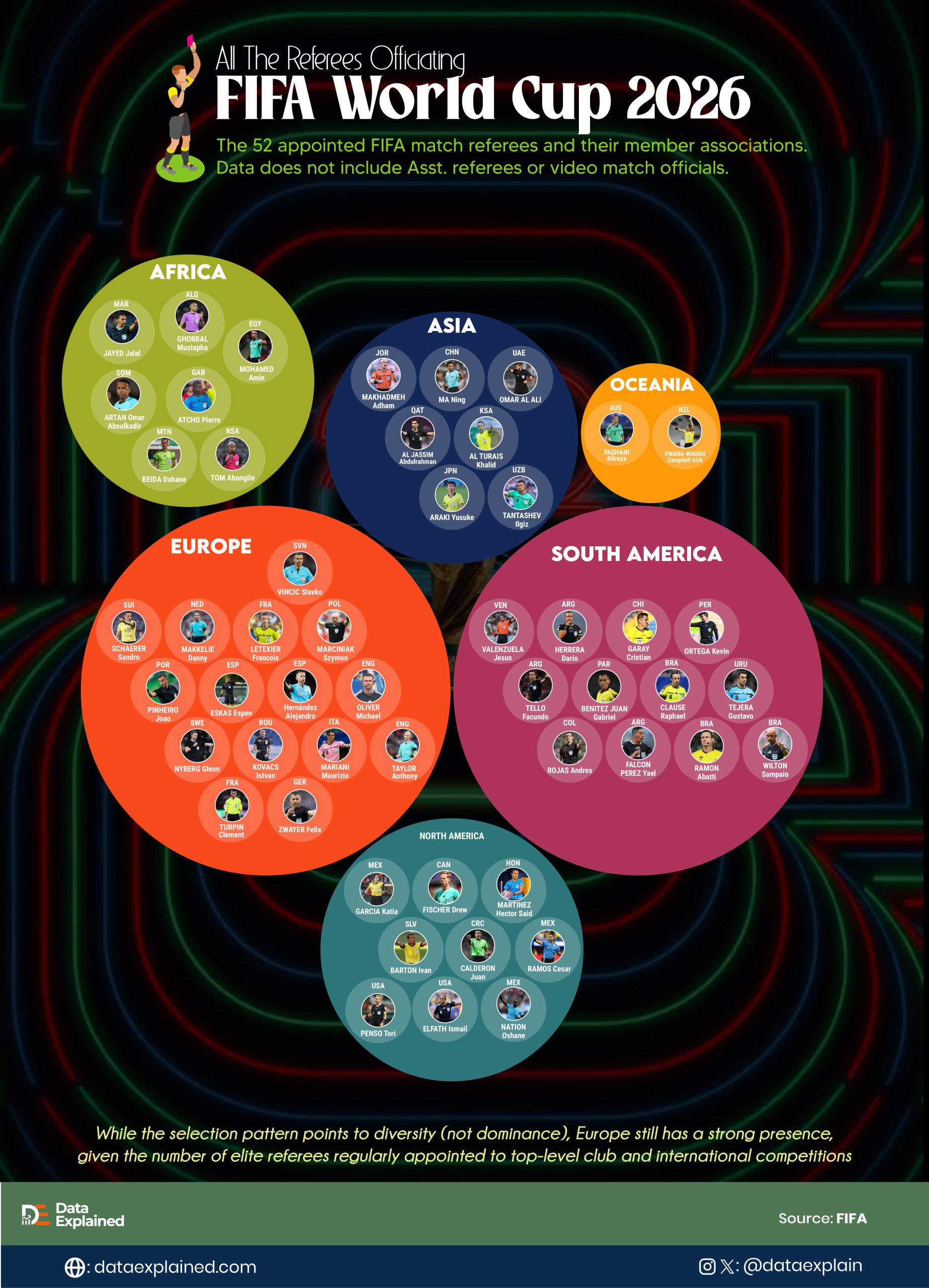
The infographic above lists all the 52 appointed FIFA match referees and their member associations. The data comes directly from FIFA.
It provides a snapshot of how the governing body prepared to oversee the world’s biggest football tournament.
TL;DR
- FIFA has appointed 52 referees from associations across all six football confederations for the 2026 World Cup.
- The panel combines experienced officials with referees from a wider range of countries than many fans might expect.
- As scrutiny of officiating grows, the appointments are as much about public trust as about managing matches.
ALSO READ: FIFA Has Banned 12 Countries From the World Cup Since 1950
Referee Panel Drawn From Across the World
| wdt_ID | wdt_created_by | wdt_created_at | wdt_last_edited_by | wdt_last_edited_at | S/N | Referee Name | Member Association | Continent |
|---|---|---|---|---|---|---|---|---|
| 1 | emmanuel-ashemiriogwa | 15/07/2026 11:27 AM | emmanuel-ashemiriogwa | 15/07/2026 11:27 AM | 1 | AL JASSIM Abdulrahman | QAT | Asia |
| 2 | emmanuel-ashemiriogwa | 15/07/2026 11:27 AM | emmanuel-ashemiriogwa | 15/07/2026 11:27 AM | 2 | AL TURAIS Khalid | KSA | Asia |
| 3 | emmanuel-ashemiriogwa | 15/07/2026 11:27 AM | emmanuel-ashemiriogwa | 15/07/2026 11:27 AM | 3 | ARAKI Yusuke | JPN | Asia |
| 4 | emmanuel-ashemiriogwa | 15/07/2026 11:27 AM | emmanuel-ashemiriogwa | 15/07/2026 11:27 AM | 4 | ARTAN Omar Abdulkadir | SOM | Africa |
| 5 | emmanuel-ashemiriogwa | 15/07/2026 11:27 AM | emmanuel-ashemiriogwa | 15/07/2026 11:27 AM | 5 | ATCHO Pierre | GAB | Africa |
| 6 | emmanuel-ashemiriogwa | 15/07/2026 11:27 AM | emmanuel-ashemiriogwa | 15/07/2026 11:27 AM | 6 | BARTON Ivan | SLV | North America |
| 7 | emmanuel-ashemiriogwa | 15/07/2026 11:27 AM | emmanuel-ashemiriogwa | 15/07/2026 11:27 AM | 7 | BEIDA Dahane | MTN | Africa |
| 8 | emmanuel-ashemiriogwa | 15/07/2026 11:27 AM | emmanuel-ashemiriogwa | 15/07/2026 11:27 AM | 8 | BENITEZ Juan Gabriel | PAR | South America |
| 9 | emmanuel-ashemiriogwa | 15/07/2026 11:27 AM | emmanuel-ashemiriogwa | 15/07/2026 11:27 AM | 9 | CALDERON Juan | CRC | North America |
| 10 | emmanuel-ashemiriogwa | 15/07/2026 11:27 AM | emmanuel-ashemiriogwa | 15/07/2026 11:27 AM | 10 | CLAUS Raphael | BRA | South America |
The list published by FIFA includes 52 referees representing member associations from Europe, Africa, Asia, North and Central America, South America, and Oceania.
Among them are some of football’s most recognizable officials, including Danny Makkelie of the Netherlands, Szymon Marciniak of Poland, Michael Oliver of England, Clément Turpin of France and Felix Zwayer of Germany.
These referees have officiated in UEFA Champions League fixtures, continental finals and previous FIFA tournaments, bringing years of experience to the competition.
At the same time, the panel extends well beyond football’s traditional powerhouses.
ALSO READ: World Cup Interest Falls With Every Older Generation
Data Points to Diversity (not Dominance)
One of the clearest patterns in the list is the spread of appointments across different regions.
South America’s representatives come from Argentina, Brazil, Chile, Colombia, Paraguay, Uruguay and Venezuela.
In North and Central America, FIFA selected referees from the United States, Canada, Mexico and Costa Rica.
Africa is represented by officials from Morocco, Egypt, Algeria, South Africa, Somalia, Gabon and Mauritania, among others.
Europe still has a strong presence, which is unsurprising given the number of elite referees regularly appointed to top-level club and international competitions.
However, the appointments are not dominated by any single country or confederation.
What the Appointments Can (and Cannot) Tell Us
Currently, officiating is under intense public scrutiny.
Every major decision is now reviewed from multiple camera angles, dissected on television and debated across social media within minutes.
That has led to allegations and speculation about bias in some quarters.
However, the referee appointments alone cannot prove or disprove claims of favoritism toward any team or nation.
What the data does show is that FIFA has assembled a panel with broad geographic representation and a mix of established and emerging officials.
Whether that translates into greater confidence during the tournament will depend on the quality and consistency of decisions once matches begin.
ALSO READ: The World Cup Is on TV; Much of Its Advertising Money Is Leaving the Medium
Tech Is Playing a Huge Role
Technology is also changing the role of referees rather than replacing it.
The 2026 World Cup is expected to continue using VAR alongside semi-automated offside technology and other digital tools designed to support decision-making.
These systems can reduce certain types of errors, but they cannot remove the referee from the center of the game.
Human judgment remains essential when interpreting fouls, handballs, dangerous play and disciplinary decisions.
As a result, the credibility of the officials themselves remains just as important as the technology supporting them.
ELI5
FIFA selected 52 referees from various countries for the 2026 World Cup. The list shows it wants officials from all over the world, not just famous football nations.
That doesn’t prove every decision will be correct, but it shows FIFA is trying to make the tournament’s refereeing team look fair, experienced and globally representative.
Source: