
Using open-source AI models means the system’s code and documentation are publicly available, allowing anyone to use or modify them freely.
In some industries, this path is exactly what is driving growth. It’s also transforming how AI becomes accessible worldwide.
TL;DR
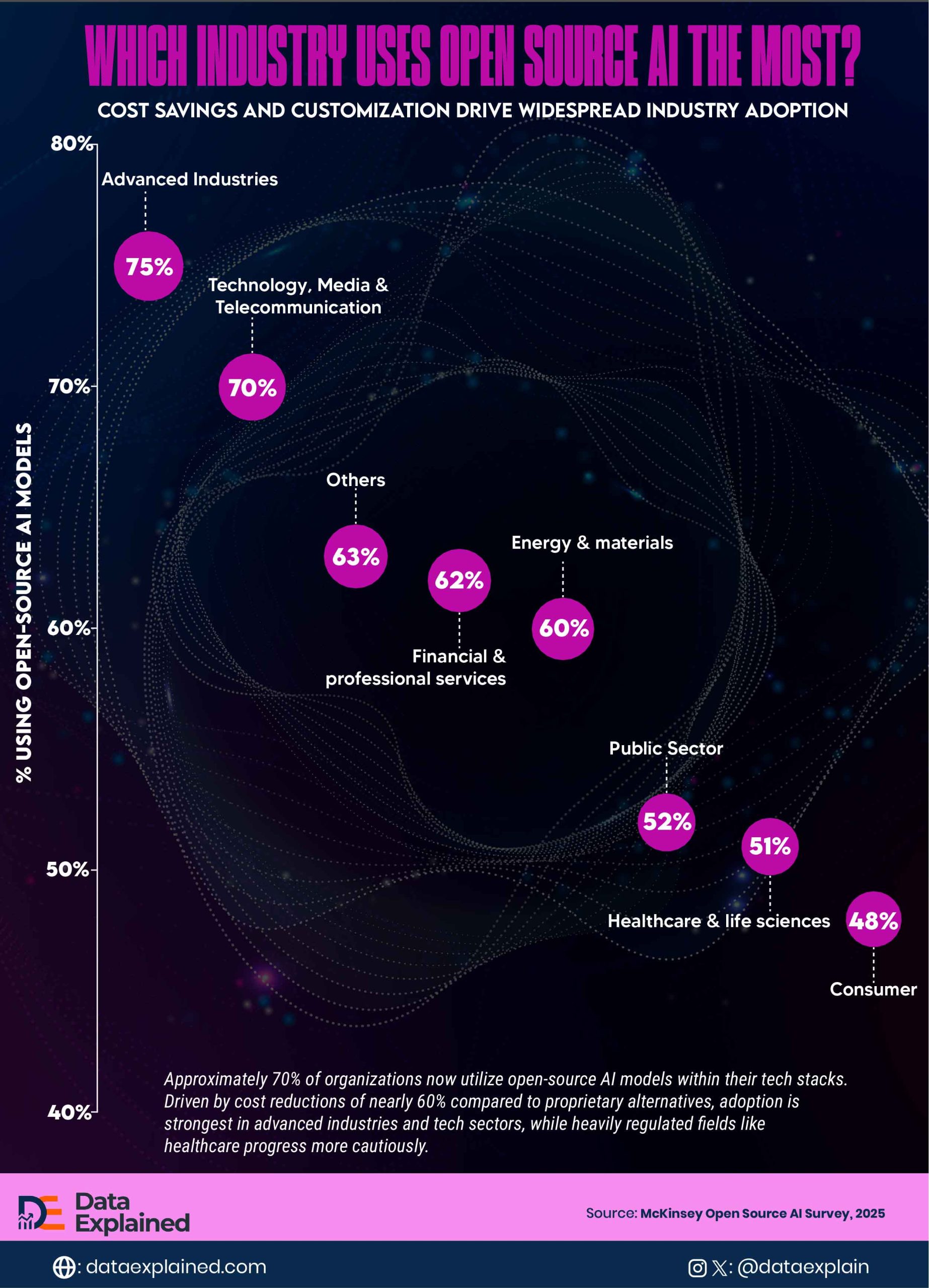
- Across industries, 63% of organizations use open-source AI models, with technology, media & telecommunications leading at 70%, financial & professional services at 62%, and healthcare & life sciences at 51%.
- By region, India leads globally with 77% open-source AI adoption, followed by the UK at 66% and the US at 62%.
- 60% of respondents report lower implementation costs with open-source AI compared to proprietary alternatives.
The data used in this visualization is drawn from a 2025 McKinsey report on open-source technology in the age of AI.
The result is based on 703 participants with experience in working with AI tech systems, sampled between December 9, 2024, and January 24, 2025.
As more organizations deploy generative AI across business functions, the survey finds that leaders are increasingly turning to open-source solutions to build out their tech stacks.
Use of Open Source AI models by Industry
| wdt_ID | wdt_created_by | wdt_created_at | wdt_last_edited_by | wdt_last_edited_at | Industry | % Using Open-Source AI Models |
|---|---|---|---|---|---|---|
| 1 | Monica Ebunoluwa | 01/06/2026 10:40 AM | Monica Ebunoluwa | 01/06/2026 10:40 AM | Advanced industries | 75% |
| 2 | Monica Ebunoluwa | 01/06/2026 10:40 AM | Monica Ebunoluwa | 01/06/2026 10:40 AM | Technology, media & telecommunications | 70% |
| 3 | Monica Ebunoluwa | 01/06/2026 10:40 AM | Monica Ebunoluwa | 01/06/2026 10:40 AM | Financial & professional services | 62% |
| 4 | Monica Ebunoluwa | 01/06/2026 10:40 AM | Monica Ebunoluwa | 01/06/2026 10:40 AM | Energy & materials | 60% |
| 5 | Monica Ebunoluwa | 01/06/2026 10:40 AM | Monica Ebunoluwa | 01/06/2026 10:40 AM | Public sector | 52% |
| 6 | Monica Ebunoluwa | 01/06/2026 10:40 AM | Monica Ebunoluwa | 01/06/2026 10:40 AM | Healthcare & life sciences | 51% |
| 7 | Monica Ebunoluwa | 01/06/2026 10:40 AM | Monica Ebunoluwa | 01/06/2026 10:40 AM | Consumer | 48% |
| 8 | Monica Ebunoluwa | 01/06/2026 10:40 AM | Monica Ebunoluwa | 01/06/2026 10:40 AM | Other | 63% |
Source: McKinsey Open Source AI Survey
The industries leading open-source AI adoption are those closest to high-performance computing and innovation cycles.
Advanced industries (75%) and the TMT sector (70%) show the most substantial uptake because they rely heavily on rapid iteration, customizable models, and lower cost structures.
Financial and professional services (62%) also stand out, reflecting their need for flexible AI tooling that can be audited, adapted, and scaled for analytics-heavy workflows.
The low adoption of open-source AI models in industries such as health care and the public sector may be due to regulatory constraints.
Although slower digitization and higher risk thresholds can also be factors.
These sectors tend to adopt AI more cautiously, relying on proven proprietary systems before transitioning to open-source alternatives.
Use of Open Source AI Models by Region
| wdt_ID | wdt_created_by | wdt_created_at | wdt_last_edited_by | wdt_last_edited_at | Region | % Using Open-Source AI Models |
|---|---|---|---|---|---|---|
| 1 | Monica Ebunoluwa | 01/06/2026 10:47 AM | Monica Ebunoluwa | 01/06/2026 10:47 AM | India | 77% |
| 2 | Monica Ebunoluwa | 01/06/2026 10:47 AM | Monica Ebunoluwa | 01/06/2026 10:47 AM | UK | 66% |
| 3 | Monica Ebunoluwa | 01/06/2026 10:47 AM | Monica Ebunoluwa | 01/06/2026 10:47 AM | US | 62% |
| 4 | Monica Ebunoluwa | 01/06/2026 10:47 AM | Monica Ebunoluwa | 01/06/2026 10:47 AM | France | 56% |
| 5 | Monica Ebunoluwa | 01/06/2026 10:47 AM | Monica Ebunoluwa | 01/06/2026 10:47 AM | Brazil | 48% |
| 6 | Monica Ebunoluwa | 01/06/2026 10:47 AM | Monica Ebunoluwa | 01/06/2026 10:47 AM | Other regions | 64% |
India emerges as a global hotspot for open-source AI adoption, with 77% adoption, driven by its strong developer community, cost-sensitive ecosystem, and fast-growing AI talent base.
The UK also exhibits high adoption, signaling strong experimentation in markets that are heavily investing in digital transformation.
Open Source vs Proprietary AI Models
The table below shows the perceived ease of use and preferences by access type.
| wdt_ID | wdt_created_by | wdt_created_at | wdt_last_edited_by | wdt_last_edited_at | Access Type | Open Source Easier to Access & Run | Closed Source Easier to Access & Run |
|---|---|---|---|---|---|---|---|
| 1 | Monica Ebunoluwa | 01/06/2026 10:54 AM | Monica Ebunoluwa | 01/06/2026 10:54 AM | Hosted on own infrastructure | 43% | 29% |
| 2 | Monica Ebunoluwa | 01/06/2026 10:54 AM | Monica Ebunoluwa | 01/06/2026 10:54 AM | API access | 31% | 39% |
| 3 | Monica Ebunoluwa | 01/06/2026 10:54 AM | Monica Ebunoluwa | 01/06/2026 10:54 AM | Hosted by the provider | 30% | 45% |
Organizations with their own hardware overwhelmingly favor open source.
A complete 43% say open source is easier to run in-house, compared with 29% for closed systems.
API users flip the script, leaning toward proprietary tools (39%) for “plug-and-go” simplicity. In other words, the more technical muscle a company has, the more open source feels like home.
Meanwhile, the in-house crowd not only finds open source easier but also prefers it, signaling a deeper strategic alignment.
And this is where open source wins.
Why are Companies Choosing Open Source AI now?
| wdt_ID | wdt_created_by | wdt_created_at | wdt_last_edited_by | wdt_last_edited_at | Reason | % of Organizations Citing Reason |
|---|---|---|---|---|---|---|
| 1 | Monica Ebunoluwa | 01/06/2026 11:05 AM | Monica Ebunoluwa | 01/06/2026 11:05 AM | Cost | 63% |
| 2 | Monica Ebunoluwa | 01/06/2026 11:05 AM | Monica Ebunoluwa | 01/06/2026 11:05 AM | Ease of implementation | 31% |
| 3 | Monica Ebunoluwa | 01/06/2026 11:05 AM | Monica Ebunoluwa | 01/06/2026 11:05 AM | Security, risk, and system control | 31% |
| 4 | Monica Ebunoluwa | 01/06/2026 11:05 AM | Monica Ebunoluwa | 01/06/2026 11:05 AM | Resources available | 30% |
| 5 | Monica Ebunoluwa | 01/06/2026 11:05 AM | Monica Ebunoluwa | 01/06/2026 11:05 AM | Better suited to organizational use cases | 30% |
| 6 | Monica Ebunoluwa | 01/06/2026 11:05 AM | Monica Ebunoluwa | 01/06/2026 11:05 AM | Quality | 27% |
| 7 | Monica Ebunoluwa | 01/06/2026 11:05 AM | Monica Ebunoluwa | 01/06/2026 11:05 AM | External perception of open source | 22% |
| 8 | Monica Ebunoluwa | 01/06/2026 11:05 AM | Monica Ebunoluwa | 01/06/2026 11:05 AM | Frequency of user prompting | 11% |
Despite the statistics and the evident excitement over Open Source AI, only 13% of respondents say their organizations have contributed to open-source projects, and a striking 50% aren’t sure they ever will.
That hesitation doesn’t stem from brand anxiety or an internal risk culture. Executives want the benefits of open source, but they’re reluctant to participate visibly, preferring to consume rather than contribute.
It’s a classic corporate paradox.
Open source is driving AI progress across industries, but many companies are willing to go along rather than pioneer and fully adopt it within their systems.
This hasn’t slowed adoption, however. Open source is becoming the backbone of AI strategy.
ELI5
According to the McKinsey report, 63% of organizations use open-source AI models, with the highest usage in technology, media & telecommunications at 70%, followed by financial & professional services at 62% and healthcare & life sciences at 51%.
Regionally, India leads with 77% adoption. The appeal is obvious. 60% of respondents report lower implementation costs with open-source AI compared to proprietary alternatives.
Source: