Deepfake attacks are increasingly harming ordinary people rather than just celebrities or politicians.
This is according to new data from Resemble AI’s 2025 Deepfake Threat Report.
The report analyzed 1,567 verified deepfake incidents gathered from global media coverage and documented in a continuously maintained incident database.
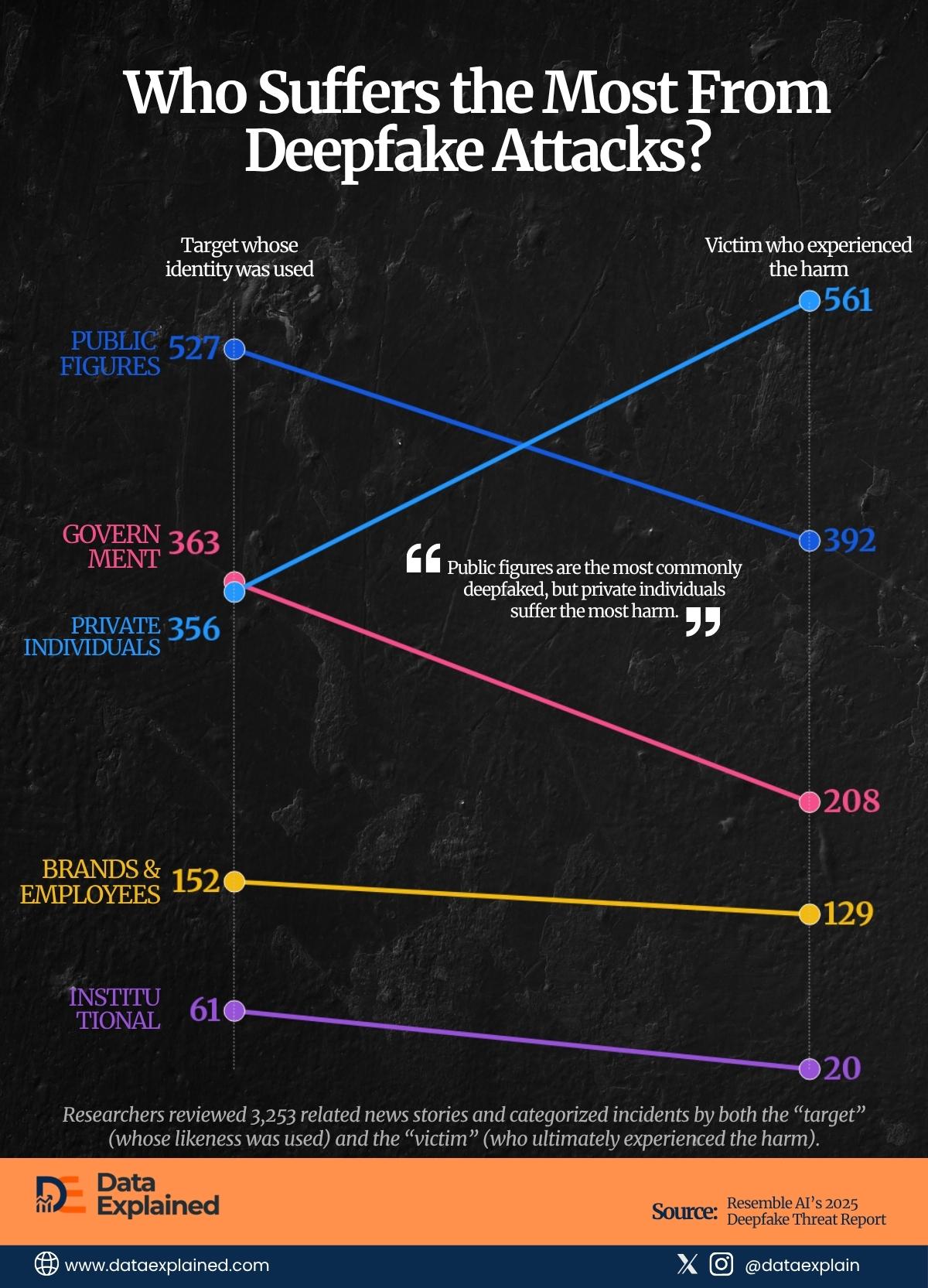
Researchers reviewed 3,253 related news stories and categorized incidents by both the “target” (whose likeness was used) and the “victim” (who ultimately experienced the harm).
TL;DR
- Public figures are the most commonly deepfaked, but private individuals suffer the most harm.
- The report tracked 1,567 verified deepfake incidents globally in 2025.
Who Gets Deepfaked vs. Who Gets Hurt
| wdt_ID | wdt_created_by | wdt_created_at | wdt_last_edited_by | wdt_last_edited_at | Entity Category | Target whose identity was used | Victim who experienced the harm |
|---|---|---|---|---|---|---|---|
| 1 | emmanuel-ashemiriogwa | 14/05/2026 05:24 PM | emmanuel-ashemiriogwa | 14/05/2026 05:24 PM | Public Figures | 527 | 392 |
| 2 | emmanuel-ashemiriogwa | 14/05/2026 05:24 PM | emmanuel-ashemiriogwa | 14/05/2026 05:24 PM | Government | 363 | 208 |
| 3 | emmanuel-ashemiriogwa | 14/05/2026 05:24 PM | emmanuel-ashemiriogwa | 14/05/2026 05:24 PM | Private Individual | 356 | 561 |
| 4 | emmanuel-ashemiriogwa | 14/05/2026 05:24 PM | emmanuel-ashemiriogwa | 14/05/2026 05:24 PM | Brands & Employees | 152 | 129 |
| 5 | emmanuel-ashemiriogwa | 14/05/2026 05:24 PM | emmanuel-ashemiriogwa | 14/05/2026 05:24 PM | Institutional | 61 | 20 |
Public figures were the most common deepfake targets, appearing in 527 incidents. Government entities followed with 363 cases, while private individuals appeared in 356 incidents.
Brands, institutions, and employees made up smaller portions of the dataset.
But when researchers examined who actually suffered harm, the picture changed dramatically.
Private individuals became the largest victim category, appearing in 561 incidents, more than public figures, governments, or brands.
Public figures were involved in 392 victim cases, while governments were involved in 208.
What Does this Mean?
The gap between who gets impersonated and who gets hurt suggests that deepfakes are increasingly functioning as tools for fraud and social engineering rather than simply viral misinformation.
In many cases, public figures or trusted institutions are used as bait.
A fake celebrity endorsement, cloned executive voice, or AI-generated government message may use a recognizable identity to deceive ordinary people into sending money, sharing information, or trusting fraudulent content.
That pattern aligns with a growing number of warnings from governments and cybersecurity researchers globally.
The Scope Matters, too
Researchers also acknowledged that coverage in the database leans heavily toward U.S.-based publications, meaning incidents in other regions may be underrepresented.
Even with those limitations, the data points to a broader shift in how deepfakes are being used.
The dataset also shows that institutions themselves appear less frequently as victims than individuals do.
Researchers recorded only 20 institutional victim cases, despite 61 incidents in which institutions were the targets.
That imbalance may reflect the ability of large organizations to absorb or contain attacks more effectively than individuals.
It may also point to underreporting, especially in cases involving reputational damage or cybersecurity breaches.
Brands and employees were also heavily represented among victims, appearing in 129 incidents.
Many of those cases likely involve impersonation scams using fake customer support, fraudulent recruitment messages, or AI-generated executive communications.
The Bigger Picture
The scale of the report is itself significant.
Tracking more than 1,500 verified incidents in a single year suggests deepfakes are no longer rare or experimental.
They are becoming industrialized. That is, easier to create, cheaper to distribute, and increasingly tied to financial crime.
That may be the report’s clearest warning.
The core threat is no longer just whether people can tell if a video is fake. It is whether digital communication itself can still be trusted.
As AI-generated media becomes more realistic, the burden increasingly shifts toward verification systems, identity authentication tools, and platform safeguards designed to detect manipulation before harm occurs.
ELI5
Deepfakes are fake videos or voices made with AI. Famous people are still copied the most, but regular people are now getting hurt more often through scams and fraud.
Criminals use fake celebrity or government messages to trick people into trusting them. The report shows deepfakes are becoming a real everyday problem, not just internet entertainment or political misinformation.
Sources:
Resemble AI’s 2025 Deepfake Threat Report.