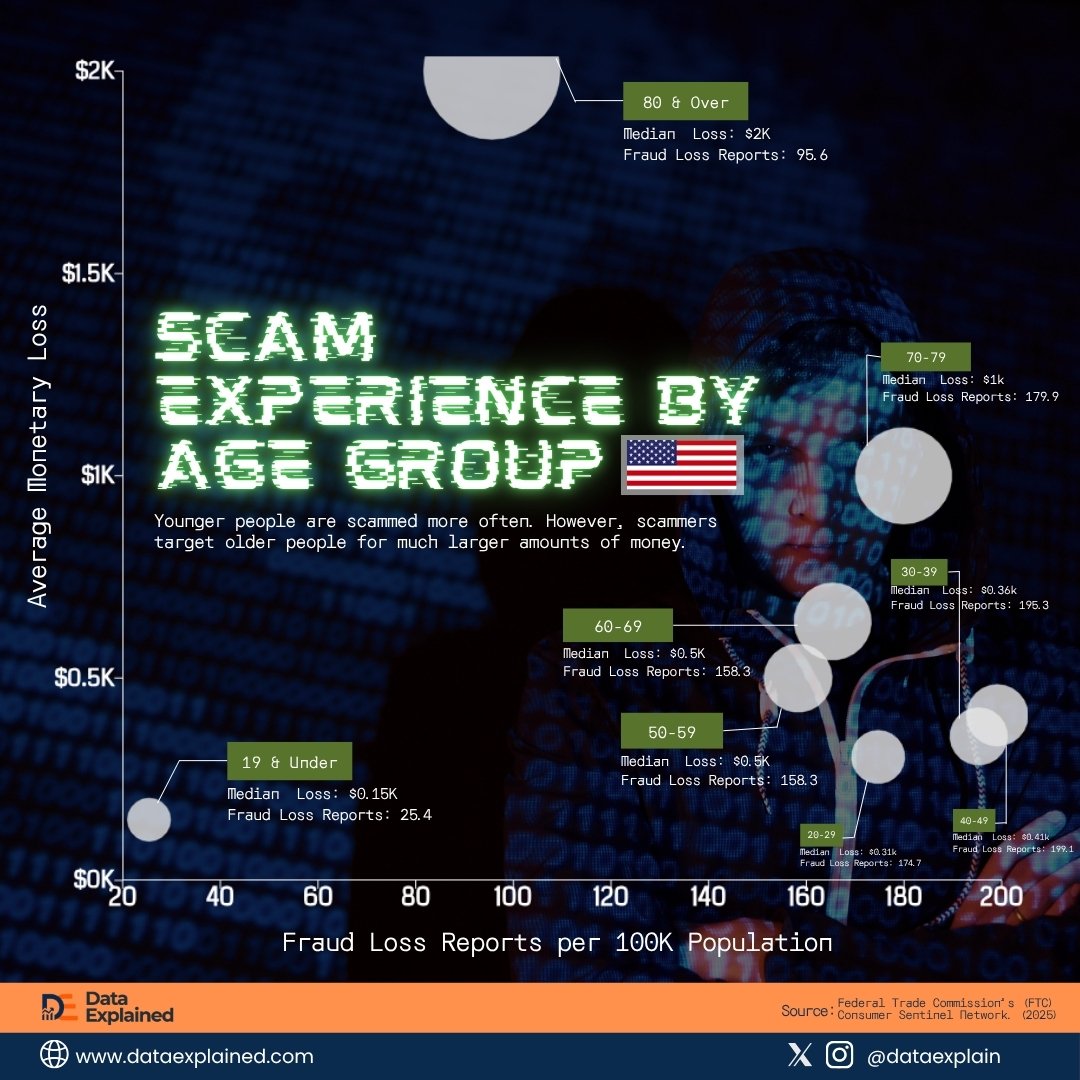
While young and middle-aged adults are scammed more often, it is those over 80 who are being “whaled.” That is, losing life-changing sums of money in single incidents.
Using the most recent data from the U.S. Federal Trade Commission (FTC), the infographic above shows age and loss distribution to fraud.
The data show a striking “cross-over” effect between the frequency of fraud and the intensity of losses.
TL;DR
- Seniors over 80 lose a median of $2,000 per scam, exactly double the loss of those in their 70s.
- Americans aged 30–49 report the most scams, but criminals extract five times more money from the oldest victims.
- The oldest age group has the lowest reporting rate despite suffering the most severe financial damage.
| wdt_ID | wdt_created_by | wdt_created_at | wdt_last_edited_by | wdt_last_edited_at | Age Group | Median Loss (USD) | Fraud Loss Reports per 100K Population |
|---|---|---|---|---|---|---|---|
| 1 | emmanuel-ashemiriogwa | 06/05/2026 09:43 AM | emmanuel-ashemiriogwa | 06/05/2026 09:43 AM | 19 & Under | 150 | 25.35 |
| 2 | emmanuel-ashemiriogwa | 06/05/2026 09:43 AM | emmanuel-ashemiriogwa | 06/05/2026 09:43 AM | 20 - 29 | 305 | 174.74 |
| 3 | emmanuel-ashemiriogwa | 06/05/2026 09:43 AM | emmanuel-ashemiriogwa | 06/05/2026 09:43 AM | 30 - 39 | 356 | 195.28 |
| 4 | emmanuel-ashemiriogwa | 06/05/2026 09:43 AM | emmanuel-ashemiriogwa | 06/05/2026 09:43 AM | 40 - 49 | 408 | 199.11 |
| 5 | emmanuel-ashemiriogwa | 06/05/2026 09:43 AM | emmanuel-ashemiriogwa | 06/05/2026 09:43 AM | 50 - 59 | 500 | 158.32 |
| 6 | emmanuel-ashemiriogwa | 06/05/2026 09:43 AM | emmanuel-ashemiriogwa | 06/05/2026 09:43 AM | 60 - 69 | 640 | 165.35 |
| 7 | emmanuel-ashemiriogwa | 06/05/2026 09:43 AM | emmanuel-ashemiriogwa | 06/05/2026 09:43 AM | 70 - 79 | 1,000 | 179.86 |
| 8 | emmanuel-ashemiriogwa | 06/05/2026 09:43 AM | emmanuel-ashemiriogwa | 06/05/2026 09:43 AM | 80 & Over | 2,000 | 95.59 |
The most alarming trend in the dataset is the exponential increase in median financial loss with age.
While a victim in their 30s loses a median of $356, that number jumps to $1,000 for those in their 70s.
Most shockingly, victims aged 80 and over lose a median of $2,000, doubling the loss of the group immediately younger than them and losing over five times more than those in their 30s.
Frequency Fallacy
While the dollar amounts for seniors are devastating, they aren’t actually the group reporting the most fraud.
That title belongs to Americans aged 30 to 49.
According to the FTC’s reporting rates per 100,000 population, these middle-aged groups report nearly 200 cases per capita, the highest in the country.
Because this demographic is digitally “everywhere” (from LinkedIn and dating apps to Instagram and professional email), they encounter far more scam attempts.
However, because they are often more tech-literate and have less accumulated wealth than retirees, the “per-scam” damage remains significantly lower.
The Silent Crisis
Perhaps the most worrying insight in the dataset is what is not being reported.
The “80 & Over” group has the lowest reporting rate of any adult age group, at just 95.59 reports per 100,000 people.
This suggests a “dark figure” of crime.
Many seniors may be too ashamed to report a loss, or they may be isolated and unaware of how to file a federal report. This silence is what allows scammers to continue targeting them with impunity.
In response, recent 2026 government policies, such as the Financial Exploitation Prevention Act, are being debated to allow banks to temporarily “freeze” suspicious transfers from senior accounts.
ELI5
Younger people are scammed more often because they use the internet more. However, scammers target older people for much larger amounts of money.
While a 30-year-old might lose $356, someone over 80 loses a median of $2,000. This means that while middle-aged people report more crimes, our seniors are paying the highest price for the internet’s fraud crisis.
Source:
Federal Trade Commission (FTC’s)