Relations between the United States and Venezuela have deteriorated, this time over allegations of terrorism, drug trafficking, and human rights abuses against President Nicolás Maduro’s government.
Washington has ordered blockades of sanctioned oil tankers linked to Venezuela.
Venezuela sits on the world’s largest proven oil reserves and depends heavily on crude exports to sustain its economy and people.
While U.S. sanctions have restricted direct trade for years, American companies such as Chevron have continued to receive limited waivers to import Venezuelan crude.
That raises a key question at the heart of today’s dispute: how much Venezuelan oil does the United States actually import, and who are Venezuela’s biggest buyers now?
TL;DR
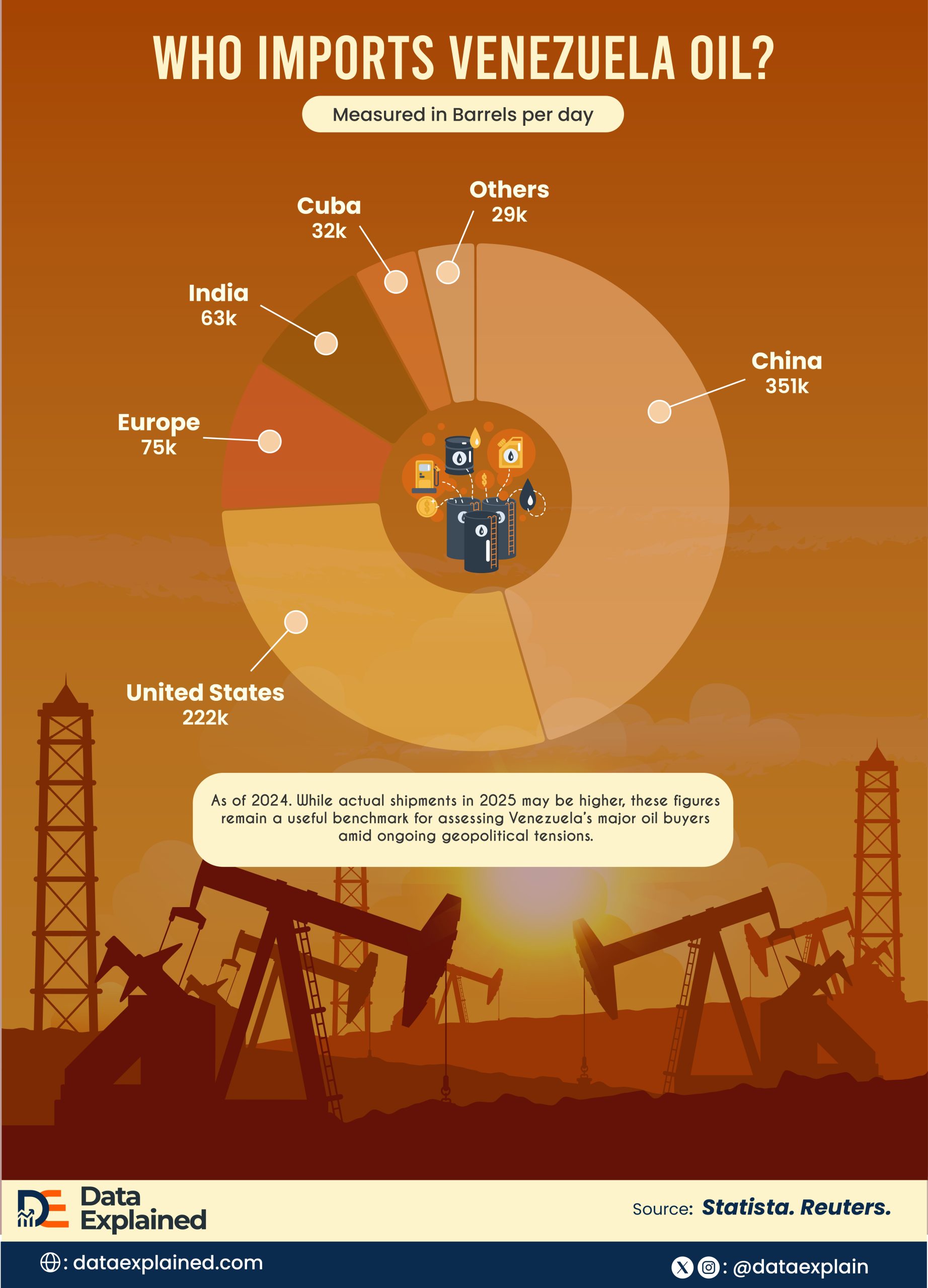
- China is currently the largest importer of Venezuelan oil with 351,000 barrels/day as of 2024.
- U.S tariffs and sanctions have cut down buyers of Venezuelan oil
The data for this explainer was drawn from Reuters and gathered by Statista.
It’s based on compiled 2024 figures on Venezuelan crude oil exports by destination.
Venezuela Oil Imports by Country
While actual shipments in 2025 may be higher, these figures remain a useful benchmark for assessing Venezuela’s major oil buyers amid ongoing geopolitical tensions.
The table below shows oil imports by country/region, measured in barrels per day.
| wdt_ID | wdt_created_by | wdt_created_at | wdt_last_edited_by | wdt_last_edited_at | Country/Region | Oil imports (in barrels/day) |
|---|---|---|---|---|---|---|
| 1 | Monica Ebunoluwa | 06/02/2026 05:08 PM | Monica Ebunoluwa | 06/02/2026 05:08 PM | China | 351,000 |
| 2 | Monica Ebunoluwa | 06/02/2026 05:08 PM | Monica Ebunoluwa | 06/02/2026 05:08 PM | United States | 222,000 |
| 3 | Monica Ebunoluwa | 06/02/2026 05:08 PM | Monica Ebunoluwa | 06/02/2026 05:08 PM | Europe | 75,000 |
| 4 | Monica Ebunoluwa | 06/02/2026 05:08 PM | Monica Ebunoluwa | 06/02/2026 05:08 PM | India | 63,000 |
| 5 | Monica Ebunoluwa | 06/02/2026 05:08 PM | Monica Ebunoluwa | 06/02/2026 05:08 PM | Cuba | 32,000 |
| 6 | Monica Ebunoluwa | 06/02/2026 05:08 PM | Monica Ebunoluwa | 06/02/2026 05:08 PM | Others | 29,000 |
China as Venezuela’s Largest Oil Buyer
China has overtaken the United States as the largest importer of Venezuelan oil for several key reasons.
Chief among them are the U.S. sanctions and tariffs imposed under the Trump administration.
Primary sanctions target U.S. citizens and companies with strict penalties, including imprisonment and criminal charges, effectively cutting American buyers off from Venezuelan crude.
Secondary sanctions and tariffs affect countries such as Europe and India that trade with the U.S. or use the U.S. financial system, exposing them to consequences such as frozen accounts or additional import taxes.
However, these restrictions do not directly impact China, which continues to make direct payments to Venezuela and navigate trade outside the reach of U.S.-based sanctions.
Another major factor is China’s energy security and reserve-building strategy.
For years, Beijing has prioritized oil stockpiling to reduce its dependence on other global suppliers.
Venezuelan crude, often sold at a discount and available despite sanctions, allows China to expand its strategic petroleum reserves while securing a stable long-term supply.
A third reason is the steep discounts offered by Venezuela.
To encourage buyers willing to navigate sanctions, Caracas (Venezuela’s capital) sells crude oil at prices significantly below global benchmarks such as Brent.
Current Sanctions and Trade Dynamics from the U.S
The Trump administration’s recent intensification of pressure marks a new phase.
In December 2025, U.S. forces seized the oil tanker Skipper off Venezuela’s coast, a sanctioned vessel accused of transporting Venezuelan crude in violation of U.S. restrictions.
It also slapped fresh sanctions on multiple ships and associates tied to President Nicolás Maduro’s regime.
A “total and complete” blockade of sanctioned oil tankers entering or leaving Venezuelan waters was also ordered, a move Washington says is aimed at cutting off revenue streams tied to alleged narco‑terrorism and criminal activity.
These actions have had a chilling effect on Venezuelan crude exports, slowing shipments as more vessels avoid detection, reroute, or sit idle, and complicating logistics for buyers and exporters alike.
As a result, Venezuela may be forced to adopt alternative trading strategies and markets if it hopes to maintain oil revenues, which account for the vast majority of its export income.
Alternatively, they confront sustained economic pressure from Washington’s tightening grip.
Where Does This US-Venezuela Pressure Lead To?
U.S. sanctions, tanker interdictions, and the blockade of Venezuelan vessels are likely to further weaken Caracas’s oil-dependent economy.
Exports have already fallen sharply, and continued pressure could push output even lower, straining a government that relies on oil for most of its revenue.
While global supply can absorb the shortfall for now, Venezuela may struggle to find buyers willing to navigate sanctions and shipping risks.
The pressure is also reshaping Venezuela’s international trade and alliances.
Caracas is expected to deepen ties with non-Western partners, particularly in Asia, while exploring alternative markets.
Prolonged confrontation could either force political concessions or further destabilize the regime, with knock-on effects for regional security and global energy flows.
ELI5: US-Venezuela Oil Conflict
The US seizure of an oil tanker near Venezuela is not the only point of contention between the two countries.
Drugs, oil, sanctions, and election disputes are all playing a part in the escalating conflict.
Venezuela holds the world’s largest oil reserves (303 billion barrels) but produces only about 1 million barrels per day due to infrastructure problems and sanctions.
U.S. sanctions have redirected Venezuelan oil exports away from Western markets, forcing the country to sell at steep discounts—primarily to China, which now purchases 50-80% of Venezuela’s crude exports.
Sources