Novo Nordisk, the company behind blockbuster weight-loss drug Ozempic, saw its stock crash 17% on Wednesday, marking the worst year in company history.
The Danish drugmaker has lost $360 billion in value over the past 12 months, shrinking from a company worth more than Denmark’s entire economy to less than half that size.
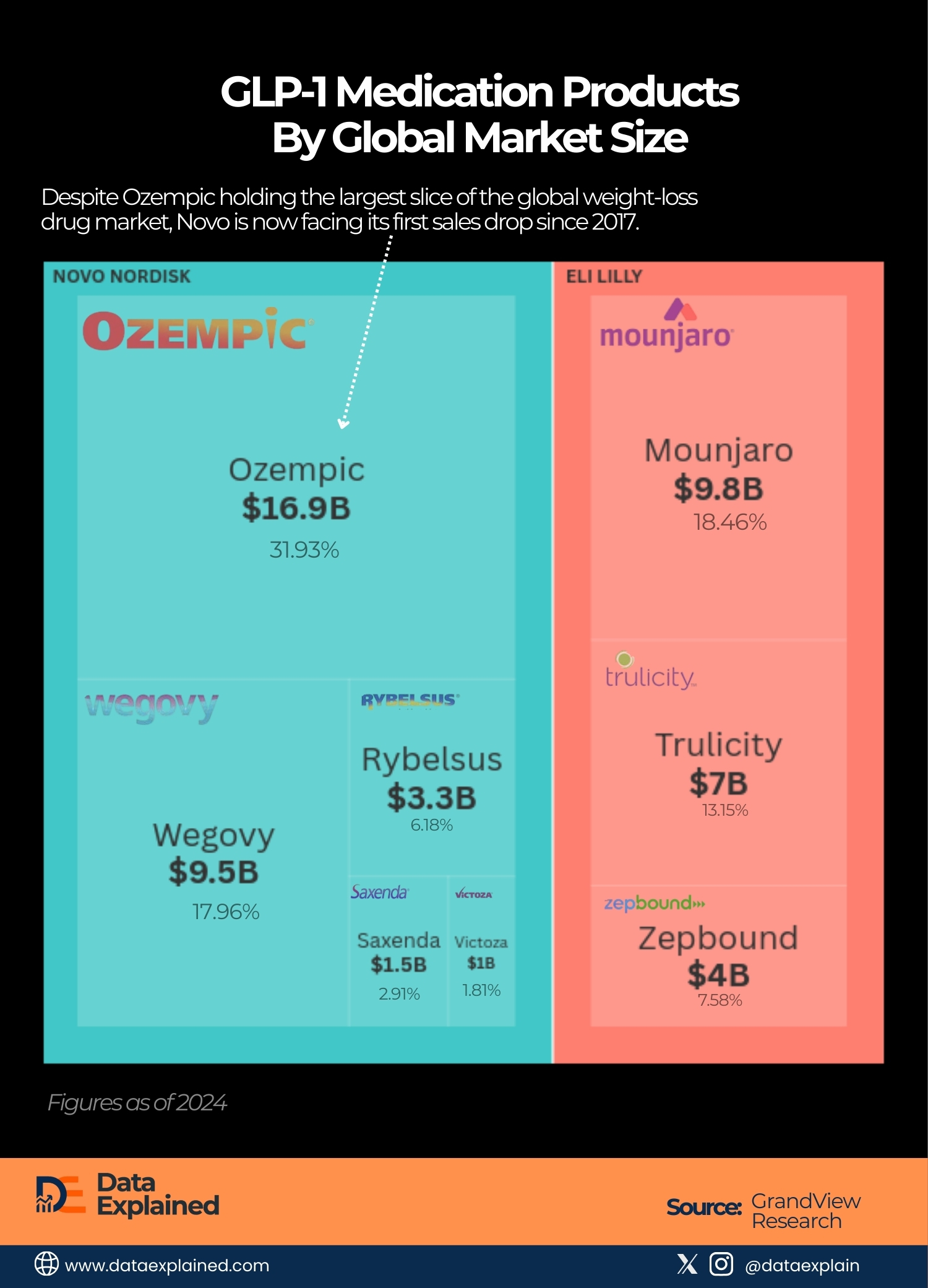
Despite Ozempic holding the largest slice of the global weight-loss drug market at 32% (worth $16.9 billion), Novo is now facing its first sales drop since 2017.
The visualization above shows the the different GLP-1 medication products owned by Eli Lilly and Novo Nordisk, and their global market sizes.
It’s based on the data from Grand View Research.
TL;DR
- Novo Nordisk’s stock dropped 17-18% after predicting a 5-13% sales decline in 2026, citing competition from Eli Lilly, U.S. price cuts, and patent issues, despite Ozempic’s past success.
- Eli Lilly leads the GLP-1 diabetes and obesity market with Zepbound and Mounjaro, capturing $65 billion in market share and growth, as Novo faces a challenge
| wdt_ID | wdt_created_by | wdt_created_at | wdt_last_edited_by | wdt_last_edited_at | GLP-1 product name | Parent company | Market share USD (billions) | % market share |
|---|---|---|---|---|---|---|---|---|
| 1 | emmanuel-ashemiriogwa | 05/02/2026 01:49 PM | emmanuel-ashemiriogwa | 05/02/2026 01:49 PM | Ozempic | Novo Nordisk | 16.9 | 31.93 |
| 2 | emmanuel-ashemiriogwa | 05/02/2026 01:49 PM | emmanuel-ashemiriogwa | 05/02/2026 01:49 PM | Mounjaro | Eli Lilly | 9.8 | 18.46 |
| 3 | emmanuel-ashemiriogwa | 05/02/2026 01:49 PM | emmanuel-ashemiriogwa | 05/02/2026 01:49 PM | Wegovy | Novo Nordisk | 9.5 | 17.96 |
| 4 | emmanuel-ashemiriogwa | 05/02/2026 01:49 PM | emmanuel-ashemiriogwa | 05/02/2026 01:49 PM | Trulicity | Eli Lilly | 7.0 | 13.15 |
| 5 | emmanuel-ashemiriogwa | 05/02/2026 01:49 PM | emmanuel-ashemiriogwa | 05/02/2026 01:49 PM | Zepbound | Eli Lilly | 4.0 | 7.58 |
| 6 | emmanuel-ashemiriogwa | 05/02/2026 01:49 PM | emmanuel-ashemiriogwa | 05/02/2026 01:49 PM | Rybelsus | Novo Nordisk | 3.3 | 6.18 |
| 7 | emmanuel-ashemiriogwa | 05/02/2026 01:49 PM | emmanuel-ashemiriogwa | 05/02/2026 01:49 PM | Saxenda | Novo Nordisk | 1.5 | 2.91 |
| 8 | emmanuel-ashemiriogwa | 05/02/2026 01:49 PM | emmanuel-ashemiriogwa | 05/02/2026 01:49 PM | Victoza | Novo Nordisk | 1.0 | 1.81 |
The main reason for Novos plight is a brutal price war and surging competition from American rival Eli Lilly, whose competing drugs Mounjaro and Zepbound saw sales jump 175% last year.
Breaking Down the 2025 GLP-1 Revenue Leaders
CNBC reports that Eli Lilly leads the obesity and diabetes drug market, accounting for 60.5% of the share in Q4 2025, compared to Novo Nordisk’s 39.1%.
Lilly’s total revenue reached $65.2 billion, with its GLP-1 drugs contributing around $43 billion, including $6.9 billion from Trulicity.
Novo Nordisk generated approximately $49 billion in revenue. Its GLP-1 portfolio, which includes Ozempic, Wegovy, and Rybelsus, contributed over $36 billion.
Insights from Mordor Intelligence indicate that Ozempic is the top-selling product, with sales of $24.05 billion, driven by strong demand for diabetes treatment.
Mounjaro ranked second with $23 billion in revenue, establishing a solid market position.
Why Novo Nordisk’s Stock Suffered a Historic 18% Single-Day Drop
Novo Nordisk’s shares dropped by 18% after the company issued a disappointing sales forecast for 2026.
This marked the most significant single-day decline since 2017.
The decline was driven by guidance projecting a 5-13% decrease in sales and operating profit, despite a 10% increase in revenue.
Increased competition from companies such as Eli Lilly and the expiration of semaglutide patents in certain international markets contributed to this decline.
Also, lower prices realized in the U.S., partly due to the Trump administration’s “Most Favored Nations” policy, added to the pressure.
To cope with the 2026 “price war,” manufacturers had to cut costs.
Novo Nordisk agreed to lower prices on its GLP-1 medications to stay competitive.
With patents expiring in certain regions, the emergence of generic drugs could further reduce revenue.
The Same Drug, Different Names
Semaglutide is sold using a “double brand” strategy.
It is marketed as Ozempic for diabetes, Wegovy for weight loss, and Rybelsus as an oral diabetes medication.
Tirzepatide is marketed as Mounjaro for diabetes and Zepbound for obesity.
This dual-branding strategy helps secure separate FDA approvals for different doses and indications, enabling targeted marketing and increased revenue.
It also facilitates insurance reimbursement, as payers often cover diabetes drugs but limit coverage for weight-loss medications. This approach helps companies capture unmet demand in both markets.
The Dark Side of the Boom
Some research has brought to light how people tend to quickly regain weight after stopping the medication.
Studies from 2025-2026 in BMJ indicate that users gain approximately 0.4 kg per month after discontinuation, returning to their original weight within approximately 1.7 years.
This leads to dependency, highlighting hidden costs for patients and increased profits for pharmaceutical companies.
This pattern encourages lifelong use, creating a steady revenue stream for companies in the $70 billion market.
So, What Next?
In January 2026, Novo Nordisk introduced its oral Wegovy pill – the first GLP-1 obesity treatment available in oral form.
Priced between $149 and $299 per month, it quickly gained traction, with over 26,000 prescriptions filled in the second week in the U.S.
This early success may help Novo regain market share from Eli Lilly, which is seeking approval for its own oral GLP-1 drug later in 2026.
The strong initial demand suggests the potential for increased revenues in the $70 billion GLP-1 market.
Despite this, Novo expects sales to decline by 5-13% in 2026 due to rising competition. Eli Lilly’s injectable Zepbound continues to lead the market, making it uncertain if Novo can retake the top spot.
ELI5
GLP-1 drugs like Ozempic by Nordisk have been the leading medicine in diabetes and weight loss medication.
However, Nordisk’s stock dropped 17-18% after predicting a sales decline in 2026. This is due to rivalry from Eli Lilly’s U.S. price cuts and patent expirations.
- Eli Lilly currently leads the GLP-1 diabetes and obesity market, with about a 60% share, driven by products such as Zepbound and Mounjaro.
- It accounts for $65 billion in market share, followed by Novo Nordisk at $43 billion, amid ongoing challenges.
- Notably, it takes 1.5 to 1.7 years for a patient using GLP-1 drugs like semaglutide to return to their initial weight, without medications for a while.
- All cardiometabolic benefits are lost, making users overly dependent while creating steady revenue for pharmaceutical companies.
Sources:
Grand View Research, Nature Review, IQVIA, Charles River Associates, BMJ, PubMed, Yahoo-Finance, FiercePharma, Reuters