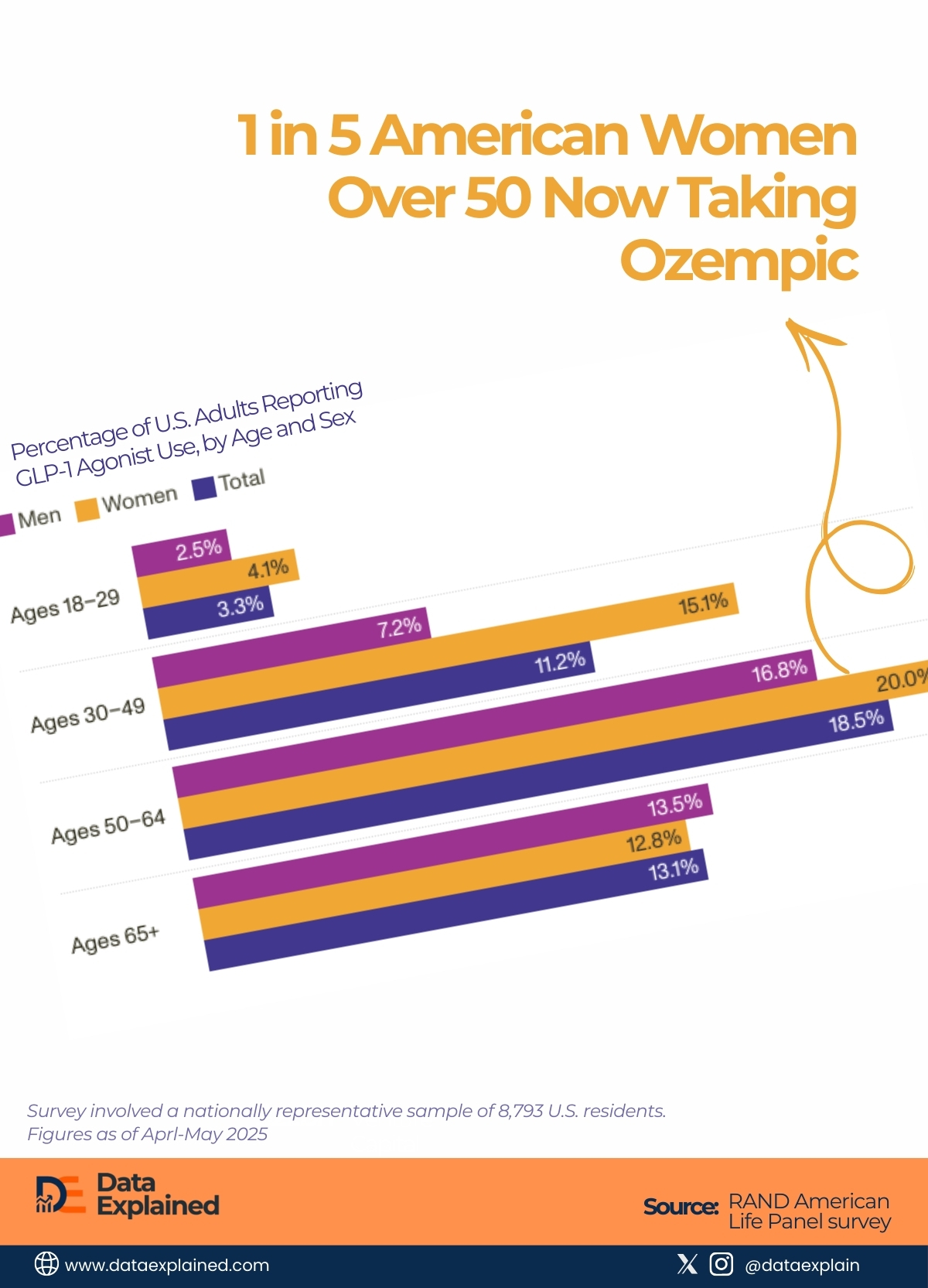
One in five American women between the ages of 50 and 64 are now taking GLP-1 drugs such as Ozempic, Wegovy, and Mounjaro, the highest rate of any age or gender group in the country.
This data comes from a RAND survey conducted in spring 2025.
It found that 20% of women in this demographic reported using the medications, which were originally developed for diabetes but have gained widespread adoption for weight loss.
In the visualization above, we use the survey data to show the percentage of U.S. adults reporting use of GLP-1 agonists by age and sex.
TL;DR
- Women aged 50–64 have the highest GLP‑1 usage rate, with 1 in 5 taking the drugs.
- Young adults use GLP‑1 medications at very low rates despite social media hype.
- Middle-aged women are the primary demographic driving the multi-hundred-billion-dollar GLP‑1 market.
For context, GLP-1 drugs are a class of medications that are prescribed to manage blood sugar for those with type 2 diabetes and to treat obesity. These drugs work by imitating glucagon-like peptide-1.
GLP‑1 Drug Usage by Age and Gender in the U.S.
The survey involved a nationally representative sample of 8,793 U.S. residents.
| wdt_ID | wdt_created_by | wdt_created_at | wdt_last_edited_by | wdt_last_edited_at | Age Group | Total Usage of GLP-1(%) | Men (%) | Women (%) |
|---|---|---|---|---|---|---|---|---|
| 1 | emmanuel-ashemiriogwa | 04/02/2026 04:26 PM | emmanuel-ashemiriogwa | 04/02/2026 04:26 PM | 18-29 | 3.3 | 2.5 | 4.1 |
| 2 | emmanuel-ashemiriogwa | 04/02/2026 04:26 PM | emmanuel-ashemiriogwa | 04/02/2026 04:26 PM | 30-49 | 11.2 | 7.2 | 15.1 |
| 3 | emmanuel-ashemiriogwa | 04/02/2026 04:26 PM | emmanuel-ashemiriogwa | 04/02/2026 04:26 PM | 50-64 | 18.5 | 16.8 | 20.0 |
| 4 | emmanuel-ashemiriogwa | 04/02/2026 04:26 PM | emmanuel-ashemiriogwa | 04/02/2026 04:26 PM | 65+ | 13.1 | 13.5 | 12.8 |
As you can see in the table above, 20% of women ages 50-64 are using GLP-1 drugs.
This rate exceeds that of all other age-gender groups, including men in the same age bracket, whose rate is 16.8%.
The gap is even more dramatic when comparing across generations.
Women in their 50s and early 60s are using these medications 2.4 times more than young adults ages 18-29.
While younger women use GLP-1s at a rate of just 4.1%, their mothers’ generation has embraced these drugs at a rate five times higher.
Why middle-aged women?
It’s a question that demands an answer from biological and behavioural sciences.
To begin, menopause is associated with a metabolic slowdown of approximately 200-250 kcal/day, according to research published in the journal Climacteric.
A three-year study tracking women aged 42-50 found that most gained an average of 2.2 kg during the menopausal transition, with 20% gaining more than 4.5 kg, indicating that menopause fundamentally alters how women’s bodies process fat.
These changes carry significantly higher health risks.
Naturally, medical care is the next point of contact, and it is through healthcare access that these prescriptions are made possible.
Data from the Agency for Healthcare Research and Quality indicate that women aged 45-64 make 60.5 preventive care visits per 100 women annually, whereas men in the same age group make only 42.5 visits per 100 men (a 42% gap).
It’s easy to conclude these are just studies. However, data does not lie; it can represent the broader picture.
Insurance coverage has also dramatically improved for this demographic.
Following the enactment of the Affordable Care Act, the uninsured rate among women ages 50-64 declined from 12.1% to 5.5%, according to the Kaiser Family Foundation.
Only 3% of Young Adults Use Ozempic Despite Social Media Hype
There is a stark disconnect between the drugs’ viral presence online and their actual real-world adoption among the demographic most active on these platforms.
Despite dominating social media feeds, young adults ages 18-29 use GLP-1 medications at a rate of just 3.3%.
The social media narrative couldn’t be more different.
DID YOU KNOW?
- Research published in ScienceDirect analyzing the first 100 videos under the TikTok hashtag #Ozempic found these videos collectively received approximately 70 million views, with the hashtag itself accumulating over 600 million total views on the platform.
A separate study from the Journal of Medical Internet Research examining 11 GLP-1-related hashtags on Instagram found over 306,000 posts using these tags.
Content analysis revealed that 78% of sampled posts mentioned weight loss, and 57 of the first 100 TikTok videos specifically focused on weight loss uses rather than medical treatment for diabetes.
In essence, while middle-aged women have embraced these medications at rates of 20%, the young adults creating and consuming this content remain largely spectators.
The $70 billion market: Who’s Profiting From This Trend?
The GLP-1 receptor agonist market has exploded into one of the most lucrative pharmaceutical sectors in history.
According to Grand View Research, the market size reached $70.08 billion in 2025 and is projected to hit $201.79 billion by 2033.
By the end of 2024, Ozempic, Rybelsus, Wegovy (semaglutide), and Mounjaro and Zepbound (tirzepatide) had generated a cumulative $71 billion in U.S. revenue.
From 2025 to 2030, these products are projected to generate $400 billion in additional U.S. revenue, bringing the total to $470 billion by the end of 2030.
Two pharmaceutical giants dominate the market: Novo Nordisk and Eli Lilly.
Eli Lilly became the first pharmaceutical company to surpass a $1 trillion market capitalization in 2024, buoyed by global demand for obesity medications.
ELI5
Rand did a survey of 8,793 people representing U.S adults. About 1 in 5 women aged 50–64 use GLP‑1 drugs like Ozempic.
Younger adults rarely use them despite social media hype.
This demographic now fuels a multi-hundred-billion-dollar market, highlighting midlife women as the main drivers of adoption and industry growth.
Sources
Rand | Grandviewresearch | Evaluate | Reuters | Investor.lilly | Investor.lilly | Statnews | Stock observer